Padel Court: Where the Holiday Begins With a Serve
The courts at Irada, padel and pickleball, sit side by side, abutting the vineyard, and beyond that, the dry scrub of 4,000 acres of reserve forest rolling away towards the horizon. The Deccan sun in the morning has no restraint, and by nine o’clock makes the idea of vigorous exercise feel somewhat punitive. This is Vijay Mallya’s old countryside home, a neoclassical manor, now a 66-acre wine estate near Baramati where padel and pickleball feature as prominently in the sales pitch as the cellar and the spa.
Padel requires doubles on both sides, which is either its great charm or its great inconvenience depending on the company you brought along. Pickleball, more forgiving in every respect, accommodated the shortfall. A paddle the size of a ping-pong bat, a plastic ball and a court small enough that you feel athletic. I stepped onto the right-hand court as the sun cleared the treeline, having opted to play over walking a trail frequented by chinkaras.
From the cypress-fringed clay courts of Italy to courts suspended between jungle and sea in Thailand, the world’s great hotel tennis courts offer a peculiar luxury—the chance to chase a yellow ball through landscapes most people travel thousands of miles merely to admire. Indians have never been ones to organise their holidays around tennis academies and golf courses but with the pickleball craze around the country, they are beginning to look for courts wherever they travel. Industry estimates suggest the number of pickleball courts in India grew from roughly 200 in early 2024 to more than 1,200 by 2025, with three to four new courts appearing every week across Mumbai, Bengaluru, Ahmedabad and Delhi. Padel’s footprint is smaller. However, the glass-walled court has become, for a certain class of urban Indian, what the golf course was for their fathers, a place where business gets done, and where families bond.

The Second Life of Sanskrit
10 Jul 2026 - Vol 05 | Issue 28
Being classical has become cool
And many families in India are bonding over games. Shyam Sadasivan, a life coach in Bangalore, came to tennis through his 16-year-old. The boy started playing four years ago, post-Covid, and Sadasivan felt inspired to pick up a racquet himself. When his son finished tenth grade, the reward they chose was to get in the car and drive to Chennai and then Pondicherry, to a beach property with a very nice court by the sea. They played morning and evening for three days. Sadasivan decided then that for their next annual family holiday, they’d book a hotel with tennis courts. Some family members wanted a pool and a spa, the grandparents were happy at the beach, and Sadasivan and his son dreamt of playing tennis every free minute. They found all of it at Jetwing Lighthouse in Galle. “Good location, good courts, good service, a local community with memberships that keeps the courts alive,” Sadasivan says. Despite the fact that they have access to a court in their gated community in Donnanakundi, Bengaluru, where a friendly tournament is underway even now, it is good to play while on holiday, he says.
The hospitality industry has understood this. Take Oleander Farms in Karjat, which has added padel and pickleball courts as demand for racquet-sport amenities has grown. Many premium villas in Alibaug and Karjat now come with private padel and pickleball courts where guests can switch from morning games to sunset cocktails, turning what were once weekend homes into miniature luxury clubs of their own. From the best five-star hotels in Indian cities to hillside hideaways, the new status symbol of luxury hospitality is no longer the infinity pool but the glass-walled padel arena or a floodlit pickleball court. In North Goa, properties and clubs around Assagao have begun adding padel and pickleball facilities aimed at both tourists and local players.

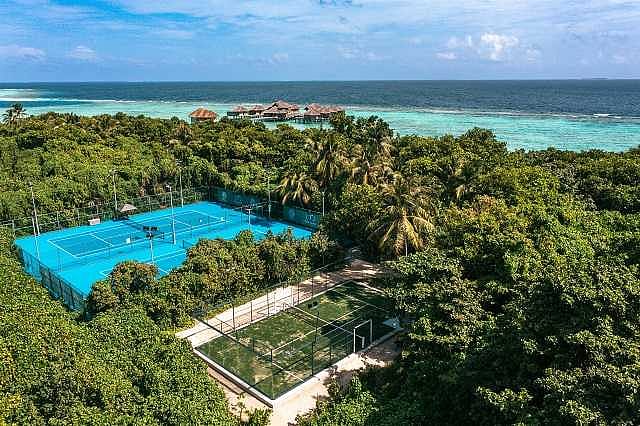
In the Maldives, where there is intense competition for the same dollar, racquet coaches are increasingly indispensable as dive instructors and wellness practitioners. Last year, at Vakkaru, a lush island resort in the heart of the Maldives, our days quickly began revolving around the padel court. The resort itself felt like a tropical dream, a ring of powder-white sand, towering palms, and overwater villas suspended above water so clear it seemed illuminated from below. We would play in the mornings, surrounded by dense greenery and flashes of turquoise through the trees, before drifting off to the beach or snorkelling on the house reef. We met other guests through impromptu doubles matches and ended up discussing rematches over dinner. One of us also ended up improving our tennis backhand thanks to the inhouse coach.
“We used to plan trips around restaurants. Now we plan them around courts,” says Aditi Kulkarni, a 34-year-old yoga instructor from Pune. The Kulkarnis are part of a six-couple WhatsApp group that books a weekend away roughly once in two months, usually within driving distance of Pune. The destination is decided by a surprisingly specific question: does the resort have a padel court? “We stumbled into it accidentally,” says Rohan Kulkarni, who works in finance. “A friend dragged us to a padel session last year. It was one of the few sports where everyone could play together from day one. You don’t need years of coaching like tennis.”
The group typically checks in on a Friday evening, plays a couple of matches before dinner, starts Saturday with coffee and padel, breaks for lunch, returns for another round in the evening and spends the rest of the night at the bar. “The sport is an excuse. Earlier, when we travelled together, half of us wanted to trek, some wanted to shop and others were happy to be in the pool. Padel gives the weekend a structure. Everyone shows up.”
The group spends more on accommodation than they once did because court access has become a deciding factor. “We’ve rejected perfectly nice properties because they didn’t have a court,” Rohan admits. “That sounds ridiculous when I say it out loud.” Their children have become part of the ritual. Between matches, the kids cycle around the property or jump into the pool while the adults organise mini-tournaments complete with mock trophies and increasingly elaborate trash talk.
What is driving this is not, or not only, the sports themselves. Active travel has shifted, in Tripadvisor’s formulation, “from hobby to identity”, with travellers now chasing personal bests and courts with the same purposefulness once reserved for temples and viewpoints. The sports tourist is a different creature from the leisure tourist: more loyal to properties that serve their habit, more willing to pay for coaching that moves their game forward by the time they fly home. They are also, increasingly, the most valuable guest a mid-to-luxury property can attract, because they book longer stays, return more often, and bring others. The court is social infrastructure. It does what a bar does, but without the headache.
The model for what a property can look like when it commits fully to this logic is Robinson, the TUI-owned group of more than 20 resorts strung across the world, built on the principle that movement is the basis of a good holiday. At the Robinson in Turkey’s Sarigerme, where clay courts back onto pine hills and your day is organised around sport rather than around meals, you arrive with a game, you leave with a better one, and somewhere in between you have also had a holiday.
India does not yet have a Robinson. What it has is a collection of properties feeling their way toward the same idea from different directions. The pickleball economy is growing rapidly. It seems people have figured out that the best souvenir from a holiday is not something you put on a shelf but something you carry in your forehand. A marginally better drop shot. A slightly sharper cross-court return.