Operation Sindoor Anniversary: India Maintains Hardline Stance on Indus Water Treaty
One year after Operation Sindoor, India continues to maintain a hardline position on the Indus Waters Treaty, keeping the agreement in abeyance and signalling that terrorism and bilateral cooperation cannot coexist.
The treaty was suspended following the Pahalgam terror attack, marking one of the most significant shifts in India-Pakistan relations in decades. Since then, New Delhi has maintained that Pakistan’s continued support for cross-border terrorism has fundamentally altered the basis on which the treaty was signed.
As India marks one year of Operation Sindoor, all gates of the Baglihar Dam on the Chenab River remain shut, symbolising what officials and strategic experts describe as a “new normal” in India’s counter-terror doctrine.
Why Does India Consider the Indus Waters Treaty ‘Unjust’?
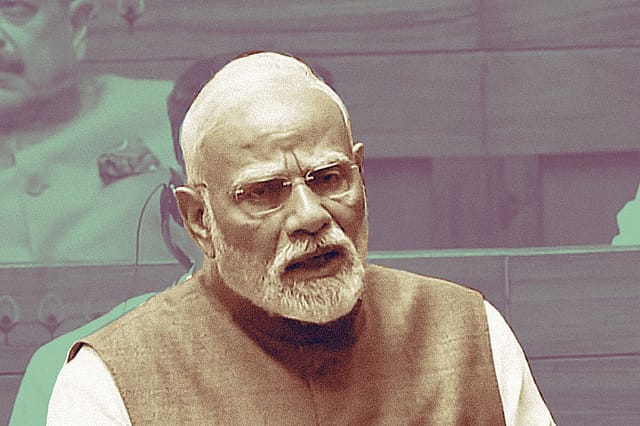
Prime Minister Narendra Modi had laid out India’s position during his Independence Day speech in 2025, declaring that “blood and water can’t flow together” and describing the treaty as unfair to Indian interests.

Zeroing In on ECI
09 Oct 2026 - Vol 05 | Issue 41
Constitutional legitimacy versus political opportunism
“India has now decided, blood and water will not flow together. The people have realized that the Indus Waters Treaty was unjust. Water from the Indus River system irrigated enemy lands while our farmers suffered. The Indus water treaty is unacceptable to us in the interest of our farmers, and in the interest of the nation,” the Prime Minister had said.
Under the treaty signed in 1960, India received exclusive rights over the eastern rivers — Ravi, Beas and Sutlej — while Pakistan received control over the western rivers — Indus, Jhelum and Chenab — despite most of the river system originating in India.
The western rivers carry nearly 135 million acre feet of water annually, while the eastern rivers account for about 33 million acre feet. Critics in India have long argued that the arrangement disproportionately favoured Pakistan and limited developmental opportunities in Jammu and Kashmir.
How Has Pakistan Objected to Indian Projects Over the Years?
Former diplomat Dilip Sinha said India repeatedly faced obstruction from Pakistan even while operating within the framework of the treaty.
“Our experience over the years in the treaty had been that Pakistan's attitude was obstructive, extremely negative. Eventually, when it became very difficult for us, and in all cases, our position was upheld by the mechanisms that is there for under the treaty. But Pakistan nevertheless continued to follow that obstructive attitude. So it became very difficult for us to work according to the treaty and draw the limited benefits that we were entitled to,” Sinha said.
Pakistan has repeatedly objected to Indian hydroelectric projects on the western rivers, including Kiru, Kwar, Baglihar and Dul Hasti, alleging that they violate storage and design provisions under the treaty.
Recently, Islamabad approached the Permanent Court of Arbitration, claiming India’s projects on the Chenab River exceeded treaty limits and could reduce downstream water flows.
India, however, has rejected the court’s jurisdiction.
The Ministry of External Affairs has maintained that the court has “no legal standing” and that with the treaty in abeyance, India is no longer obligated to fulfil its commitments under the agreement.
Why Is India Linking Water Cooperation to Terrorism?
According to Sinha, the original spirit of the treaty rested on the expectation of peaceful cooperation between India and Pakistan — something New Delhi believes no longer exists.
“The Indus Waters Treaty was signed on the understanding and in the hope that there would be cooperation between the two countries so that the common resources that we have could be exploited for mutual benefit,” he said.
Sinha alleged that Pakistan repeatedly misused bilateral cooperation mechanisms while continuing to support terrorism.
“Pakistan been unwilling to cooperate with us, been using every possible opportunity to promote terrorism against us and to harm our interests so every avenue that it could get hold of, through whatever mechanisms of cooperation we created, like cross LOC trade, cross LOC bus services, movement of people- all these were misused by Pakistan to promote terrorism against India. So we had to draw a linkage between terrorism that Pakistan was promoting and the avenues of cooperation that we had built up initially in the hope that the two countries would be friendly neighbors, who could exploit their natural resources to get mutual benefit,” Sinha said.
India now openly links the restoration of the treaty to what it calls Pakistan’s “verifiable cessation” of support for cross-border terrorism.
What Could India Gain From Keeping the Treaty in Abeyance?
Strategic experts believe greater control over the Indus river system could benefit Jammu and Kashmir through irrigation, hydropower generation and broader economic development.
Former Jammu and Kashmir DGP Shesh Paul Vaid stressed the long-term strategic importance of water resources.
“Water is everything. In fact, future wars will be on water. Water is important for the economic, agricultural development of the country,” Vaid said.
Calling the agreement a “lopsided treaty,” Vaid endorsed the government’s tougher approach.
“You cannot continue to shed blood here and ask for water. What is the compulsion on Pakistan to not give up on the policy of terrorism? Unless they (Pakistan) amend themselves and stop terrorism, they will not get water,” he said.
The treaty has often been criticised by some political commentators as India’s “second partition” after the Radcliffe Line because of the scale of river-water allocation to Pakistan.
Could India Permanently Scrap the Treaty?
Sinha argued that India should move beyond suspension and formally abandon the treaty altogether.
“I personally believe that we should just scrap the treaty. There is no obligation for us to go into this treaty. There is no international law governing the sharing of waters for this so there is no reason for us to put ourselves under pressure and compel ourselves to go in for arrangements that are detrimental to our national interest, especially since Pakistan is not willing to reciprocate in any manner to our gestures. So we simply have to go ahead and utilise our resources to the optimum for the benefit of our people. If Pakistan wishes to cooperate with us, Pakistan is welcome to come forward and seek our cooperation, but I don't see that attitude forthcoming from Pakistan...Pakistan is continuing the hostile attitude so I see no reason why we should even think in terms of doing anything to placate Pakistan,” he said.
India maintains that keeping the treaty in abeyance is part of a broader national security strategy after repeated terror attacks linked to Pakistan-based groups.
Earlier this year, Droupadi Murmu said in Parliament that suspending the treaty formed part of India’s wider counter-terror approach, signalling that “all instruments of national power” would be used to safeguard national security.
As India commemorates one year of Operation Sindoor, the continuing suspension of the Indus Waters Treaty reflects a larger strategic recalibration — one that combines military retaliation, diplomatic pressure and resource leverage as part of India’s evolving response to cross-border terrorism.
(With inputs from ANI)