New Women’s LS Quota Move Secures Support of Male MPs
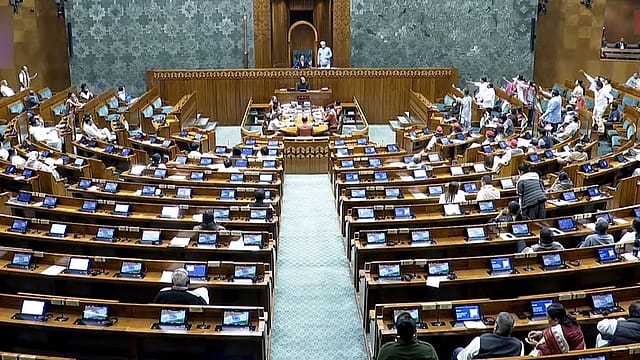
The mood was a touch jocular in Parliament on Tuesday when a senior MP accosted a junior asking whether his “bhagya Lakshmi” would stand in for him after reservation of seats for women in Lok Sabha was implemented. The suggestion that a sitting male MP’s wife could step in post the promised one-third reservation, however, lacked any real sting. The proposal under discussion, the MPs well knew, did not amount to a drastic reduction of seats held by men.
Change from the Past
This is quite a change from failed attempts to legislate the “women’s quota”, as it came to be called, in the past. In March, 2010, Congress-led United Progressive Alliance managed to steer the Constitution (108th) Amendment Bill through Rajya Sabha but only in teeth of trenchant opposition from its own constituents Samajwadi Party and Rashtriya Janata Dal (RJD). Unruly scenes led to the suspension of several SP and RJD MPs.

Losing Memory
16 Oct 2026 - Vol 05 | Issue 42
The making of a medical and social emergency
The opposition of Mandal stalwarts Mulayam Singh Yadav and Lalu Prasad – supported by Janata Dal (U)’s Sharad Yadav -- was such that the ill-fated Bill never made it to Lok Sabha. Though the support of the Bharatiya Janata Party and the Left would have ensured its passage, RJD and SP had a strong presence in the House and threat of physical resistance and violence was very real. On one occasion, Mulayam had theatrically warned male MPs that a dire fate awaited them as they would be reduced to pulling on hookahs like village elders put to pasture.
Even when Modi 2.0 moved the Nari Shakti Vandan Adhiniyam Bill, 2023, the possibility of a a culling of male MPs was very much a possibility. But for one, the RJD and SP were greatly reduced in numbers and were no longer part of the ruling coalition. For another, BJP had a majority of its own in Lok Sabha and was determined to pass the Bill. And lastly, the mood had changed and there was no real resistance to the move despite misgivings of a male-dominated House – It was just not possible to oppose the women’s quota any more.
A BJP plank for 2029
The latest bid to make reservation of seats for women a reality was very much subject of discussion in Parliament a day after home minister Amit Shah initiated discussions with political parties. But MPs were largely sanguine that a projected increase in the overall number of Lok Sabha seats will mean division and re-drawing of constituencies but not amount to extinction. “The current numbers are protected. There will be additional constituencies for women,” said an MP.
The Lok Sabha chamber has space for 988 MPs and can be enhanced to 1132. So no one is going to feel the squeeze, literally and figuratively.
The Modi government’s move to pass legislation enabling reservation of one-third seats in Lok Sabha either during the remainder of the Budget session that ends on April 2 or by calling a short special session is aimed at making implementation of the “women’s quota” ahead of the 2029 election a major part of the Bharatiya Janata Party’s re-election plank. The idea is to ensure a proposal first introduced in Parliament in 1996 would finally reach fruition a little more than 30 years later.
The proposal entails increasing the number of Lok Sabha seats to 816 or which 273 would be set aside for women. At first go, reservations will be rolled out for Lok Sabha and not state legislatures or Union Territories with assemblies. This would preclude the Rajya Sabha too since its members are elected by MLAs. Though not a complete roll out, it would make women’s reservation in legislatures irreversible. Similar provisions in state assemblies would follow.
The Census 2011 logic
The decision to implement the proposed reservation based on the 2011 Census is crucial. The latest Census is due to begin next month and will be complete only next year in March. A de-limitation commission to redraw constituencies will take the 2011 data into account. This does mean demographic changes in the last 15 years will not be fully reflected, at least not immediately. Yet, not doing so would push women’s reservation to the 2034 elections assuming a full five-year term for the government formed in 2029.
There is an added benefit as the Census 2011 baseline will remove the contentious issue of the varying pace of population changes in northern and southern states and whether better population control will end up getting “punished” as more populous regions gain representation. In an interview of The Times of India in June, 2025, home minister Amit Shah said the reservation would be implemented by the 2029 national election. The government is now looking to deliver on that pledge.
The prospects of the government’s proposal receiving the required two-third support in the Lok Sabha and Rajya Sabha are bright. The move to increase the overall number of seats makes it even more palatable for incumbent MPs with men constituting 86% of the House.