Nandan Nilekani, the Plumber & the Platform: Why India Keeps Calling 'Mr Fix-It'
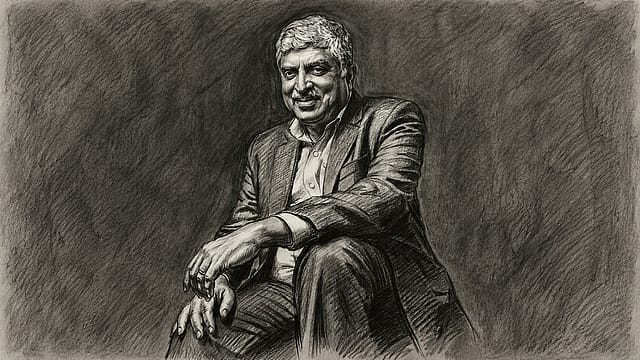
Avinash Raghava had 20 minutes.
Artificial intelligence was ripping through the software industry. Founders were scrambling to understand whether AI would strengthen SaaS, swallow it or force every company to rebuild itself. Raghava, CEO and founding volunteer of AIBoomi, formerly SaaSBoomi, wanted clarity.
He knew whom he wanted to ask.
Raghava had met Nandan Nilekani a few times, but writing to him directly still felt like a punt. Nilekani could ignore the message. He could decline politely. Either response would have been understandable.
Instead, an answer arrived: Twenty minutes.
Raghava began preparing. He mapped the conversation, sharpened his questions and worked out what he needed to extract from those 1,200 seconds.
Rise of the Pivotal Power
18 Sep 2026 - Vol 05 | Issue 38
The BRICS declaration is a strategic victory for Modi
Nilekani arrived almost exactly on time.
Then he began firing.
What was Raghava’s background? What had he built? How did his community work? What did he want to understand?
Raghava remembers the questions less as sentences and more as sound.
“Khat, khat, khat.”
Nilekani tore through the scaffolding and reached the problem. Within the allotted slot, the conversation travelled across capital, emerging AI use cases, the future of software and where the industry could be heading.
Raghava walked away with greater clarity than he had carried into the meeting.
Years earlier, Nilekani had explained the economy behind those 20 minutes.
“I am generous with my money, but frugal with my time,” he said in an August 2019 conversation on Accel’s SeedToScale podcast. “Money, you can give it away and make it again. Time is a perishable resource.”
Raghava had been given something Nilekani believed could never be recovered.
And Nilekani had made every minute work.
Later, Raghava took a group of Indian technology companies to meet him. Each founder demonstrated a product. Nilekani watched, questioned and offered his assessment. The session stretched to roughly two hours.
Some of his questions startled the founders. How did a man juggling Infosys, public digital infrastructure, philanthropy and several national-scale projects know so much about their tiny corners of the technology universe?
“He is so plugged in,” reckons Raghava.
Nilekani appeared to know what was moving at OpenAI and Anthropic, what Silicon Valley investors were tracking, what Indian startups were attempting and what the government was considering.
Messages and invitations, Raghava says, often received a definite yes or no within a few hours.
“What that machinery is, I don’t know,” he says.
On August 20, one of the oldest products of that machinery generated another new number.
The Aadhaar App crossed five crore downloads. More than 60 lakh residents had used it to update their mobile numbers, over 15 lakh had updated their addresses and another 23 lakh had changed their email details. Services that once demanded a visit to an Aadhaar centre were migrating to smartphones.
The app allows Aadhaar holders to update information, download an e-Aadhaar, lock or unlock biometrics and share selected identity details. More than 200 entities have also joined Aadhaar’s offline verification ecosystem, which is intended to let people prove who they are without surrendering more information than necessary.
The plumber had left the building years ago. The pipes kept spreading.
THE FEAR BEHIND THE CURIOSITY
Subrata Mitra has gone to Nilekani with technology questions, requests for advice and ideas that have little to do with either.
The subject changes. Nilekani’s response rarely does.
“Whatever may be his age, he is as curious as a child,” says Mitra, who belongs to India’s original generation of venture capitalists. Mitra co-founded Erasmic in 2004 and, four years later, helped launch Accel’s India office after the global venture firm turned Erasmic into its Indian outpost.
“Any new thing you tell him, he is willing to listen. He is willing to analyse it,” underlines Mitra.
Novelty catches Nilekani’s imagination. Someone may wrestle with a problem for a month, examining it from every visible direction. Nilekani will listen and point towards one or two angles that everyone else missed.
Mitra saw it when he considered starting a small non-profit.
Nilekani did not applaud the intention and stop there. He spotted the constraint. The project was not digital. It would take time to scale. Then he weighed that limitation against its value and concluded that it was still worth doing.
The sequence was classic Nilekani: curiosity, dissection, scale, judgment.
But curiosity alone does not explain why a man who has already built Infosys, Aadhaar and pieces of India’s digital infrastructure keeps studying the next unfamiliar problem.
Nilekani supplied a more unsettling answer on the SeedToScale podcast of Accel in 2019.
“I have a fear of being irrelevant and because of that, I have to keep learning,” he said. Nilekani could not rely on an achievement from 10 years earlier to guarantee that he would remain useful today. “If I have to meet a startup founder or the CEO of a Fortune 100 company or the President of a country, they should see value in meeting me.”
That sentence stretches across the Nilekani universe.
He wants to remain relevant to the young founder carrying a laptop, the technology chief running a global corporation and the political leader governing millions.
Past glory may open the door. Nilekani still wants to deserve the meeting.
THE ACCIDENTAL PLUMBER
Shweta Rajpal Kohli was the first journalist to interview Nilekani after he was appointed to lead the Unique Identification Authority of India in 2009.
He was leaving the corporate familiarity of Bengaluru for the bureaucratic maze of Delhi. Kohli, then a journalist at NDTV and now president and CEO of the Startup Policy Forum, asked what the transition meant.
Nilekani had once described himself as an “accidental entrepreneur.” Now, he told her, he was becoming an “accidental social entrepreneur”.
Then he reduced one of the most ambitious technology projects attempted anywhere in the world to a startup. “I view Aadhaar as a startup. Aadhaar is nothing but a startup,” he said.
UIDAI carried a national mandate and the authority of the state. It did not yet possess the machinery needed to identify a billion people.
Nilekani was 54. At Infosys, he had occupied a corner office with a golf course beside it. The company employed around 100,000 people. He left that behind, moved from Bengaluru to Delhi and became employee number one of a government venture.
“It was like doing a startup at 54 and in the government,” he recalled on SeedToScale.
The move had nearly taken a very different shape.
After the UPA returned to power in 2009, Nilekani said he was approached for the job of human resource development minister. The government wanted “out-of-the-box thinking”. The proposal travelled almost to the announcement of the Cabinet before doubts surfaced over placing someone without political experience in the ministry.
Nilekani and the government eventually converged on identity. He had already argued for a digital identity system in his book Imagining India. The project played to his strengths, offered a measurable objective and came with a deadline.
Education almost got Nilekani in 2009. Aadhaar got him instead.
Kohli remembers the metaphor he chose for the assignment. “Ultimately, I am a plumber,” Nilekani told her. “My job is plumbing. Even giving a billion people a biometric identity is a plumber’s job.”
For most people, plumbing means maintaining an existing system: locate the leak, replace the pipe, tighten the joint.
Nilekani’s plumbing began before the pipes existed.
“I DID NOT KNOW HOW TO MOVE A FILE”
The billionaire technologist entered government carrying a useful piece of knowledge.
He knew what he did not know.
“I did not know anything about the government,” Nilekani admitted on SeedToScale. “I did not know how to move a file.”
So, he did what he would later do with AI, startups and several other unfamiliar problems. He went looking for people who understood the terrain.
Nilekani approached KP Krishnan, a bureaucrat he considered an encyclopaedia of government, and asked for names. Krishnan helped him locate officers who combined administrative depth with the ability to take risks.
Ram Sewak Sharma became UIDAI’s second employee. An IAS officer with a master’s degree in computer science, Sharma programmed as a hobby on weekends. Nilekani found other officers to handle finance, administration and the movement of government machinery.
Then he assembled the technology side.
Srikanth Nadhamuni came in to lead technology. Pramod Varma became the chief architect. Sanjay Jain arrived from Google. Entrepreneur and technologist Vivek Raghavan joined the mission.
On one side stood bureaucrats who knew how the state moved. On the other stood technologists who knew how world-class systems were built.
The hard part was forcing two different cultures to work as one team. Nilekani kept the administrative and political operations in Delhi, the principal technology operation in Bengaluru, and pulled the groups together around an audacious target.
His description of the partnership with Sharma is revealing: “I managed the environment. He’s the guy who got it done.”
Nilekani did not cast himself as the solitary genius who built Aadhaar. He cast himself as the person who created the conditions in which people with very different abilities could build it together.
That is precisely the quality Raghava noticed years later. “He does a very good job of extracting the intellect from other people,” Raghava says. “He is like a curator.”
The curator does not paint every canvas. He recognises what belongs in the room.
THE ELEPHANT’S MEMORY
Raghava says Nilekani possesses “an elephant’s memory”.
Once he understands what someone does unusually well, he appears to file that capability away. Raghava had helped build a community of software founders. Nilekani remembered him as the person who knew how to assemble a community.
The mind was not merely storing names. It was indexing abilities.
Nilekani acknowledged that method on SeedToScale. He described mentorship as continuous. He had learnt from NR Narayana Murthy in business and Sam Pitroda in public policy. He watched business and political leaders closely, studying how they behaved, prioritised and attacked problems.
“I am always open to learning from other people,” he said.
That openness came with a warning for founders. “Founders should be egoless,” Nilekani said. “Your ego should come from your achievement. Ego should not come from interaction.”
A founder who believes he already holds all the answers eventually limits the institution to the size of one person. Nilekani argued that lasting companies require leaders who delegate, empower others and share the glory.
A one-man show cannot scale. The principle applies equally to a startup, a technology company and a public institution attempting to enrol half a billion people.
THINKING IN BILLIONS
Raghava first encountered Nilekani’s appetite for scale while working at Nasscom. Nilekani was looking for technology professionals who could help build Aadhaar.
Later, a small group gathered around a theme: How could India leapfrog?
They discussed finance, healthcare and other systems in which technology could allow the country to jump stages of development rather than crawl through them.
“He doesn’t think in thousands,” Raghava says. “His thinking is in millions and billions.”
The instinct had been forged at Infosys.
When the company was earning between $3 million and $5 million in annual revenue, its founders talked about reaching $100 million. As it approached $100 million, they asked what would be required to hit $1 billion.
“We always set very large goals,” Nilekani once reportedly said.
Infosys planned through three horizons: a five-year blue-sky view, a detailed three-year strategy and a one-year operating plan. The company first imagined where the world, technology and business might be five years later. Then it walked backwards to the decisions required today.
Scale, Nilekani argued, could never be an afterthought.
How many people must the system reach? What infrastructure will that require? What will each connection cost? Which decisions must be taken now for the target to become possible five years later?
The future was a destination from which he planned backwards.
Aadhaar inherited that grammar.
The same appetite drew Nilekani into EKA, an Accel initiative intended to put prominent Indian entrepreneurs in a room with leading American CEOs and founders in Silicon Valley.
Mitra approached him for help.
The proposition offered no guaranteed deal, investment or measurable outcome. Put talented people together for a day and a half, allow ideas to collide and see what emerges.
Nilekani understood the uncertainty.
“I don’t know what will come out of it. That is up to you guys,” Mitra recalls him saying. “But this is something that is worth doing.”
It could help carry Indian startups to the West. That was enough.
Then came the calls.
Microsoft CEO Satya Nadella, Adobe CEO Shantanu Narayen and other senior technology leaders were within reach.
“All of these guys are like a phone call away,” Mitra says.
The size of Nilekani’s network explains whom he can reach. It does not explain why he keeps deploying that network for experiments whose outcomes remain unclear.
His willingness to live with uncertainty may.
Nilekani said he possessed relatively little fear of failure. That allowed him to leave established positions, abandon familiar environments and attempt things he could not fully control.
He had done it at 54, when he traded his corner office for employee number one.
Then he tried politics.
THE LIMIT OF ADAPTABILITY
Nilekani joined Congress in 2014 and contested the Lok Sabha election from Bangalore South. He lost to BJP leader Ananth Kumar by more than 2.28 lakh votes.
The defeat hurt.
In a 2016 interview with NDTV, Nilekani called the experience “mortifying”. Politics, he concluded, was not a meritocracy. He would not contest another election because he had discovered he possessed no “competitive advantage” in it.
On SeedToScale, he examined the failure more clinically.
Nilekani had believed he could adapt to different environments. Politics proved otherwise. The skills it demanded were not his skills.
The lesson was uncomfortable: embracing change did not eliminate the need to understand one’s fundamental strengths. “Don’t play to your weaknesses,” he said.
Yet political defeat did not end his influence over public policy.
Weeks after Narendra Modi became prime minister, Nilekani met him and Finance Minister Arun Jaitley to argue that Aadhaar should survive the change of government. The BJP had attacked the project during the election campaign. Nilekani reportedly made the fiscal and administrative case for retaining it.
The new government listened.
Nilekani later told NDTV that Modi already understood the technology and had seen Aadhaar’s value as Gujarat chief minister. The meeting, he joked, may have supplied the final “5 per cent” of persuasion.
Was meeting the political opponent whose party had just defeated him awkward? “Only in speaking Hindi,” Nilekani replied.
Congress had given him Aadhaar. The NDA expanded it. The politician lost his election, but the plumber persuaded the winning side to retain the pipes.
Kohli sees this portability as central to the Nilekani story. “He isn’t identified with any political camp,” she says. “He isn’t seen as belonging to any one group.”
The description may sound strange for a former Congress candidate. But Nilekani’s partisan identity receded while his infrastructure expanded. Governments came to treat him less like a politician carrying an ideology and more like a specialist carrying a toolbox.
THE MAN EVERYBODY COULD ACCEPT
In 2017, the toolbox was summoned back to Infosys.
Nilekani had left the company eight years earlier. By then, he was immersed in digital public infrastructure, philanthropy, education and startups.
Then Infosys convulsed. A bruising confrontation between Murthy and the board escalated. Questions over governance intensified. Chief executive Vishal Sikka resigned. Investor confidence buckled.
Nilekani returned as non-executive chairman. His explanation for why the warring factions could agree on him was almost comically economical: he was “acceptable to all the parties”.
That may be his rarest form of capital. Technical knowledge can be hired, consultants can produce an architecture, and committees can assemble specialists. Trust cannot be installed with a software update.
Nilekani could stand between founders, directors, executives, shareholders and regulators because each side believed he would stabilise the company without capturing it for himself.
Mitra identifies the ingredient: “No ego.”
That does not mean Nilekani lacks confidence. A person does not attempt to enrol a billion people while paralysed by self-doubt. His ego simply appears less interested in occupying every inch of the room.
Mitra saw this when he invited Nilekani to his book launch. “I’ll come,” Nilekani told him. “But let me just enjoy the day. Don’t put me on the pedestal tonight. I just want to enjoy myself.”
He wanted to attend as a reader, friend and guest.
India has spent much of the past two decades refusing that request.
WHEN THE PLUMBING FAILS
Pedestals can obscure the damage below.
Aadhaar’s scale and utility are undeniable. So are the questions it has raised.
Civil liberties groups, technologists and welfare activists have challenged the system over privacy, surveillance, security and exclusion. Biometric authentication failures have reportedly denied legitimate beneficiaries access to food and welfare. Data leaks and the widening use of Aadhaar intensified fears that an identity layer could evolve into an instrument for tracking citizens.
In its 2024 profile naming Nilekani among the world’s 100 most influential people in AI, TIME raised reports linking Aadhaar failures to ration exclusions and starvation deaths. Nilekani declined to address the cases individually, saying in an email that “Aadhaar has benefited over a billion Indians in many ways”.
The Supreme Court upheld Aadhaar’s constitutional validity in 2018 while restricting some of its uses and striking down provisions that allowed private companies to demand it. Nilekani welcomed the judgment, arguing that the scrutiny had produced a “better and stronger Aadhaar”.
His critics would dispute whether the scrutiny went far enough.
The conflict exposes the danger embedded in Nilekani’s greatest strength. A platform operating at population scale can spread access at extraordinary speed. It can also multiply the consequences of careless implementation, a design flaw or a failed authentication.
When a pipe reaches a billion people, even a small leak can flood lives. That tension matters because the latest broken system placed before Nilekani may be even more emotionally combustible.
EDUCATION RETURNS
In July 2026, weeks of student protests over examination paper leaks forced the government into action. Education Minister Dharmendra Pradhan resigned. Prime Minister Modi announced a high-powered task force to make India’s examination system more dependable, transparent and technology-driven.
Nilekani would lead it. Education had returned 17 years after that almost-ministerial appointment.
The circle carries another irony. After graduating from IIT Bombay, Nilekani intended to take the IIM entrance examination. He could not sit for it and did not seriously pursue his applications abroad. Suddenly, he found himself at a loose end.
That accident pushed him towards Patni Computer Systems.
In 1979, Nilekani walked into Murthy’s room. Murthy asked him a few questions and gave him a job. Nilekani, Murthy and five others eventually left Patni to establish Infosys in 1981.
The examination Nilekani missed helped create the entrepreneur he became.
Nearly five decades later, he has been asked to repair examinations for millions of young Indians who cannot afford to miss theirs.
The task will test far more than his ability to build a secure technology platform. India has already produced reports on examination reform. A committee headed by former ISRO chief K Radhakrishnan submitted 101 recommendations in 2024 after controversies involving NEET-UG and UGC-NET. Several measures were initiated, but important changes remained incomplete. The Indian Express reported that questions were raised over the status of the earlier report when the new Nilekani-led task force was announced.
The problem may not be a shortage of expertise.
It is the distance between recommendation and execution, between a secure design and thousands of examination centres, officials, printers, couriers, servers and candidates.
It is a plumbing problem.
Nilekani once described himself through a four-quadrant matrix: thinking and doing on one axis, the public and private sectors on the other. A management professor might think in the private sector. A CEO would execute there. An economist might think in the public realm. A minister would have to deliver.
Nilekani believes life allowed him to occupy all four quadrants.
Infosys taught him to execute in the private sector. UIDAI taught him to execute inside government. His books and technology frameworks forced him to think beyond the immediate institution. Moving between those quadrants gave him, he argued, a more complete view of how ideas become systems.
That is the theory now facing its hardest examination.
Raghava believes Nilekani understands how India runs on technology better than almost anyone else. Mitra goes further. “Education is a huge thing for India,” he says. “It’s a small thing for Nandan.”
It is a magnificent line. It is also a warning against believing any national problem becomes small merely because an exceptional man has agreed to confront it.
Nilekani’s record contains audacity and achievement, along with controversy, resistance and unintended consequences. The examination system will demand every element of his operating machinery: the child’s curiosity, the elephant’s memory, the curator’s instinct, the entrepreneur’s urgency, the politician’s scars and the plumber’s obsession with connections.
Twenty minutes were enough for Raghava to glimpse that machinery at work. India has handed it a much larger clock. And millions of young people are waiting to see whether ‘Mr Fix-It’ can stop the next leak before it reaches their examination paper.