Kogilu Demolition Row Puts Siddaramaiah Govt on the Defensive
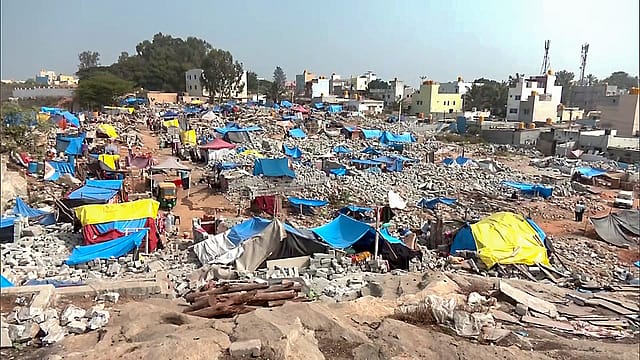
In the last week of December, a stretch of government land on the ragged edge of Yelahanka became something like a mirror to the faultlines running through Karnataka’s politics, and, in a way, across India’s broader civic imagination.
More than two weeks after the Karnataka government razed around 160–170 structures in this northern Bengaluru settlement, the people who lived here are asking for a place to live. On January 4, families gathered again at the edge of the demolished site, holding a weary protest. They said they had received neither temporary shelter nor confirmation of permanent rehabilitation.
The demolition itself took place on December 20, when municipal authorities cleared government land in Kogilu Layout that officials say had been encroached upon in recent years. Satellite images circulated later by the state show the area largely vacant as recently as 2023, strengthening the government’s claim that most of the structures were recent and unauthorised. The land, officials argue, was earmarked for public use and had become unsafe for habitation, surrounded by waste and open dumping. Legally, the state insists, the action was defensible. Morally, it has proven far harder to contain.
In the days since, the issue has moved swiftly from a local administrative exercise to a political flashpoint. Displaced residents have approached the Karnataka High Court, seeking relief and rehabilitation. The State Human Rights Commission has intervened, directing the government to immediately provide tents, food, clean drinking water and medical facilities, a move that reframed the issue less as a land dispute and more as a humanitarian lapse.

Global By Design
29 May 2026 - Vol 04 | Issue 73
Is the future of fashion Indian?
Yet even as emergency relief is discussed, permanent housing remains entangled in procedure. According to government assessments, only a portion of the evicted families qualify under existing housing programmes.
The BJP has accused the Siddaramaiah government of rewarding encroachment and bypassing long-waiting beneficiaries of state housing schemes. A party fact-finding panel claims that 95 per cent of the demolished houses were built in the last two years, using this as proof that the settlement was neither historic nor deserving of special accommodation. Some opposition voices have gone further, questioning the identity of residents and invoking the language of “illegal immigrants”, a charge that residents and civil society groups say has deepened stigma and fear at a moment of acute vulnerability.
The rhetoric has not gone unchallenged. At a recent public meeting, organised by a residents’ committee formed after the demolition, speakers read aloud the Preamble of the Constitution, framing the dispute as one of dignity. Activists argued that even if the land was encroached upon, displacement without shelter amounted to punishment by deprivation.
Within the Congress itself, the episode has exposed discomfort. The party’s central leadership has urged caution and sensitivity, wary of the optics of a Congress government being likened to the “bulldozer politics” it routinely criticises elsewhere..
What the Kogilu episode has revealed is not just the fragility of informal housing in a rapidly expanding city, but the uneasy distance between administrative logic and lived consequence.