Know How India Votes: The EVM Explained From Booth to Result
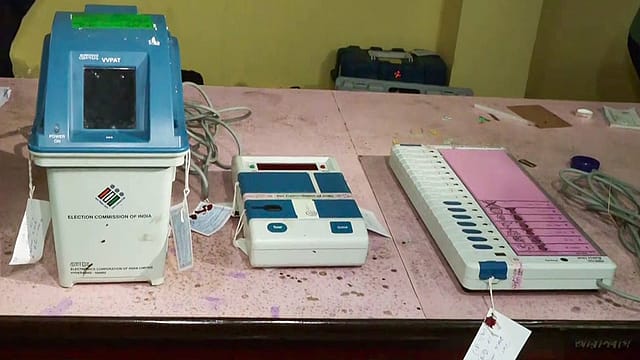
Few pieces of hardware have shaped Indian democracy as profoundly as the Electronic Voting Machine.
Yet the average voter presses a blue button and walks out with little sense of what happens inside that white box.
As debates around electoral transparency resurface before every major poll, a clear-eyed account of why India chose the EVM is long overdue.
Why Did India Need an EVM?
Paper ballots were expensive, slow to count, and vulnerable to fraud through pre-filled fake votes.
In the late 1970s, the Election Commission enlisted Bharat Electronics Limited and the Electronics Corporation of India Limited to design a machine. By 1980, a working prototype existed.
Was the Very First EVM Trial a Legal Disaster?
Yes. According to the Election Commission of India, EVMs were first deployed in May 1982 at 50 polling stations in Parur Assembly Constituency, Kerala.
The Congress candidate A.C. Jose lost, moved the Supreme Court, and argued no law authorised electronic voting. The court agreed and struck the election down.
How Did the EVM Get Legal Backing?
Parliament amended the Representation of the People Act, 1951, inserting Section 61A in December 1988, formally empowering the Commission to use EVMs from 15 March 1989 onwards.

The Liberation of Bengal
05 Jun 2026 - Vol 04 | Issue 74
A silent revolution ends the reign of fear
What Does an EVM Consist Of?
The machine has two units: a Control Unit with the Presiding Officer and a Balloting Unit inside the voting compartment, connected by a five-metre cable.
Each unit covers up to 16 candidates; up to 24 units can be cascaded for 384 candidates including NOTA.
The machines are battery-powered with no internet connectivity.
How Did EVMs Become the National Standard?
The phased rollout began in November 1998 across Madhya Pradesh, Rajasthan, and Delhi.
A Centre for Study of Developing Societies study reportedly found over 95 percent of voters welcomed the machines.
By 2004, all 543 Parliamentary Constituencies used EVMs. According to the Election Commission, over 315 crore votes have been cast on EVMs since 2000.
What Does the EVM Debate Signal?
The EVM's four-decade arc, from a struck-down Kerala experiment to Supreme Court endorsement in 2018, is a story about institutional trust.
The machine has been upgraded through three generations and exported to Namibia, Nepal, Bhutan, and Kenya.
What remains unresolved is not the technology but how democratic institutions sustain public confidence.
That tension between mechanical reliability and democratic legitimacy is the conversation that truly matters.
(With inputs from yMedia)