‘India is Ready’: Sunita Williams on Future Space Stations, Astronaut Autonomy & the Next Giant Leap
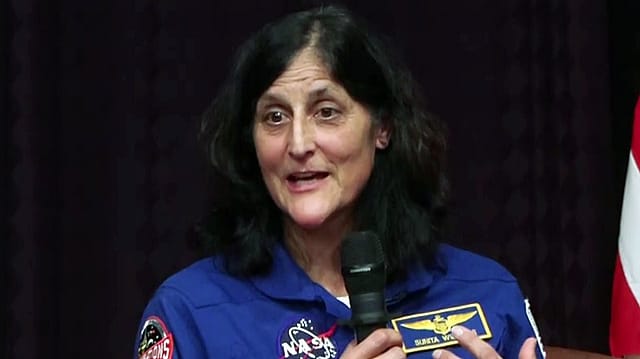
When something breaks on Earth, help can be a phone search away. In space, even finding the answer can depend on a conversation with the ground. Sunita Williams says the next generation of spacecraft must give astronauts more tools to solve problems themselves.
Speaking at the Space Expo in Bengaluru on Wednesday, Williams said India was “ready for the challenge” of building future space stations. But as human missions travel farther from Earth, she stressed, spacecraft will need greater autonomy, new technologies and sustained international cooperation.
The lessons come from three missions spanning space station construction, scientific research and flying a new spacecraft.
“It’s no easy feat, and I know India is ready for the challenge as well,” she said, referring to the work of building space stations alongside efforts by commercial companies around the world.

Losing Memory
16 Oct 2026 - Vol 05 | Issue 42
The making of a medical and social emergency
Why astronauts need answers onboard
At the session, “The Next Chapter of Space: A Conversation on Exploration, Science and Innovation”, Williams described a limitation that people on Earth might find surprising: astronauts cannot look up answers as easily as someone reaching for a phone.
On the International Space Station (ISS), she said, crews rely on good communications with ground teams to answer questions and troubleshoot problems. Future stations could benefit from onboard databases that put technical knowledge within immediate reach.
“If we could have a database of that, we could be a little less reliant on the folks on the ground,” Williams said.
That independence becomes more important as missions move deeper into space and communication delays grow. Astronauts trying to repair equipment or decide their next step will need access to information without waiting for instructions from Earth.
Even a printer can be a problem in space
Williams identified reliable 3D printing as another priority, pointing out that even printing on paper can be troublesome in microgravity.
“Yes, we wrestle with the printer in space because it relies on gravity,” she said. Her broader point was that equipment designed for Earth cannot simply be expected to work the same way in orbit. Engineers need to rethink how machines operate when gravity is no longer available to help them function.
For future space stations, that means designing such capabilities into the infrastructure from the beginning.
Williams said her more recent experience reinforced the need for crews to analyse scientific experiments and medical tests onboard.
Too often, she explained, astronauts have to transmit data to the ground or send samples back to Earth for analysis. Future missions will need machines capable of doing more of that work in space.
“We need to be able to do that ourselves, autonomously, if we are going to take those next steps,” she said.
The requirement extends from medical testing to interpreting experimental results. Onboard knowledge systems and analytical equipment would reduce dependence on both ground teams and the ability to return material to Earth.
What can new space stations do differently?
Williams said commercial and government-led space stations offer a chance to incorporate lessons from the ISS into entirely new designs.
She pointed to commercial space station company Vast while discussing the potential to introduce ideas more quickly, while preserving safety and reliability.
The ISS, she said, has demanding schedules and established processes that can make changes difficult. Parts of the station have been operating for more than 25 years, and decisions about further investment must also consider its eventual retirement.
New stations offer an opportunity to build capabilities into their foundations. Williams said some investments in the ISS could still be worthwhile if they advance broader exploration goals, including the development of a Moon base.
Three missions, lessons still unfolding
Reflecting on her career, Williams said her first mission centred on constructing the ISS with international partners. Her second included travelling with Russian partners and conducting experiments. Her most recent mission involved flying a new spacecraft.
“Sometimes those things come with a couple of hiccups, but the good side of those hiccups is you get to do amazing science and maybe some more spacewalks in the process,” she said.
Some of that science takes years to produce practical results.
Williams cited capillary-flow research from her first flight, which could help shape future systems for transferring fluids in space. On her most recent mission, she saw mathematical models from that earlier work applied to feeding plants hydroponically and delivering nutrients.
Those findings could eventually support plant-growing systems on future space stations or a Moon base.
Her research experience also included stem cells, DNA sequencing, materials science and experiments examining how the human body responds to extended periods in space.
For Williams, those decades of work provide a foundation for the next phase of exploration.
“I’m super excited for future spaceflight, because we have learned so much over the last couple of decades,” she said, describing that knowledge as a springboard for modern space stations and transportation systems that India, other countries and private companies are preparing to develop.
The session also featured Group Captain Angad Pratap and Tom Shelley, vice president for crew partnerships at Vast Space.
With inputs from ANI