Forward With Caution
Around mid-August, reports of fresh Chinese intrusions in Arunachal Pradesh’s Upper Subansiri district generated sufficient heat to elicit specific denials from Chief Minister Pema Khandu and Parliamentary Affairs Minister Kiren Rijiju while military sources insisted the situation was under control. Rijiju, who is Arunachal West MP, said part of the confusion could be explained by the fact that local people are unaware of where exactly the Indian and Chinese claim lines lie. As per local understanding, he said, Indian territory extends beyond where the current patrol ling takes place. Discerning the facts is challenging. Videos and images of Chinese markings and presence are hard to establish precisely. The Army did not comment officially and left it to the Ministry of External Affairs (MEA) to field questions with the spokesperson stating the standard position that the state of border affairs will reflect on the larger bilateral ties.
An element of speculation lingered over the so-called intrusions with Khandu saying the concerns of the community organisation that had raised the alarm should be heard even as he iterated that the Army continued to be in control of the border posts under its charge. The suspense was typical of India-China relations that have been shrouded in doubt and lack of trust which has proved more durable than efforts to move bilateral ties into a better space. So, when the MEA announced an eight-point outcome charter after the 25th round of talks between special representatives of India and China—National Security Advisor Ajit Doval and State Councillor Wang Yi—the development immediately caught the attention of the strategic community. While China has been pushing for an improvement in relations with its Ambassador to India Xu Feihong writing newspaper articles calling for a reset and a new path for ward, and while Beijing’s outreach found some traction, New Delhi continued to keep a wary eye on the borders even as it eased some curbs on Chinese participation in the Indian economy.

Losing Memory
16 Oct 2026 - Vol 05 | Issue 42
The making of a medical and social emergency
The eight-point outcome states that the two sides are committed to advancing negotiations on a framework for the settlement of the boundary question in accordance with the political parameters and guiding principles for settlement of the India-China boundary question signed in 2005 and that the expert group on boundary delimitation and the Working Mechanism for Consultation and Coordination on India-China Border Affairs (WMCC) would advance discussions on an “early and substantial harvest” of boundary delimitation. Both groups would address the issue of their respective terms of reference as a priority. The situation on the ground would be managed through diplomatic and military channels and two additional meeting points were agreed where se nior military commanders of the two sides could meet. A hut at the Chushul-Moldo meeting point (Spanggur Gap) has been the venue for dozens of meetings between senior Indian and Chinese commanders after the clashes in Galwan that resulted in the deaths of 20 Indian soldiers and an unstated number of Chinese troops. The outcome document also stated that the expert level mechanism on transborder rivers will meet in September—a positive development as the Chinese had suspended regular exchange of data on river water flows even as China is undertaking the construction of a mega dam on the upper stretches of the Brahmaputra.
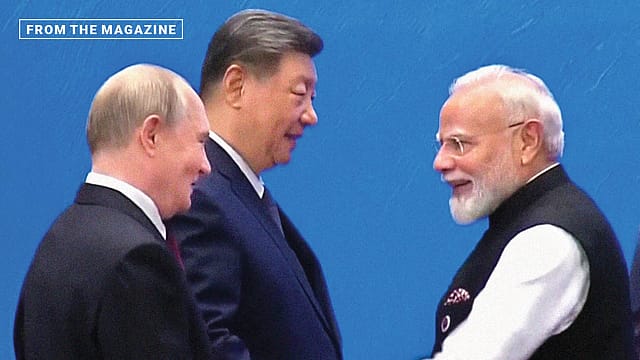
A brief meeting in the lounge area for leaders between Prime Minister Narendra Modi and Chinese President Xi Jinping at Bishkek where the Shanghai Cooperation Organisation (SCO) held its deliberations earlier this week was a precursor to a much more substantial bilateral expected to take place when Xi arrives in New Delhi for the September 12-13 BRICS leaders’ summit. Xi’s presence is in itself significant as he was last in India for an informal summit at Mamallapuram in 2019. The engagement, that followed Modi travelling to Wuhan the previous year, failed to deliver the goods as border tensions flared the very next year in April following the People’s Liberation Army’s (PLA) military deployment and mobilisation in Tibet which led to the Galwan incident and a five-year standoff that is still not over as armies on both sides are yet to de-escalate although they have disengaged at friction points along the Line of Actual Control (LAC).
It is apparent that the Doval-Wang talks had the political backing of the two leaders and the outcomes announced are a breakthrough in bilateral relations that can be viewed as a ‘positive’ development even as it is hard to predict its trajectory. At the same time, well-placed sources said the bottomline will be evidence that China is willing to demonstrate its commitment to the 2005 “guiding principles” that state differences will be resolved without the use of force and border alignment will be according to natural geographic features—India has insisted that the watershed principle should be applied. The Chinese claim lines drawn in the 1960s cut across rivers in the eastern Himalayas in disregard of natural watersheds. The two sides also agreed to protect the interests of settled populations.
The 2005 principles also state that negotiations will aim for a “final package deal” covering all sectors of the border. Just how will the “framework” for the boundary settlement envisaged in the Doval-Wang talks address the question of a package deal? Any final settlement, even if such an outcome seems distinctly futuristic, may include the unstated condition that land occupied by China as a result of an illegal transfer from Pakistan will have to be formally accepted. Then there is the question of border points where China has bent the line on the ground to suit its purposes over the last sev eral decades. A meaningful start to any border exercise, feels sources familiar with the LAC, would be to sit across the table and exchange and examine claim lines which in China’s case have been deliber ately obscured. India has acknowledged the 1914 McMahon line demarcating Arunachal Pradesh from Tibet but this is rejected by China on grounds that it was not present at the table when the line was agreed upon, ignoring the fact that Tibet enjoyed long periods of sovereignty in its history. Much of China’s claims along the LAC in the eastern and western Himalayas are of more recent vintage as the Qing court was quite reluctant to exercise authority in the Karakoram region which it regarded as ungovernable and of little value beyond border pillars and a token presence. Yet, any boundary negotiation will have to acknowledge the present territories where the lines on the ground and those on maps do not align. A verification of the LAC then could bring about greater stability to bilateral ties and inject much-needed trust in relations as protecting the borders has proved to be a cat-and-mouse game for India. The process of discussing the LAC, border point by border point, is certainly demanding but an exchange of authenticated maps, something that China has not done in several instances, will be a start the two sides seek.

The rationale driving India and China is not particularly hard to fathom even though not all parameters can be accounted for and the weightage of specific issues is hard to gauge. The lengthy standoff that followed the 2020 Galwan confrontation, with disengagement taking place only in October 2024 when patrolling by Indian troops in Demchok and Depsang was restored, might have made it clear that India has the ability and, equally important, the political will to slug it out in the Himalayas despite the imbalance between the militaries and the economies. Modi’s decision to keep troops forward deployed and to continue construction of border infrastructure made it apparent that India’s border plans were not a passing phase but had turned the page from the past when such initiatives were limited and hesitant. Despite the diplomatic freeze, Xi has had plenty of opportunities to size up the Indian prime minister.
Xi and Modi were in regular contact during the 73-day Doklam standoff at the India-China-Bhutan tri-junction in 2017 and the Chinese leader was believed to have assured Modi that the situa tion would be resolved. At the time, a BRICS summit was due to be hosted by China in September and it was felt that Xi did not want the border tensions and Modi’s absence to cloud the event. Also, while China has often enough demonstrated its readiness to use military force, this is often calibrated and matched with political calculations. In the current context, some foreign policy analysts have noted Xi’s preparedness to be more assertive in his response to US actions, such as the imposition of tariffs, than was the case during US President Donald Trump’s first term when China appeared to have been caught off-guard by punitive measures against Beijing’s “unfair” trade practices and curbs on technology transfers. At the time, though Xi is to meet Trump soon, China is not unaffected by the volatility in international relations caused by Trump taking a wrecking ball to America’s traditional relationships and the international order as well. Just like most other nations, China too is hedging and might well consider prioritising its concerns in the South China Sea and Taiwan while Xi is due to be ratified for his fourth term in office in the second half of 2027. Going by the high-level purges in the Chinese military, with reports that the latest exit is that of the top commander in charge of western Tibet during the tensions with India, paranoia in the political establishment continues to run high.
Xi’s constant bid to assert control over the PLA and the Central Military Commission (CMC) he heads has a significance for India-China border affairs as the PLA is seen to be the main agent in the matter even though it receives instructions from the commission. Xi has repeatedly emphasised that the PLA must follow the political directives and objectives in the exercise of ANI its mission. The current engagement has certain unavoidable risks for India but some of the pressure to ease curbs on Chinese businesses and investments comes from domestic industry which seeks access to cheaper inputs. China has a strong presence in manufacturing equipment needed to build infrastructure and is a leading sup plier of heavy earth-moving construction machinery. It is also a key part of the industry manufacturing large tunnel-boring machines, which are made in countries like Germany, and can impact delivery of critical equipment needed for highway and Metro construction in India. There is a continued reluctance on the part of Indian companies to invest in setting up these highly specialised businesses given the large investments required, time lags and, of course, the attractive option of Chinese imports.
While economic, foreign policy and political factors incentivising the normalisation of India-China relations are evident, the centrality of national security and by implication peaceful borders cannot be overemphasised and New -Delhi has made this plain in discussions at various levels with the Chinese. This message was conveyed at the level of the political leadership as well as during “back channel” discussions even as India’s preparedness to “move on” was made evident.
The response to the 2020 LAC intrusions took time and a great deal of effort on the part of Indian troops who carried out complex and risky manoeuvres on the intervening night of August 29-30, 2020 to turn the tables on the Chinese perched on the Finger Area along the Pangong Tso and displayed a high degree of tenacity and discipline during eyeball-to-eyeball deployment along friction points on the LAC. Any political engagement with China will not lose sight of this.