Doctors Remove Nearly 2,000 Gallstones From 83-Year-Old Man in Rare Laparoscopic Surgery
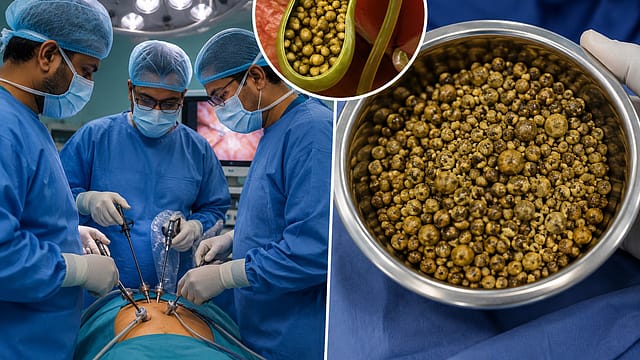
Doctors at Yashoda Medicity in Ghaziabad have successfully performed a rare laparoscopic surgery on an 83-year-old patient, removing nearly 2,000 gallstones from his gallbladder. The complex minimally invasive procedure, carried out by a multidisciplinary team, enabled the elderly patient to recover quickly despite multiple medical challenges.
Years of untreated pain led to rare diagnosis
Yashoda Medicity successfully performed a rare laparoscopic surgery on an 83-year-old male patient, removing nearly 2,000 gallstones from his gallbladder in a technically demanding procedure for Calculous Cholecystitis.
The surgery was led by Dr Pradeep K Dewan, Vice Chairman and Head of the Institute of Minimal Access, Robotic & Bariatric Surgery at Yashoda Medicity, showcasing the hospital's expertise in treating complex surgical cases through advanced minimally invasive techniques, even in elderly patients with multiple medical conditions.
The patient, an 83-year-old advocate from Bulandshahr, had been suffering from upper abdominal pain radiating to his back, along with retrosternal discomfort, for nearly six years. Initially dismissing the symptoms, he delayed seeking medical care. However, as the pain became more frequent and severe, he approached specialists at Yashoda Medicity for evaluation.
Greening the Future
23 Jul 2026 - Vol 05 | Issue 30
Securing a sustainable India
Investigations revealed that his gallbladder was completely packed with gallstones and had developed a thickened wall due to long-standing disease. The stones ranged in size from tiny mustard seeds to chickpeas and weighed approximately 150-200 grams in total.
Rare surgery completed in 90 minutes
Doctors said the presence of nearly 2,000 gallstones is an exceptionally rare clinical finding, making the laparoscopic surgery particularly challenging. Despite the complexity, the surgical team completed the intricate 90-minute procedure successfully, allowing the patient to recover with minimal postoperative discomfort.
Dr Dewan said, "Cases involving such a large number of gallstones are extremely uncommon. What concerned us most was that the patient had been silently enduring severe pain for several years before seeking medical attention. We are relieved that he sought care when he did, as any further delay could have resulted in serious complications such as jaundice, pancreatitis, or, in rare cases, an increased risk of gallbladder cancer."
He further added, "The surgery itself was highly challenging, given the sheer number of gallstones and the patient's advanced age. Such complex procedures demand a high degree of surgical expertise and precision to safely remove the diseased gallbladder without causing harm to the surrounding tissues and vital structures. Despite these complexities, we were able to successfully complete the procedure laparoscopically, enabling the patient to recover remarkably well and return home the very next day. Seeing him regain his health so quickly was deeply gratifying for our entire team."
Patient discharged a day after surgery
Despite being 83 years old and having hypertension along with serum electrolyte imbalance, the patient was successfully managed through meticulous pre-operative optimisation, advanced laparoscopic surgery and comprehensive perioperative care by Yashoda Medicity's multidisciplinary team.
The patient was admitted on June 15, underwent surgery on June 16 and was mobilised within four hours of the procedure. Thanks to the minimally invasive approach and coordinated postoperative care, he recovered smoothly and was discharged on June 17.
The hospital said the case highlights the effectiveness of advanced minimally invasive surgery in managing even highly complex cases in elderly patients. It also emphasised the importance of seeking timely medical evaluation for persistent abdominal pain and recurrent digestive symptoms to prevent serious complications and improve recovery outcomes.
(With inputs from ANI)