Digital Divide Must Not Become an AI Divide: Jyotiraditya Scindia
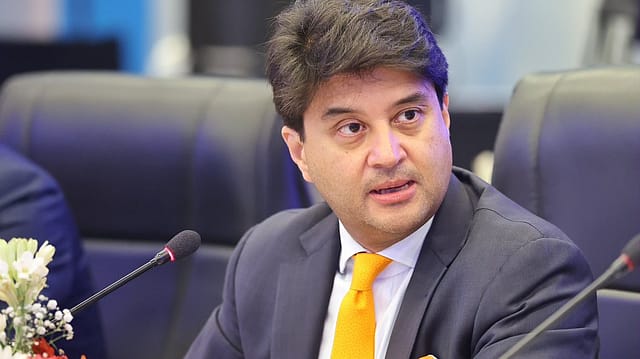
India must ensure that artificial intelligence reaches every citizen and does not deepen existing inequalities in access to technology, Union Communications Minister Jyotiraditya Scindia said on Friday.
Speaking at the India Mobile Congress 2026 in New Delhi, Scindia said AI should improve access to essential services, with its success judged by tangible benefits to people.
“The real test is whether it helps a farmer make a better decision, it enables a doctor to diagnose faster, it allows a teacher to reach a child more effectively,” he said.
Scindia, who inaugurated the International Telecommunication Union’s AI for Good Lab workshop, warned that the digital divide of the past two decades must not become the AI divide of the next two. Nearly 2.2 billion people worldwide remained offline, he said.

The Modi Years
02 Oct 2026 - Vol 05 | Issue 40
A Nation Rebuilt
WIDER ACCESS TO AI INFRASTRUCTURE
The minister said India’s approach was to develop core AI capabilities as shared infrastructure, giving more people access to computing resources, datasets, models and connectivity.
Under the IndiaAI Mission, more than 38,000 high-end graphics processing units had been onboarded at around ₹65 per hour, nearly a third of the global average cost, he said. Another 20,000 GPUs were being added.
Scindia also cited India’s 1.1 billion broadband connections and 5G coverage across 99.9 per cent of districts. Indian developers contributed 5.2 per cent of open-source AI projects on GitHub with at least 10 stars, he added.
He stressed that AI systems must be responsible, inclusive, secure and accessible at scale.
AI TOOLS AGAINST TELECOM AND FINANCIAL FRAUD
Highlighting technology’s role in public safety, Scindia said around 7.2 crore fraudulent or irregular mobile connections had been disconnected through Sanchar Saathi.
More than 35 lakh lost or stolen handsets had been traced, with over 12 lakh recovered, he said.
The Financial Fraud Risk Indicator was also helping banks and payment platforms identify suspicious mobile numbers. Around 45 lakh bank accounts had been restricted and potential fraud worth more than $500 million prevented, according to the minister.
Scindia said the AI for Good Lab would focus on AI readiness and policy, skills development and public AI infrastructure. India is among 10 pilot countries participating in the initiative.
Calling for greater international cooperation, he urged researchers to build systems that address diverse needs, meet safety and fairness standards, and undergo testing before deployment at scale.
“The true measure of artificial intelligence will not be the size of its models, or the ROI, or the sophistication of its algorithms, but the number of human lives that it improves,” he said.
With inputs from ANI