Delhi AQI crosses 600: Severe pollution chokes capital as GRAP curbs tighten
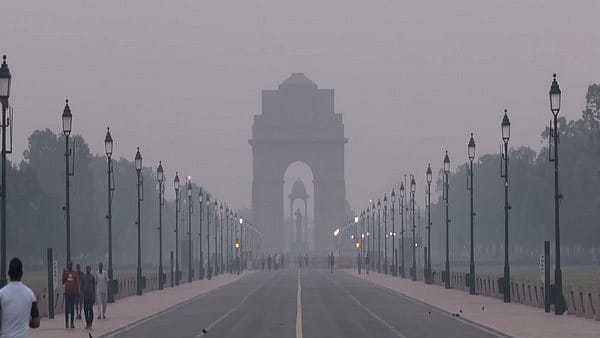
The morning commute in Delhi came with a familiar November warning: the air outside was becoming difficult to breathe. On Wednesday, November 4, a reported air quality reading of 605 at 7.41 am put the capital's pollution crisis back in the spotlight, even as several monitoring stations recorded severe levels.
The Central Pollution Control Board's station data showed Punjabi Bagh at 452, Dhaula Kuan at 417, India Gate at 414, Ghazipur at 410, ITO at 418 and RK Puram at 423. Chandni Chowk, meanwhile, recorded 369, while IGI Airport's Terminal 3 registered 358. These readings placed several parts of the city in the very poor category.

The Era of Forever Wars
30 Oct 2026 - Vol 05 | Issue 44
Coping with an explosive Middle East
Delhi pollution: Why are neighbourhoods recording such high AQI levels?
Delhi's pollution is not uniform. Traffic-heavy junctions, construction activity, industrial emissions and local sources of dust and smoke can push readings higher in particular neighbourhoods. Weather conditions also play a major role in how quickly pollutants disperse.
The latest deterioration comes despite government claims that stubble burning has declined compared with previous years. Union Environment Minister Bhupender Yadav said on Tuesday that around 40 per cent of paddy stubble had been put to use through ex-situ management, which involves using crop residue for purposes other than leaving it in fields to be burnt.
Asked why pollution remained severe despite these measures, Yadav said the Commission for Air Quality Management (CAQM) was monitoring wind direction, wind speed and the movement of air before deciding on further action. The minister's remarks underline a central challenge: reducing one source of pollution does not automatically bring down the city's overall AQI.
GRAP restrictions: Delhi checks vehicles at Gurugram border
With air quality worsening, police stepped up vehicle checks at the Delhi-Gurugram border under restrictions introduced through the revised Graded Response Action Plan (GRAP). The rules, effective from November 1, restrict the entry of certain vehicles that do not meet the prescribed emission standards.
According to the Delhi Traffic Police advisory, BS-VI-compliant vehicles, electric vehicles, CNG vehicles and exempted categories are allowed, subject to applicable rules. Restrictions apply to non-BS-VI vehicles registered outside Delhi, vehicles without a valid Pollution Under Control Certificate and certain non-compliant interstate buses. Trucks passing through the capital are also required to use peripheral expressways.
The CAQM's revised GRAP schedule, approved in September, moved some restrictions to earlier stages so that action can begin before pollution worsens further. The plan also includes measures targeting road dust, construction activity, waste burning and diesel generator use.
Delhi versus Mumbai air quality: How bad is pollution across cities?
The contrast with Mumbai was notable. According to the figures supplied by CPCB, the city recorded an overall AQI of 175, while several neighbourhoods, including Borivali East, Chakala-Andheri East, Kandivali West, Malad West and Worli, were in the satisfactory category. Shivaji Nagar recorded 109, placing it in the moderate category.
For Delhi, however, the immediate concern is whether the combination of vehicle restrictions, dust-control measures and crop-residue management can make a meaningful difference as winter sets in. With meteorological conditions limiting the dispersal of pollutants, the capital's air quality remains a test of both emergency action and longer-term pollution control.
(With inputs from ANI)