Delhi Air Pollution Turns Severe as AQI Hits 402, Thick Smog Cuts Visibility
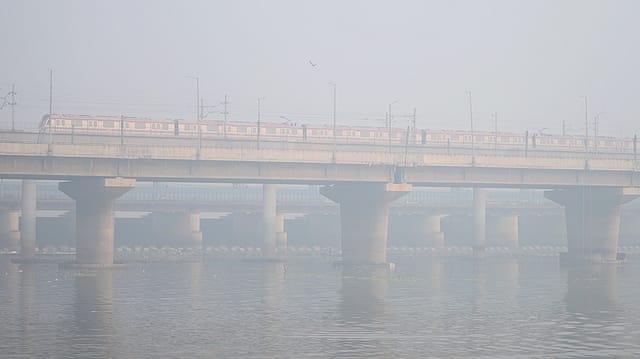
Delhi woke up to thick smog and poor visibility on Friday, November 13, as the citywide Air Quality Index (AQI) reached 402 at 5 am, according to Central Pollution Control Board data reported by News9. Pollution was considerably worse in some neighbourhoods. IIT Delhi recorded 487, while Chandni Chowk and Delhi University’s North Campus both registered 476.
The morning reports gave different figures for the capital. ANI put the overall AQI at 494 at 7:31 am. The earlier reading of 402 is the citywide figure corroborated by News9 and India Today. By that morning snapshot, 33 of 58 monitoring stations were already in the severe category.

The Wealth Issue 2026
06 Nov 2026 - Vol 05 | Issue 45
Portraits of Dreamers and Doers under 35
IIT Delhi and ITO among the worst-hit areas
ANI’s morning station readings put IIT Delhi at 488 and ITO at 455. Anand Vihar registered 419, Rohini 413 and Rajokri Border 402. Several other areas were in the ‘very poor’ category, including RK Puram at 391, Mandir Marg at 378 and Lodhi Road at 341. Dhaula Kuan recorded a moderate reading of 161.
The Delhi government has deployed water sprinklers to control dust. The Commission for Air Quality Management invoked Stage III of the Graded Response Action Plan across Delhi-NCR on November 6, ahead of Diwali.
What the 49 per cent pollution estimate actually measured
The Centre for Research on Energy and Clean Air (CREA) identified 255 missing hourly PM2.5 readings across 59 Delhi monitoring stations between 4 pm on November 8 and 4 pm on November 9. In a sensitivity analysis, the researchers assigned each missing reading a value of 1,000 micrograms per cubic metre, the upper limit cited by the CPCB. Under that assumption, the 24-hour average rose from 269 to 400 micrograms per cubic metre, an increase of about 49 per cent, Hindustan Times reported.
AAP leader Saurabh Bharadwaj cited the analysis on Thursday to accuse the Delhi government and the CPCB of understating pollution. He argued that an official AQI of 370 could have been 560 or higher. CREA’s estimate concerned PM2.5 concentrations, and its researchers said they had not independently established that all 255 missing readings exceeded the measurement limit. The analysis produced no revised AQI.
With inputs from ANI