‘No Sky Is Beyond India’s Reach’: Rajnath Singh Calls for Stronger Air Force Capabilities
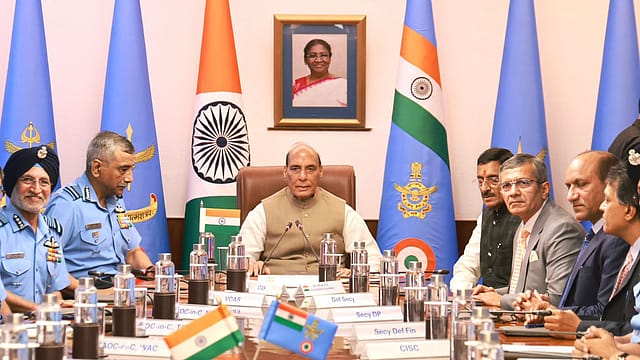
Defence Minister Rajnath Singh on Thursday called on the Indian armed forces to strengthen their offensive and defensive capabilities to maintain an element of surprise in future conflicts, while also praising astronaut Group Captain Shubhanshu Shukla for his achievements in space.
Addressing the Air Force Commanders’ Conference in New Delhi, Singh stressed the need to improve intelligence and surveillance, integrate military systems and identify threats before they unfold. He said the armed forces must be capable of striking without giving adversaries time to respond while remaining prepared for unexpected attacks.
“Our Defence Forces must develop capabilities and methods that leave the adversary with no time to react or recover, while simultaneously ensuring that we are never caught off guard by an unexpected move from the enemy,” he said.
DRONES, CYBER AND SPACE WARFARE
Singh said modern conflicts were increasingly extending beyond traditional battlefields, with missiles, drones and advanced weapons systems playing a greater role. Referring to the Russia-Ukraine and Israel-Hamas conflicts, he highlighted the growing importance of drones and air defence systems.

The Wealth Issue 2026
06 Nov 2026 - Vol 05 | Issue 45
Portraits of Dreamers and Doers under 35
He urged the Indian Air Force (IAF) to prepare for emerging challenges, including kamikaze drones, surveillance and counter-drone operations. He also called for dedicated doctrines and operational frameworks for electronic, cyber and space warfare.
“Victory in future conflicts would depend not merely on the number of aircraft, but also on technological sophistication, speed of response and precision of preparations,” he said.
The minister said the changing security environment required continuous adaptation in military structures, joint operations and operational planning.
LESSONS FROM OPERATION SINDOOR
Singh commended the IAF for implementing its doctrines and operational methods during and after Operation Sindoor. He praised the professionalism, restraint and judgement displayed by air personnel during the operation.
He said lessons from the operation were reflected in the Air Force's evolving procedures, particularly its increased emphasis on drones and air defence systems.
Highlighting the coordinated role of the Army, Navy and Air Force during Operation Sindoor, he said jointness and integration must remain central to military planning and operational execution.
Singh also called for continued investment in training personnel in emerging technologies. He said the technological knowledge of younger recruits could contribute to better decision-making and organisational development.
On the proposed Second Tour of Duty for Agniveers, the minister said the decision had been taken after receiving feedback from the armed forces. He reiterated the government's commitment to incorporating suggestions from the three Services into policy decisions.
IAF LAUNCHES INDIGENOUS AI APPLICATIONS
During the conference, Singh launched a set of artificial intelligence applications developed in-house by the IAF's AI Centre of Excellence under the Unit for Digitisation, Automation, Artificial Intelligence and Application Networking (UDAAN).
The applications are designed to automate and speed up tasks related to operations, administration and aerospace safety. They have been deployed on the IAF's secure network.
The initiative is part of the Air Force's efforts to use technology to improve operational capabilities and administrative efficiency.
The inaugural session was attended by Minister of State for Defence Sanjay Seth, Chief of the Air Staff Air Chief Marshal Ashutosh Dixit, Defence Secretary Rajesh Kumar Singh and senior officials from the defence establishment.
The two-day conference is being held under the theme ‘The Year of Empowerment: Maximising Efficiency Through Decentralisation’. It brings together senior IAF commanders to discuss operational, maintenance and administrative priorities.

RAJNATH SINGH PRAISES SHUBHANSHU SHUKLA
Separately, Singh met Group Captain Shubhanshu Shukla, who presented him with a copy of his memoir, The Second Orbit. The book, published on June 25, 2026, recounts Shukla's journey to the International Space Station (ISS) and his experience as an astronaut.
In a post on X, Singh described the book as an account of courage, determination and achievement.
“His extraordinary journey will inspire countless young minds to dream fearlessly, push boundaries and believe that no sky is beyond India's reach,” the minister wrote.
Shukla became the first Indian national to visit the ISS and the second Indian to travel to space, more than four decades after Wing Commander Rakesh Sharma's 1984 mission to the Soviet space station Salyut 7.
In August 2024, the Indian Space Research Organisation announced Shukla as the mission pilot for Axiom Space's Ax-4 mission to the ISS. The commercial human spaceflight mission also included commander Peggy Whitson of the US, European Space Agency astronaut Sławosz Uznański-Wiśniewski of Poland and Tibor Kapu of Hungary.
The crew conducted around 60 microgravity experiments, including research into cancer growth in space and the effects of spaceflight on crop seed development.
Shukla is also a recipient of the Ashoka Chakra, India's highest peacetime gallantry award.
With inputs from ANI