Coal and stone mining, injudicious urbanisation turned Assam’s floods into a disaster
Experts argue that Assam bore the brunt of the current monsoon emergency not merely because of excessively high rainfall but also because of illegal coal mining in Nagaland along the border with Assam and unauthorised stone extraction in the Sivasagar district of Assam.
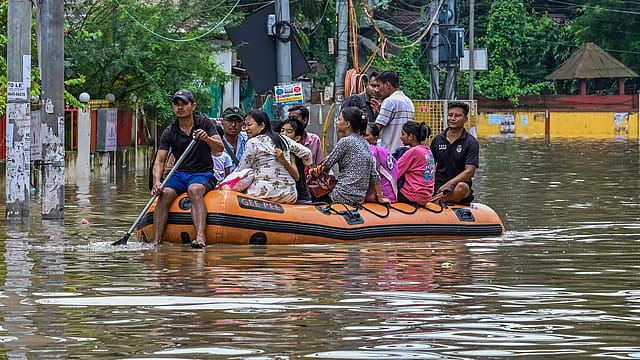
Assam is the worst-affected state in the monsoon this season, with the death toll touching 85 as of August 2 and more than 3 lakh people impacted across seven districts where hundreds of villages lie inundated by floods. Besides, huge damage to agriculture has been reported across thousands of hectares of vital farmland.
That the floods have reached areas such as Charaideo, Jorhat and Sivasagar – which are typically unaffected by monsoon-related floods – has come as a shock to outsiders, but not to those who have warned about “anthropogenic” reasons, meaning those caused by human activity. Dr Pranjal Protim Buragohain, Professor, Department of Economics, Dibrugarh University, Assam, tells Open that injudicious urbanisation in Nagaland and other illegal activities such as coal and stone mining have contributed hugely to this catastrophe. “As a result, the water sequestration capacity of the soil in the newly affected regions has drastically deteriorated,” he says. Water sequestration capacity refers to an ecosystem’s ability to retain, store and manage water resources. That capacity is closely linked to vegetation and soil composition.

Zeroing In on ECI
09 Oct 2026 - Vol 05 | Issue 41
Constitutional legitimacy versus political opportunism
Buragohain’s university colleague from the Department of Applied Geology, Dr Pranjit Kalita, an assistant professor who has conducted surveys and studies in the upper Assam region, explains that coal mining along the Assam–Nagaland border, especially in Nagaland’s Mon and nearby districts adjoining Upper Assam, has contributed to this crisis. There is coal within the sedimentary rocks in the hills around here, and illegal mining reduces water retention capacity. “It takes very little time for floodwaters from the Nagaland border to reach the affected areas of Charaideo, Jorhat and Sivasagar,” Kalita notes. Various organisations have raised the issue of rat-hole mining and deforestation in Upper Assam.
The rivers that caused the devastation include the Dikhow, which ultimately joins the Brahmaputra. The Buridihing, Disang, Dhansiri and the Brahmaputra are all flowing above danger levels. Dr Kalita says that the Bihubar region in Sivasagar district has seen extensive illegal stone extraction, compounding the flood woes this time around. He emphasises that rampant mining led to the formation of man-made lakes, many of which have also overflowed following the heavy rains.
Guwahati-based singer Jutimala Buragohain, who is currently in Dibrugarh to help with relief operations along with others, says many volunteers have reached Charaideo and Sivasagar with mattresses, cooking utensils and other essentials. As of now, the Indian Army is managing rescue operations across multiple districts under Operation Jal Rahat, along with local authorities and state forces, to help hundreds of thousands stranded by severe monsoon floods. Jutimala Buragohain told Open, “Many of our team drove down to the main centres and then had to go around looking for survivors in boats. Still, many villages are submerged.” Several untrained people have also helped save lives using makeshift boats built from wooden logs and other materials to create floating platforms. Meanwhile, Ramesh Hazarika of the Department of Economics at Madhabdev University in Assam said he and others had joined hands to supply essential goods to survivors. “Initially, it was people from neighbouring districts like us (in Lakhimpur) who came to the aid of those in the worst-affected areas, even before the government launched its relief and rescue operations. The flooding was so sudden that many residents were caught off guard, as these areas are not usually prone to monsoon floods. People took the initiative to reach out and help one another,” he said.
The risk of flash floods in the region is far from over. The India Meteorological Department (IMD) has warned of heavy to very heavy rainfall across the Northeast over the next seven days, including in Arunachal Pradesh, Assam and Meghalaya.