BJP’s First Budget Sets Bengal on Growth Path
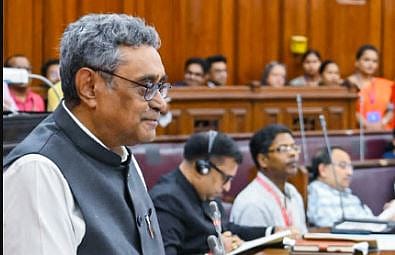
Just before he presented his maiden Budget on Monday, West Bengal’s finance minister Swapan Dasgupta prayed at a temple tucked in the premises of the state legislative assembly. Chief Minister Suvendu Adhikari was there to boost his spirits.
In the event, the signs were propitious. The new finance minister has managed a mini miracle of sorts. He has kept the promises made during the election campaign to speed up welfare spending even as he has kept a sharp eye on expenditures. West Bengal is a fiscally stressed state with a debt overhang of more than Rs8 lakh crore. This alone is sufficient to pull down its prospects.
But on Monday the story turned out to be different.
Revenue receipts for 2026-27 are sharply up by 31% over the revised estimates for the year since the interim budget was presented by the last government earlier in the year. The magic in this figure comes from the grants-in-aid from the Centre that have jumped from Rs22,068.85 crore (revised estimates for 2026-27) to a whopping Rs71,393.19 crore. This represents a much need bit of help for West Bengal. Grants-in-aid are governed by the recommendations of the Finance Commission, a constitutional authority that looks at distribution and devolution of taxes from the Centre to the states.

The Second Life of Sanskrit
10 Jul 2026 - Vol 05 | Issue 28
Being classical has become cool
On the expenditure side, the notable figure is the allocation for social welfare and nutrition amounting to Rs63,894 crore, the single biggest item for allocation in the expenditure pie of nearly Rs4.29 lakh crore.
Dasgupta has been mindful of the sharp constraints under which he has to deliver promises as well as ensuring that West Bengal’s economy is put back on the track. The most important metric from this perspective is the revenue deficit. For 2026-27, the Budget pins this at Rs21,984.41 crore, sharply down from the revised estimates for the year at Rs41,164.05, a reduction of whopping 46%. This combination of increased allocation for welfare as well as pruning of revenue expenditure has not been easy. The state is in a debt trap. Interest payments in 2026-27 stand at Rs53,033.97 crore while repayments of principal amounts owed by the government are lower at Rs44,606.53 crore. These payments together amount to nearly one lakh crore rupees for 2026-27, a figure that can upset any calculations for a government oriented towards growth and development. To be fair, this situation has persisted for a while now.
The key problem for West Bengal is overcoming “revenue suppression.” The sheer scale of lawlessness of the past many decades has taken a toll on the state that was once the industrial heartland of India. As order is restored in the state, it should be able to recoup the revenue that rightfully belongs to the government. There is no doubt that is what is being planned and implemented in the state under the new leadership. The first Budget of the BJP government points in that direction.