Satluj: Embers of the Past
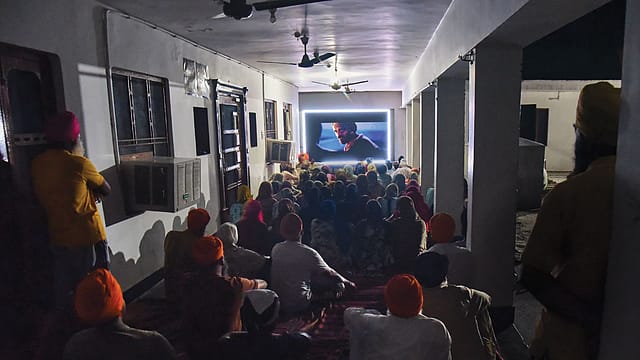
AT 80 YEARS of age, Kashmir Singh has a sprightly gait, bar a slight limp in one foot. Singh, who came for evening prayers to the gurdwara near Jagaron in Ludhiana district, ended up watching Satluj, the film that is now a rage in Punjab. The film, based on the life and activism of Jaswant Singh Khalra, a ‘human rights’ activist who was killed in 1995, drew crowds across gurdwaras and gatherings in the state. While it was taken off an OTT platform where it was originally screened, there is no going back.
Unsurprisingly, the film is finding resonance in Sikhs of a certain age. “Puttar bara mara vela si (Son, it was a very bad time),” Singh tells Open while reminiscing about the Punjab of the 1990s when the state police finally managed to end the run of terrorism there. Does he think the film reflects the contemporary political reality of Punjab? “Rabb oho vela pher na kade dikhaye Punjab vich. Punjab nu santap mile,” is all that he is willing to say. What he says cannot be translated exactly, but the substance is clear: pray to God that those times never return to Punjab and that it gains a measure of calm.
Calm is not exactly a quality on display in the state. As matters stand, the two key political parties in the state, the Aam Aadmi Party (AAP), which is in power with the government led by Bhagwant Mann, and the Shiromani Akali Dal (SAD), the traditional party of Sikh interests that is smarting from the loss of power a decade ago, are slugging it out to gain the “religious vote.” The two other parties, Congress and BJP, are watching from the sidelines. Congress fancies its chances to dislodge AAP next year. But at the moment, its factions in Punjab are slugging it out with each other instead of making efforts to corner the Mann government. BJP, never a major participant in Punjab’s politics except as a junior partner to SAD, is also watching identity politics unfold, assessing if it has a chance next year.
While these high-level political manoeuvres continue, Punjab has descended into a law and order nightmare that is now turning into a potential low-level insurgency. To give one instance, on July 14, Amritsar rural police recovered a cache of weapons and ammunition. This is the most recent example of a rising trend in the cross-border flow of arms. AK-47s and M-4 guns are not exactly the weapons of choice of small-time gangsters. The risk that the state’s collapsing law and order situation will be exploited by separatists is a fact of life and not a figment of imagination. This year, until now, there have been 61 cases of arms recovery. In 2025, this number was 138. This trend has been going northward since 2022. That year marked the end of the so-called farmers’ agitation. Something else is taking shape in Punjab now.
This combination of political parties leaving no corner for securing an advantage and a generalised collapse of law and order is the classic recipe for a much bigger round of violence in Punjab. The history of the years from 1979 to 1993 amply demonstrates that. The film Satluj, its interpretation and the controversy it has spawned, reflect Punjab’s current politics quite well.

In April, the Punjab Legislative Assembly passed an amendment to the Jaagat Jot Sri Guru Granth Sahib Satkar Act, 2008. The amended law ostensibly gave teeth to the 2008 law to deter the potential desecration of Guru Granth Sahib, the holy book of the Sikhs, at the hands of miscreants. This law fell foul of the Sikh clergy. In late June, the entire Mann council of ministers as well as Sikh members of the Legislative Assembly (MLAs) were summoned to the Akal Takht—the throne of the timeless one— the ultimate authority in Sikh affairs. There, the jathedar of Akal Takht, Giani Kuldeep Singh Gargaj, gave them a sermon that these politicians are unlikely to forget soon. What was considered a masterstroke on the part of AAP, a law against any sacrilege towards the Guru Granth Sahib, backfired spectacularly. Mann was declared guru dokhi and Khalsa panth virodhi, someone who had betrayed the guru and was against the Sikh religion.
This religious veto over legislative authority has not gone down well in AAP as well as India at large. AAP spokespersons are tightlipped and cautious in criticising the jathedar. No one wants to be seen as confronting religious authority in Punjab. One AAP spokesperson, Ripandeep Singh Sidhu, told Open: “The authority of the Akal Takht is accepted by every Sikh, and we [AAP] accept that, too. But they [the Sikh clergy] have acted in a partisan manner. They are acting at the behest of a political party, and everyone in Punjab knows that.”
Sidhu’s not-so-hidden hint is towards SAD, the party of Sikh interests. The clergy and the Shiromani Gurdwara Parbandhak Committee (SGPC), along with SAD, form the organisational trinity that controls Sikh politics.
On the surface, what Sidhu says is a plausible argument, one that finds resonance outside Punjab. The idea that religious authorities can hold a veto over legislators and dictate matters to a Legislative Assembly rings alarm bells. India is a secular country where legislatures are independent in their domain, and Punjab has a history of mixing religion with politics in a dangerous manner. The sight of clerics ordering Punjab’s ministers and legislators to “do the needful” and taking their consent was deeply unsettling to Indians at large.
But as is the case with many neat arguments, there is a thread that can unravel them quickly. That is the case with what AAP says about “religious politics” in Punjab. The state has seen a string of incidents involving the desecration of Guru Granth Sahib since 2016. These incidents have continued for the better part of a decade, leading to unease among Sikhs everywhere. There has been a constant demand for a law to deter persons from indulging in such activities for a while now. Efforts to craft such a law have been unsuccessful until the AAP government passed an amendment to the 2008 Act in April this year.
“Unfortunately, the AAP government took a shortcut,” Daljit Singh Cheema, a senior SAD leader and former education minister of Punjab, told Open. He added, “We tried to enact such a law, but we were unsuccessful as the Union government told us that you cannot bring a Bill for this purpose [for punishing sacrilege against the Guru Granth Sahib] involving just one religion [Sikhism].” Later, the Amarinder Singh government—which succeeded SAD in 2017—made a renewed attempt to bring such a law by adding other religions to make it more inclusive from a religious perspective. But that attempt, too, went nowhere. The fact that Punjab’s legislature could not pass a law that had substantial public appeal was the second hint that trouble was in store in the years ahead. But, as is the case with many political errors and oversights, their cost is apparent only much later.
“What the [Bhagwant] Mann government has done is to use the 2008 Act, which was a law to regulate the publishing and printing of texts [birs] of Guru Granth Sahib to ensure their sanctity and standards, for the purpose of punishing any acts of sacrilege against the holy book,” Cheema adds. The 2008 Act was in the nature of a regulatory device that has now been converted into an instrument that prescribes punishments against persons who hold the birs of Guru Granth Sahib.
“Imagine that you are a devout person who keeps the holy book at your home or a granthi [religious preacher] at a gurdwara. If someone desecrates the Guru Granth Sahib, you, as a custodian of the bir, are liable for punishment even if you have done no wrong. The very people who abhor any disrespect to the holy book are in danger of being punished for the wanton acts of unscrupulous persons. This is a travesty,” says Cheema.
Both arguments, the one proffered by Sidhu and the other by Cheema, have a strong linkage with Punjab and India’s political and legal reality. So where does the needle rest?
THE MATTER CANNOT be decided by appeal to legal logic or political persuasion. One answer is to be found in Punjab’s history. In Sikhism, historically speaking, there is no distinction or separation between political power and spiritual authority. In the early 17th century, during the heyday of Mughal imperialism under Emperor Jahangir, Guru Hargobind, the sixth Sikh guru, merged the political [miri] and spiritual [piri] realms in his hand and that of succeeding gurus. This was soon after the execution of his father, Guru Arjan Dev—the fifth Sikh guru—on Jahangir’s orders. Punjab is no longer subject to medieval barbarity, but the conceptual apparatus of that age has remained intact in Sikh politics. From the perspective of ordinary Sikhs, the “summoning” of Punjab’s council of ministers and all Sikh MLAs to the Akal Takht and being taken to task is pretty much acceptable, if not the right treatment to be meted out to errant politicians. In a modern constitutional democracy, this is considered unacceptable. Scholarly opinion in Punjab will recoil at this interpretative stretch of miri-piri as an explanation for Punjab’s politics. But come to think of it, no other conceptual category or device can explain the gulf between what is considered unacceptable in mainstream India and what is par for the course in Punjab. This is the contradiction that lies at the heart of Punjab’s politics, from the current controversies to Jaswant Singh Khalra’s strange blend of human rights activism and Khalistani separatism and from the twisted justification of Sikh separatism in the hands of the scholar Bhai Sahib Sirdar Kapur Singh (1909-1986) all the way back to the adventures of Banda Bahadur (1670-1716).
There is a scene somewhere in Satluj where the narrator states that matters had come to such a pass by 1995 that “crops were scared to grow and leaves were scared to rustle in Punjab.” This is, of course, poetic licence taken by the filmmakers. By 1995, violence and terrorism had come to an end. The death toll after more than a decade of terrorism was grim: from 1981 to 1993, 21,441 persons had been killed in the fury that consumed the state. The worst year in this gory saga was 1991 when 5,265 persons—civilians, security forces personnel and terrorists—were killed. Statistics cannot describe what Punjab underwent in those awful years. But if it helps, there was no single year when the number of civilians killed was less than that of terrorists. The only year when more terrorists were killed was probably the least violent one, 1981, when 14 terrorists perished, and 13 civilians were killed. (All data from South Asia Terrorism Portal).
By the time Khalra was killed in 1995, his “investigations” into “disappeared persons” in the 1990s had allegedly pinned the number of those who had died at 25,000. In the decades since his death, this number has become something of a lodestone for Sikh separatists in India and elsewhere. The number is astounding. When compared to the total number of those killed between 1981 and 1993, it stands at a fantastic 116 per cent of the recorded deaths. If Khalra’s tally were to be added to the official count, the toll in Punjab would be close to double the official count. Such a situation is possible only in the chaos of war between countries. It is impossible during the course of an insurgency in a country with a free press, an independent judiciary and other institutions.
Three decades after those events in Punjab, it is relatively easy to spin a revisionist history in a film. But for those who lived in Patti-Bhikhiwind-Tarn Taran belt and for the uniformed men who were tasked with restoring order in that awful corner of northern Punjab, the story is very different from what Khalra said and what Satluj creatively tries to erase. This zone, a part of the old Amritsar district, was effectively a no-go zone. Police and paramilitary forces did not venture there unless fortified by numbers. If one drives from Amritsar to Bhikhiwind, a distance of around 40km, there are points where the border with Pakistan is less than 10km. Today, one can see a line of eucalyptus trees running parallel to the road. That tree line marks the border. The place is properly fenced today. In Khalra’s time, it was very easy to cross that line into Pakistan. The results were predictable.
Khalra lived and worked in the eponymous village in the old Amritsar district. Not far from Khalra lies Bhikhiwind town. A quarter-century after he died, well after all the fires of Khalistan had been extinguished, a grisly crime was committed in Bhikhiwind. Balwinder Singh Sandhu, a leftist peace activist who ran a school there, was gunned down in broad daylight in his home. His crime? His efforts to bring back Hindus who had migrated to save their lives from Bhikhiwind and adjoining areas in the 1990s and earlier. Sandhu, a Shaurya Chakra winner, was killed in October 2020. The vengeful champions of Khalistan could not tolerate a man who tried to keep communal amity in that part of Punjab.
What Satluj portrays as the forceful, police-dictated quest for peace is at odds with the history of Punjab from 1989 to 1995. In those muddled “Third Front” years, politicians in New Delhi looked for some magical ‘formula’ that could restore peace in Punjab. KPS Gill, the state’s DGP, was shunted out. His successor, DSMangat, farfromtacklingterrorism, becameavictim. InFebruary 1991, his convoy of vehicles was blown up on a bridge in the heart of Ludhiana. By that time, the terrorist ranks had splintered in a fission-like fashion, with each group extorting money and all that they could lay their hands on. It was in this atmosphere of chaos that a juvenile “healing touch” policy was imposed on Punjab. The state’s misery continuedforsomemoreyearsuntilitbecameobviousthateliminating terrorism, root and branch, was the only way out. Far from the police coming uninvited to people’s homes, eating a meal and then gunning them down, the fight to restore order was an uphill task. Ask anyone who has lived in the Punjab of those years, and they will tell you that entering people’s homes at dusk, demanding food and then indulging in horrible atrocities—including demanding young women for sexual pleasure—was the terrorist’s copybook. Butdon’t let this prevent you from watching Satluj; it is a well-made film.
WHY SHOULD THIS ancient history matter now, a quarter into the new century? The trouble is that in Punjab, the past never loses an opportunity to catch up with the present. Perhaps for the first time, the state will soon witness a four-cornered political contest. In February next year, AAP, SAD, Congress and BJP will face each other. As matters stand now, no single party has an advantage over its rivals, one that is sufficient to tip the balance in its favour. After four-and-a-half years of rule, AAP has made a serious political error, one that has handed some advantage to the Akalis. But with the launch of the Mukhya Mantri Mawan Dhiyan Satkar Yojana—the ambitious direct cash transfer scheme for women—the Mann government has regained some political momentum. Had it not undertaken the misadventure of the law passed in April, its ledger of advantages would have been substantially larger. What AAP has lost, the Akalis are trying to claw their way into. Their position since they were last in power a decade ago has weakened almost to the point of no return. They are no longer a force to reckon with in Malwa, their erstwhile stronghold. It is not surprising that the SGPC and the Sikh clergy are now in overdrive. A shaheedi, or martyrdom, memorial is being planned for Khalra at Harike Pattan, a wetland and the last key point of the Satluj river before it enters Pakistan. The confluence of the river and the film could not have been more timely, just months before elections to the state Assembly. It is another matter that the SGPC or SAD did not bother to remember Khalra all these decades.
“AAP is not able to tolerate the fact that the SGPC does a superior job of managing Sikh institutions and the fact that the credit for all this goes to SAD at the political level,” Cheema says. He adds, “AAP is playing a dangerous game.”
In a ‘normal’ Indian state, politics is dictated by a combination of freebies, with some government jobs thrown in and a plethora of welfare schemes. This is the case with most states where identity politics—based on language or religion—is absent or rare. Punjab defies this formulaic politics. The reasons are partly historical and also partly economic. Punjab is the unique Indian state that has gone down from the pole economic position—it had for the longest time the highest per capita income—to the bottom of the pile. Punjab’s politicians have nothing to show. When the money runs out for freebies—as it has for more than a decade now—identity politics becomes the political weapon of choice. The results are visible now. Punjab makes political choices in one direction while the rest of India in another. The lesson of the 1990s was that Punjab’s politics should never turn to an identitarian direction. That caution has been thrown to the winds. The whirlwind is coming.