Beyond Gir: Barda Forests Emerge As Second Home For Asiatic Lions, Study Finds
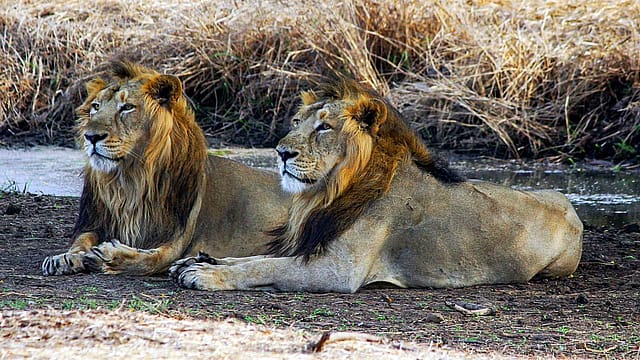
Gujarat’s Barda Wildlife Sanctuary is emerging as a potential second stronghold for Asiatic lions beyond their traditional habitat in Gir, with a new study finding that its forests and grasslands can support a long-term population of the endangered species.
The study, titled Beyond Gir: Barda Wildlife Sanctuary as a Potential Stronghold for Asiatic Lions, examined the habitat use, diet and social interactions of lions that returned to Barda after an absence of nearly 144 years.
The sanctuary, spread across 192.31 sq km in the Saurashtra region, primarily covers parts of Porbandar and Devbhumi Dwarka districts.
According to Mohan Ram, Conservator of Forests, Junagadh Circle, and one of the study’s authors, Barda now supports 17 Asiatic lions. Six animals—one male and five females—were fitted with radio collars for the research, generating more than 169,000 GPS locations between January 2023 and July 2025.

Zeroing In on ECI
09 Oct 2026 - Vol 05 | Issue 41
Constitutional legitimacy versus political opportunism
The findings indicate that the lions are using the sanctuary’s forests and grasslands, establishing home ranges and forming social associations.
A SECOND STRONGHOLD BEYOND GIR
Forest and Environment Minister Arjun Modhwadia said Barda could serve as a population buffer for lions dispersing from the southwestern side of Gir, making the protection of satellite habitats and ecological connectivity important for the species’ long-term survival.
The Gujarat Forest Department has also stepped up efforts to strengthen the sanctuary’s prey base. During 2025–26, 441 chital were translocated from Gir Wildlife Sanctuary to Barda to improve the availability of natural prey.
Spotted deer have also been released through captive-breeding efforts since 2007, alongside sambar.
Officials said eight full-time lion trackers have been deployed to monitor the animals’ movements and health, while rapid-response mechanisms have been strengthened to address human-wildlife conflict.
CONSERVATION AND LOCAL LIVELIHOODS
Alongside wildlife conservation, Barda has seen the expansion of ecotourism initiatives. Launched in 2024, the programme provides opportunities for local residents to work as nature guides and safari operators.
Visitor numbers rose from 2,271 in the initiative’s first year to 3,359 in 2025–26, an increase of 48 per cent, according to forest officials.
The sanctuary has also undertaken habitat restoration, including invasive-species removal, grassland development and soil and moisture conservation.
Around 3,200 hectares were covered by habitat-improvement work this year, officials said.
With inputs from ANI