Bengal Assembly Polls: BJP Holds Crucial Kolkata Meeting Ahead of Counting
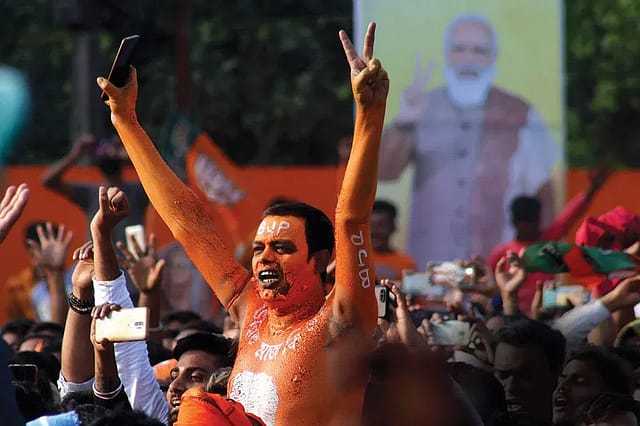
With the high-stakes vote counting for the 2026 West Bengal Assembly elections just days away, BJP has shifted into overdrive, convening a crucial strategy meeting in Kolkata even as election authorities tighten security and political tensions remain high.
The counting of votes, scheduled for May 4, is expected to determine the political future of the state, with fierce contestation between the BJP and the ruling All India Trinamool Congress.
What is the BJP planning ahead of counting day?
The BJP is set to hold a high-level meeting in Kolkata on Saturday to fine-tune its strategy and ensure seamless coordination during the counting process. According to sources, "The leadership will assess booth-level management, counting-day protocols, and coordination mechanisms to ensure a streamlined process. The meeting is expected to play a significant role in finalising the party's approach as counting day approaches.”

Rise of the Pivotal Power
18 Sep 2026 - Vol 05 | Issue 38
The BRICS declaration is a strategic victory for Modi
The meeting will also bring together ‘pravasis’—outstation leaders including Members of Parliament and Members of Legislative Assemblies—who were deployed across constituencies during the campaign. A source said, "All 'pravasis' (outstation leaders) deployed during the election campaign, including Members of Parliament and Members of Legislative Assemblies, have been directed to attend the meeting. These leaders were assigned key responsibilities across constituencies and will provide detailed feedback and updates from their respective regions."
How is the Election Commission securing the counting process?
Even as political parties prepare, the Election Commission of India has laid out extensive safeguards. West Bengal Chief Electoral Officer Manoj Kumar Agarwal confirmed that a three-layer security system will be enforced at counting centres.
"A 3-layer security in place," Agarwal said, elaborating, "Everything is complete in Nadia, Purba Bardhaman, Kolkata North and Kolkata South. No repolling is scheduled here. Partial work was complete, by the time I received report, in Howrah, North 24 Parganas, South 24 Parganas and other districts. But there was no issue of repolling there...Maybe at this point in time, 80-90% of the work is complete. I am speaking to you based on the reports received at 3-3.30 pm."
He also highlighted the introduction of a new verification mechanism. "For counting agents and counting personnel, ECI has started a QR code. It has been started from these elections itself when votes are counted in the 5 states that went to polls. ECI has also said that any by-election or election that takes place after this, this will be brought into use. So, there will be a QR code in appointment letters generated by ECI software. A 3-layer security is put in place. In the third layer of security, verification will be done through QR code,” he added.
Why are political tensions still running high?
The political battle remains intense even after voting concluded. West Bengal Chief Minister Mamata Banerjee has strongly rejected exit poll projections suggesting a BJP edge, alleging manipulation.
In a video message, she claimed the surveys were paid and "circulated from the BJP office," while expressing confidence that her party would return to power. She asserted that the Trinamool Congress would cross "226 in 2026."
The elections witnessed massive voter participation, with turnout figures reflecting heightened public engagement. According to the Election Commission, Phase II recorded 91.66 per cent voting, while Phase I saw 93.19 per cent participation, taking the combined turnout to over 92 per cent.
(With inputs from ANI)