8,931 Days in Office: PM Modi Becomes India’s Longest-Serving Head of Government
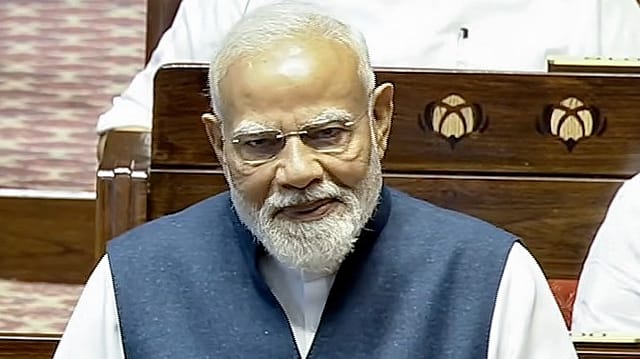
Prime Minister Narendra Modi on Sunday became the longest-serving head of a government in India, surpassing former Sikkim Chief Minister Pawan Kumar Chamling.
With 8,931 days in office as head of government, covering his tenure as Gujarat Chief Minister and as Prime Minister, PM Modi overtook Chamling's record of 8,930 days.
PM Modi has earlier served as the longest-serving Chief Minister of Gujarat and is also the Prime Minister with the longest prior experience as a Chief Minister.

Look Who's Talking Regime Change
23 Oct 2026 - Vol 05 | Issue 43
He is the first Prime Minister born after Independence and has led his party to victory in three consecutive Lok Sabha elections in 2014, 2019, and 2024.
In October last year, the Prime Minister thanked the people of India as he entered the 25th year of his tenure as head of government.
How did Narendra Modi begin his journey as Gujarat Chief Minister in 2001?
Reflecting on his journey since taking the oath as Gujarat Chief Minister in 2001, the Prime Minister said it has been his constant endeavour to improve the lives of people and contribute to national progress.
Modi first assumed office as Chief Minister of Gujarat on October 7, 2001, and continued in the role until May 21, 2014, leading the state for more than 13 years before moving to national politics.
He noted that he assumed office during "very testing circumstances," recalling that Gujarat was reeling from a devastating earthquake, along with the impact of a super cyclone, successive droughts, and political instability.
PM Modi said these challenges strengthened his resolve to rebuild the state with renewed vigour and hope.
Recalling a personal moment, he shared that his mother had advised him to always work for the poor and never accept a bribe, principles he said have guided his public life.
How did Narendra Modi transform Gujarat into a "powerhouse of good governance"?
He highlighted Gujarat's transformation during his tenure, stating that the state moved from being drought-prone and economically strained to becoming a "powerhouse of good governance," with significant progress in agriculture, industry, and infrastructure.
The Prime Minister also recalled being named the prime ministerial candidate in 2013 amid what he described as a "crisis of trust and governance," and credited the people of India for giving his party a decisive mandate in the 2014 Lok Sabha elections.
He was sworn in as the 14th Prime Minister of India on May 26, 2014, becoming the first non-Congress leader to secure a full majority in the Lok Sabha.
He later became the first non-Congress Prime Minister to complete two full terms in office and return for a third consecutive term.
He further noted that over the past 11 years, more than 25 crore people have been lifted out of poverty, and India has emerged as a bright spot among major global economies.
Emphasising empowerment, he said initiatives have benefited Nari Shakti, Yuva Shakti, and farmers.
Reiterating his gratitude, PM Modi said serving the nation remains the highest honour and reaffirmed his commitment to building a "Viksit Bharat" guided by constitutional values.
Earlier this month, PM Modi reached 30 million subscribers on his YouTube channel, strengthening his position as one of the most-followed global leaders on the platform.
With this, he currently leads among both serving and former heads of government in terms of subscriber base, remaining well ahead of other prominent international political figures.
In February, PM Modi also crossed 100 million followers on Instagram, becoming the first serving world leader and politician to achieve the milestone on the platform.
Since joining Instagram in 2014, his presence has steadily grown into one of the most active and widely followed accounts among global leaders, reflecting a sustained outreach strategy aimed at engaging audiences both within India and internationally.
He is currently at 101 million followers on the social media platform. On X, the Prime Minister has 106.4 million followers.
(With inputs from ANI)