37 judges, 3 women and 1 seat left: How the Supreme Court has changed under CJI Surya Kant
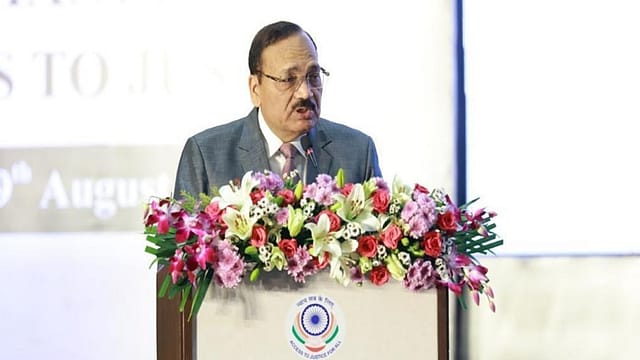
The Supreme Court has just become a little fuller, and the timing, composition and size of the new bench strength tell a larger story about India's apex court.
Chief Justice of India Surya Kant on Tuesday administered the oath of office to three newly appointed judges: Justices Sunita Agarwal, Devendra Kumar Upadhyaya and Aparesh Kumar Singh. Their elevation takes the Supreme Court's working strength from 34 to 37, leaving it just one judge short of its newly sanctioned strength of 38.
But who are the three new judges, why was the Supreme Court's sanctioned strength recently increased, and what makes Tuesday's ceremony unusual?
Who are the three new Supreme Court judges?
The three judges have all arrived at the apex court after serving as Chief Justices of High Courts.
Justice Sunita Agarwal was the Chief Justice of the Gujarat High Court, Justice Devendra Kumar Upadhyaya was the Chief Justice of the Delhi High Court, and Justice Aparesh Kumar Singh was the Chief Justice of the Telangana High Court.

The Modi Years
02 Oct 2026 - Vol 05 | Issue 40
A Nation Rebuilt
The Union government formally notified their appointments on October 5 after the Supreme Court Collegium recommended their elevation on September 28. The President's appointment notification confirmed all three elevations.
Their oath on Tuesday completed the process and brought the Supreme Court's working strength to 37.
Why is the Supreme Court's strength now 37 instead of 34?
There is a bigger change behind the numbers.
Until recently, the Supreme Court's sanctioned strength was 34 judges, including the CJI. But the Supreme Court (Number of Judges) Amendment Act, 2026 increased the sanctioned strength to 38, including the Chief Justice.
The legislation received presidential assent in August. It raised the number of judges other than the CJI from 33 to 37, effectively creating room for a 38-member Supreme Court.
The latest appointments therefore do more than fill vacancies. They bring the court close to the larger strength Parliament has now authorised.
What is significant about Justice Sunita Agarwal's elevation?
There is another number worth watching: three.
With Justice Agarwal joining the bench, the Supreme Court now has three women judges — Justice Agarwal, Justice B V Nagarathna and Justice V Mohana. Before her elevation, there were two women judges serving on the top court.
That makes Agarwal's appointment particularly notable in the composition of the present Supreme Court.
She is also the first of the three new judges to add another woman to the apex court's bench.
Why was the Supreme Court oath ceremony held in the afternoon?
Tuesday's ceremony had an unusual detail that could easily be missed.
The three judges took their oath at 3:30 pm rather than during the Supreme Court's customary morning opening.
Hindustan Times reported that this was the first time since the Supreme Court was established in 1950 that judges were being sworn in during the afternoon. The court had officially announced that the ceremony would begin at 3:30 pm and be livestreamed.
So, alongside the three new appointments, October 6 marked an unusual procedural moment for the apex court.
What does 37 judges mean for the Supreme Court?
In simple terms, the court now has 37 serving judges against a sanctioned strength of 38.
That matters because the expansion was intended to give the country's highest court greater capacity as it handles a large and continuing caseload. The increase from 34 to 38 was specifically designed to expand the court's sanctioned judicial strength.
The three latest appointments also mean the Supreme Court is now only one judge away from its full sanctioned strength.
What happens next in the Supreme Court?
For now, the immediate change is straightforward: three former High Court Chief Justices have joined the apex court, the working strength has risen to 37, and the number of women judges has increased to three.
The larger question is what the expanded bench strength will mean for the court's ability to manage its workload.
For a Supreme Court that operated with 34 sanctioned judges for decades, the numbers have changed quickly in 2026.
And Tuesday's oath ceremony put that change into perspective: three new judges, three women judges in the current bench, and a Supreme Court now just one seat away from its new sanctioned strength of 38.
(With inputs from agencies)