Why has Kareena Kapoor received a legal notice over a royal emerald pendant?
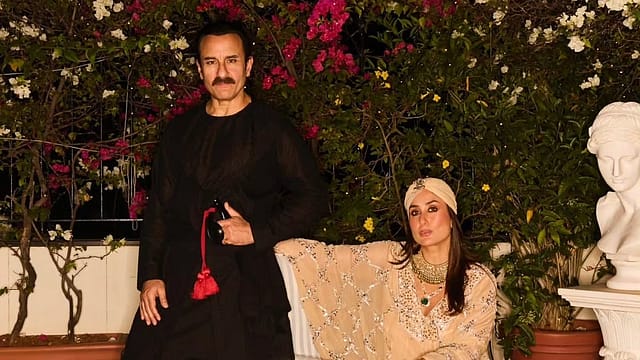
A piece of jewellery that has travelled through generations of a royal family has suddenly become the centre of a public dispute. Kareena Kapoor Khan wore the emerald pendant as part of her Diwali look, but the photographs have drawn objections from a Congress leader who says the sacred inscription was not presented with the reverence it deserves. The controversy has since brought together questions of faith, heritage and personal expression. Here is what happened.
Why did Kareena Kapoor receive a legal notice over her Diwali look?
The controversy began after the actor shared photographs of her Diwali appearance on Instagram. Her outfit featured a beige kaftan by designer Punit Balana, a matching turban and a striking emerald pendant engraved with Ayat-ul-Kursi, a verse from the Quran.

The Wealth Issue 2026
06 Nov 2026 - Vol 05 | Issue 45
Portraits of Dreamers and Doers under 35
On November 11, Madhya Pradesh Congress leader and national media coordinator Abbas Hafeez sent a legal notice to Kareena and her stylist Rhea Kapoor, who had shared details of the look online. The notice objects to how the religious inscription was presented in the photographs and asks for the posts to be removed, a public apology and an assurance that the inscription will be treated with respect.
Hafeez clarified that his objection was not to Kareena’s clothes or her freedom to wear jewellery, but specifically to the presentation of the Quranic verse.
Who is Abbas Hafeez and what exactly is his objection?
Hafeez is the Madhya Pradesh Congress chief spokesperson. However, he has stressed that he issued the notice in his personal capacity and not on behalf of the Congress party.
Speaking to The Times of India, he said: “There is a pendant from the princely state of Bhopal, linked to the heritage of the Begums of Bhopal, which bears a verse from the Quran. For the Begums, this was a matter of faith, not a fashion accessory.”
His lawyer, Mohammad Zafar, also argued that the inscription was sacred and that its display had hurt religious sentiments. The notice refers to concerns among some Islamic scholars about wearing Quranic verses as jewellery, while acknowledging that religious views may differ.
What is Ayat-ul-Kursi and why is it important to Muslims?
Ayat-ul-Kursi, commonly translated as the Verse of the Throne, is verse 255 of Surah Al-Baqarah, the Quran’s second chapter. It describes Allah’s power, knowledge and authority over all creation, including the heavens and the earth.
The verse holds particular significance for Muslims and is widely recited in prayers and for spiritual protection. Its religious importance is central to the objection raised in the legal notice.
What is the story behind Kareena’s 30-carat royal emerald pendant?
The pendant is reportedly around 200 years old and belonged to the former royal household of Bhopal. Its connection to Kareena comes through her husband, actor Saif Ali Khan. Saif’s paternal grandmother, Sajida Sultan, was the daughter of Hamidullah Khan, the last ruling Nawab of Bhopal. She married Iftikhar Ali Khan Pataudi, and their son was former Indian cricket captain Mansoor Ali Khan Pataudi, Saif’s father.
Rhea Kapoor described the jewellery in her Instagram post as: “Heirlooms of the Bhopal royal family, Kareena’s own. These pieces come through Saif’s family; his grandmother, Sajida Sultan, was the daughter of the last ruling Nawab of Bhopal.”
Kareena’s look also featured a 200-year-old kalgi, a traditional turban ornament associated with the Nawab of Bhopal.
Has Kareena Kapoor responded, and who has supported her?
As of November 12, neither Kareena nor Rhea Kapoor has publicly responded to the legal notice. The notice is a demand made by the complainant; it is not a court order or a judicial finding that either woman has committed an offence.
The Bhopal-based Hindu Utsav Samiti has backed Kareena and rejected the demand for an apology. Its president, Chandrashekhar Tiwari, argued that wearing a religious symbol close to one’s heart should not invite objections.
The dispute has therefore moved beyond a celebrity fashion post, raising a wider question about how religious inscriptions, inherited objects and personal expression intersect in public life.