Watching Abby Martin's ‘Cuba After Castro’ amidst CIA threats of 'liberating' the island nation
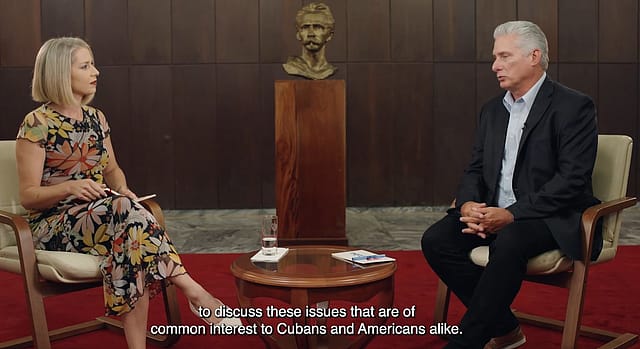
I watched Cuba After Castro: The Island in the Crosshairs on Patreon by paying $8, a few hours after I listened to visiting Cuban foreign minister Bruno Rodríguez Parrilla speak live in New Delhi and two days after CIA Director John Ratcliffe visited Havana with the threat of “liberating” Cuba militarily.
The one-hour-and-24-minute long documentary directed by noted American anchor and journalist Abby Martin along with Matthew Belen and produced by New York-based alternative media outlet BreakThrough News centres on an interview with the island nation’s technocrat President Miguel Díaz-Canel, an engineer who succeeded Raul Castro in 2019.
Flood and Fury
04 Sep 2026 - Vol 05 | Issue 36
Devighat, Nepal, August 29, 2026
Martin gets Díaz-Canel – in his first-ever interview with a US media group – to talk about the Revolution of 1959, his childhood, early meetings with Fidel Castro, his aid work in Nicaragua, the “Special Period” of hardship after the fall of the Soviet Union and the East European bloc when he bicycled his way to work after dropping his child in school. They also discuss the draconian economic blockade by the US, the “thaw” in Cuban-US relations initiated by President Barack Obama in 2016, the election of Donald Trump and hundreds of new restrictions on Cuba, Covid-19, Cuba’s indigenous vaccines produced by its public sector consortium BioCubaFarma, the protests of July 11, 2021, power shortage, food crises and endless odds since then as the Americans under Trump and Secretary of State Marco Rubio exhaust options for economic sanctions and threaten military action.
This is an intellectual route I had taken in 2023 to write my book, Mad About Cuba. So there is a sense of déjà vu. But then Martin is made of sterner stuff: she has done this at a time Cuba really looks like it is on the brink of an unprecedented existential crisis. Her interview with Díaz-Canel, which she uses to tell the history of modern Cuba after the Revolution, targets an audience that has more or less heard nothing good about Cuba and everything bad about the socialist model that ensured, as she explains in the film, that universal health care and quality education are now a right for all rather than a privilege for the well-off.

In one of his trips to interior and mountainous Cuba in the early decades of the Revolution, the late scholar Michael Parenti had said that socialism brought to Cuba access to everything the poor farmers didn’t have earlier. It ensured medical care even in the heights of the Escambray Mountains where, in the pre-Revolution era under Batista’s rule, peasants who fell ill often died because the trip to the nearest hospital took days, especially because they couldn’t cross Latifundia (massive plantations run by Americans or American agents) without getting shot for trespassing. Cuba has an outstanding record not only in universal healthcare and public education but also in biotechnology and pharmaceuticals research and development. I had recently reviewed a short film on the remarkable discovery of a wonder drug to treat Alzheimer’s disease, despite seemingly insurmountable odds caused by the blockade.
Martin’s film shows early footages of the Revolution and the struggles prior to that – all the way from Batista’s speech following the Moncada Barracks attack led by Fidel Castro and others to the Sierra Maestra mountains where the revolutionaries plotted a successful return to unseat the pro-American dictator, a friend of the Pentagon and the American Mafia who remote-controlled their empire living in Cuba which they considered their playground.
Through her interview with Díaz-Canel and travelling with him to where he interacts with people airing grievances, as well as footage from past events, her film establishes the gains of socialism in overall social and economic development of Cuba from what it used to be: a protectorate of the US which controlled its farms, industries, electricity supplies, nickel mines and most of its natural resources and treated Cubans like slaves.
That Díaz-Canel, the first non-Castro to head the country since the 1959 Revolution, granted exclusive access to Martin talks volumes about the 41-year-old American’s work as a journalist who highlights the plight of the oppressed. An alumnus of San Diego State University, she has hosted The Empire Files (2015–2018), a documentary and interview series about global war, inequality and militarism created by the American ‘empire’, besides making films such as Gaza Fights for Freedom (2019) and Earth's Greatest Enemy (2025), which exposes the US military as the world’s largest institutional polluter.
Martin asks Díaz-Canel questions about democracy in Cuba and also highlights elections, which at local levels do not involve the Communist Party. More importantly, she focuses on the challenges ahead for the Revolution as the small country plagued by numerous woes and economic strangulation continues to see large-scale migration of its people amidst American propaganda unleashed against them.
I had noted after my visit to Cuba that the young people -- who didn’t grow up with the memories of the Revolution but were born during the Special Period and have seen deprivation since then – do not want to focus on historical injustices, but want results. I found them highly educated because of Cuba’s free education system. I also met a Cuban American who had flown down to Havana from Miami to get an abortion for free – a surgical procedure that is apparently banned in Florida. Cuban-Americans like her are known to return to the US and badmouth Cuba as part of a survival kit and narrative sold to the biggest military power and economic power in the history of the world, which wants to see a small neighbour dead because it has a different idea about development and growth.
The US continues to use extraterritorial sanctions by threatening countries that do business with Cuba and address their shortage problems. Huge restrictions were imposed in the 1990s under the Helms-Burton Act, Torricelli Act and numerous other punitive measures targeted at financially crippling Cuba – Trump followed it up in his first term imposing 243 restrictions on travel and business with Cuba. On January 29, this year, Trump signed Executive Order 14380, to restrict the island's fuel access. On May 1, he issued Executive Order 14404, “Imposing Sanctions on Those Responsible for Repression in Cuba and for Threats to United States National Security and Foreign Policy”, authorising the imposition of sanctions against non-US companies that engage in a wide range of business with Cuba.
The US administration is also contemplating the type of indictment on 94-year-old Raúl Castro, brother of Fidel and former president, that eventually led to the US abduction of Venezuelan leader Nicolás Maduro. Which means Cuba is in a situation as envisaged by the US bureaucrat named Lester D Mallory in April 1960 in an internal US memo in which he said that the only way to destroy Cuba was to impose sanctions that bring about hardship, hunger, economic dissatisfaction and then disenchantment against the leaders of the Revolution where were extremely popular with the people.
In New Delhi, the Cuban foreign minister Parrilla explained why all this is happening. It is because for the US, Cuba has never been a foreign-policy issue, but a domestic issue concerning a vote base of Cuban-Americans: this group has been trained to hate the socialist land of their birth, influenced by anti-Cuba propaganda on which the US spends enormous sums.
Parrilla was speaking at the Harkishan Surjeet Bhavan, named after the late Marxist leader. Parrilla recalled that Surjeet had during the Special Period travelled to Cuba along with MA Baby, current general secretary of the Communist Party of India (Marxist), after dispatching “10,000 pounds of wheat and 10,000 pounds of rice” and that they were welcomed in Havana by Fidel Castro himself.
Speaking to a packed auditorium, Parrilla noted that Cubans are not naïve by any standards, and understand that a military intervention by the US would be nothing short of a humanitarian catastrophe. He also said that the tightening of the blockade by the US year after year – despite a brute majority of members of the UN asking the US to lift the sanctions on Cuba year after year for more than three decades – has been excruciatingly painful. He also shared that the US, during the Covid lockdown, had refused to lift sanctions on oxygen and ventilators to Cuba. He called these American moves acts of genocide and collective punishment that had caused extreme hardship.
In Cuba, thanks to the American blockade, Parilla said that the infant mortality rate has risen to 9.9 deaths per thousand births from 5 deaths per 1,000 live births in 2019. In 2018, the figure was 4. Similarly, thanks to sanctions that stop Cuba from procuring medicines, raw material for medicines and medical equipment, the survival rate of children with cancer has fallen from 85% earlier to around 65% now.
Martin’s film, which is being privately screened across the world and is available on Patreon for a fee, comes at a time of deep anguish for Cuba and for all those who champion the sovereignty of the country and believe that right must prevail over might. She familiarises her viewers with a leader who has succeeded the Castros and about whom global audiences know little, at a time when America’s economic warfare and threats of military action against its little island neighbour of less than 10 million people seem to have reached a historic fever pitch.
A Cuban journalist recently told me why the US is more hostile to Cuba than to Vietnam -- which, ironically, brought the American empire to its knees in the most humiliating episode of the last century -- with which it now enjoys a robust relationship. Her explanation was revelatory: “Because there are no expat Vietnamese that act as a pressure group in the US the way Cuban-Americans do.”
That is another aspect Martin and Belen focus on in the film, which demystifies why Americans behave the way they do with Cuba.
Cuba After Castro: The Island in the Crosshairs
Directors: Abby Martin and Matthew Belen
Producer: Breakthrough News
Duration: The one hour and 24 minutes