Robert Pattinson: From a Twilight Vampire to Batman and now the New James Bond
In 2005, Robert Pattinson appeared in Harry Potter and the Goblet of Fire and was killed off at the end. As the popular yet compassionate Cedric Diggory, he found himself competing against Harry Potter in the Triwizard Tournament. It was a supporting role, but it gave the 19-year-old British actor his first taste of international recognition.
Three years later, Pattinson would become one of the most recognisable faces in the world. The reason: he was a vampire.
When he was cast as Edward Cullen in Twilight (2008), an adaptation of Stephenie Meyer’snovels, Pattinson could hardly have anticipated what followed. The film, about a teenage girl who falls in love with a vampire, became a global phenomenon. Its success spawned four sequels, made stars of Pattinson and his co-stars Kristen Stewart and Taylor Lautner, and turned him into a teenage heart-throb.

The Wealth Issue 2026
06 Nov 2026 - Vol 05 | Issue 45
Portraits of Dreamers and Doers under 35
But that wasn’t all. While the audience was taken by his spectacular looks and Edward’s romantic appeal, critics were far from impressed. Pattinson became an easy target for jokes about his acting. The Twilight films were often dismissed as melodramatic, and he was seen by many as little more than a good-looking actor who had landed a lucrative franchise.
The criticism was not entirely fair. Pattinson had an unusual intensity to Edward (that we would see in his later roles), even if the material did not always give him much room to work with. In interviews, he was frequently self-deprecating about the films and the attention they brought him. But he was not interested in spending the rest of his career playing variations of the same character.
Then in 2012, the end of Twilight offered him an opportunity to change direction. He began seeking out filmmakers whose works were far from the vampire romance that had made him famous. One of his most important choices he made was to appear in David Cronenberg’s Cosmopolis (2012), in which he played a wealthy young financier travelling across New York in a limousine. It was a strange, deliberately cold film, and a far cry from the romantic Edward Cullen.
Pattinson was also drawn to projects such as David Michôd’s The Rover (2014), in which he played a vulnerable young man in a bleak, lawless Australia, and James Gray’s The Lost City of Z (2016), about an explorer searching for a lost civilisation in the Amazon. He was willing to look awkward, unkempt and occasionally ridiculous (one can think of the roles his former
Harry Potter co-star Danielle Radcliffe had chosen). The point was to play people who were nothing like the image audiences had formed of him.
In 2017, came Good Time, which was a turning point for Pattinson. He played Connie Nikas, a small-time criminal who attempts to get his developmentally disabled brother out of police custody. The film follows Connie through a chaotic night in New York. He lies, he manipulates, he makes desperate decisions. Pattinson portrayed him as a man with restless energy, making it difficult to look away from him even when his character becomes thoroughly unpleasant.
Then came Robert Eggers’ The Lighthouse (2019). Shot in black and white, the film follows two lighthouse keepers stranded on a remote island. Pattinson plays Ephraim Winslow, a young man whose relationship with his older colleague, played by the legendary actor Willem Dafoe, gradually descends into madness. It was a demanding performance, involving physical comedy, rage, paranoia and some weird and strange scenes. The actor who had once been criticised for playing a vampire was now sharing the screen with Dafoe in one of the decade’s more unusual films.
Slowly, Pattinson’s choices had begun to change the conversation around him. He was no longer simply the former Twilight star trying to escape his past. Directors such as Cronenberg, the Safdie brothers and Eggers were interested in working with him. His willingness to take risks had become one of his biggest strengths.
This did not mean he ever wanted to abandon mainstream cinema. In 2020, he was a part of Christopher Nolan’s Tenet. Pattinson played Neil, a mysterious operative who helps the protagonist navigate a world in which time can move backwards. Unlike many of his earlier independent roles, this was a large-scale production, involving elaborate sequences and Nolan’s characteristically complicated storytelling.
A bigger opportunity followed when Matt Reeves cast him as Bruce Wayne in The Batman (2022). The announcement was initially met with scepticism. For some, the actor who had played Edward Cullen was an unlikely choice to take over one of the most recognisable characters in popular culture. But Pattinson had spent years demonstrating that he could handle difficult material.
The film went more hardcore on Batman’s psyche than earlier versions had done. Pattinson’s Bruce Wayne was young, more withdrawn and troubled, and still learning how to function as Gotham’s masked vigilante. He played him as a man consumed by anger and grief, with little interest in the billionaire playboy persona, which was hugely played upon by Christian Bale’s Batman. Pattinson’s Batman was more detective than superhero, and the film drew heavily from crime thrillers and noir cinema.
It was also a reminder that Pattinson could carry a major studio production. The Batman was a commercial success and earned him a new generation of admirers. His return to big-budget films was no longer a gamble.
In 2026, he again partnered with Nolan in The Odyssey as Antinous, one of the cunning suitors pursuing Penelope in her husband Odysseus’ absence.
Pattinson continued to move between mainstream productions and unusual projects, including his work in Mickey 17 (2025), Bong Joon Ho’s science-fiction film in which he played multiple versions of the same character— cowards, adventurers, among others.
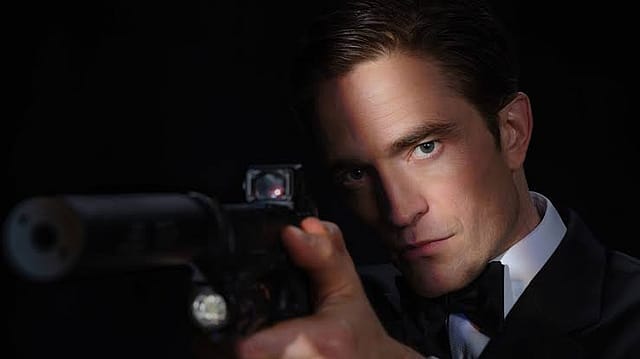
And now comes James Bond.
On November 16, Amazon MGM Studios announced that Pattinson would succeed Daniel Craig as the next 007. The film will be directed by Denis Villeneuve (who is also directing Pattinson in Dune 3), with a screenplay by Steven Knight. It will be the first Bond film made under Amazon MGM’s. Pattinson, at 40, has big shoes to fill. Others who portrayed Bond include Sean Connery, Pierce Brosnan and Roger Moore,
It is a remarkable development for an actor whose career once seemed defined by a teenage vampire romance. Bond demands a different kind of screen presence: physical confidence, charm, humour and the ability to command a room. Pattinson has shown elements of all these qualities in his work, though this will be his biggest test yet.
Cedric Diggory was a supporting character who died before the end of his first film. Edward Cullen made him a global star. Connie Nikas and Ephraim Winslow helped establish his acting credentials. Batman made him a leading man in a new franchise. Now he is James Bond. It has taken two decades, but Pattinson has managed something few actors achieve: he has made it difficult to predict what he will do next.