Oscars 2026: Historic Wins, Political Statements and Red Carpet Elegance Define the Night
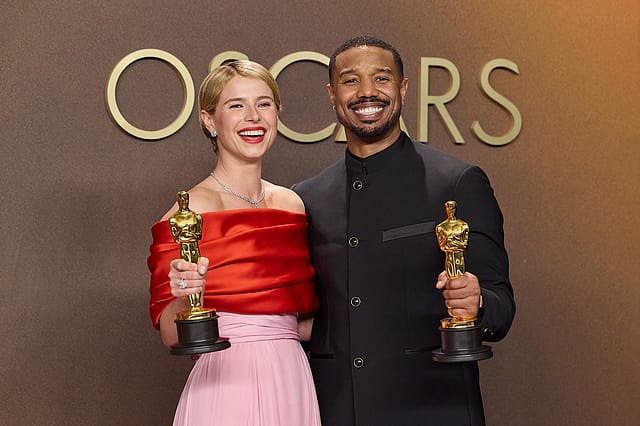
A Timothée Chalamet joke at the Oscars was inevitable this year. Days earlier, the actor found himself the subject of criticism and many a hilarious meme, thanks to a reckless comment about nobody caring about ballet and opera. At the 98th Academy Awards 2026, held on March 15 (livestreaming in India the next morning) at the Dolby Theatre in Hollywood, host Conan O’Brien joked, “Security is extremely tight tonight. I'm told there are concerns about attacks from both the opera and ballet communities.” At this point, the joke only adds to an exhausting pile—the news cycle has changed a few times over, the ballet and opera communities have commented about their significance, people have agreed and disagreed and Chalamet has surely moved on. Everyone who rooted for the actor to lose the Oscars as a result of this careless statement must be pleased though it is fair to assume that Michael B Jordan did not win Best Actor for Sinners only because his fellow nominee forgot to think before he spoke.
The Oscars are Hollywood’s biggest honours, its trophies coveted and its red carpet revered. The MET Gala and the red carpet at Cannes Film Festival may offer serious competition, and other film events and gala are playing catch-up. But the Oscars arrive earlier in the year, the final summit of awards season, its red carpet mojo combined with the awards' prestige value. To be a guest (when A-listers regularly get dropped from the roster of invitees) is great, to be a presenter is an honour, to be nominated is worth investing in couture for. To win is the ultimate high.
Losing Memory
16 Oct 2026 - Vol 05 | Issue 42
The making of a medical and social emergency

The red carpet was elegant though understated, perhaps recalling the precarious geopolitical mood in the world right now. A predictable roster of luxury brands made their appearance—Emma Stone, Renata Reinsve and Chase Infiniti in Louis Vuitton, Chalamet and Elle Fanning in Givenchy, Rose Byrne, Priyanka Chopra and Leonardo DiCaprio in Dior, Teyana Taylor and Nicole Kidman in Chanel, Demi Moore in Gucci and Anne Hathaway in a floral Valentino (she appeared on stage with Vogue's Anna Wintour in an act clearly intended as promotion for The Devil Wears Prada 2). Gimmick and unpredictable dressing were largely absent, unless one counted Chloe Chao’s decision to drape a veil over her shimmering black dress. White was the dominant colour and some celebrities also accessorised with protest pins, including Javier Bardem who came on stage with Priyanka Chopra to present the Best International Feature and began his speech saying, “No to war and free Palestine.” They awarded the trophy to Sentimental Value, directed by Joachim Trier, the first Norwegian film to win in this category. Trier quoted James Baldwin, saying, “All adults are responsible for all children”, and politicians who do not believe this don’t deserve our vote.
The wins largely went by what has already been predicted across the major categories. The Best Actress Trophy was Jessie Buckley’s to lose. The Hamnet actress had been on a winning streak since the start of the award season, for her physically and emotionally intense portrayal of Agnes in Chloe Zhao’s adaptation of Maggie O’Farrell. The Oscars completed her sweep. Dressed in a two-toned Chanel, she accepted the trophy, dedicating it to mothers (March 15 is Mother’s Day in the UK)—the first Irish actress to win in the category. Sean Penn, absent from the proceedings, won Best Actor in a Supporting Role for One Battle After Another while Ami Madigan took home the Best Actress in a Supporting Role trophy for the horror film, Weapons.
Sinners, which won Best Original Screenplay, offered stiff competition but Paul Thomas Anderson’s highly entertaining political drama One Battle After Another picked up the Best Picture trophy and a win for the director as well as the Best Adapted Screenplay. The film, which was released to great critical praise, was widely tipped to win. The trophy for Best Song went to ‘Golden’, the wild hit from the KPop Demon Hunters, which unsurprisingly also won Best Animated Feature. Predictable or not, clinching an Oscar feels special. No K-Pop song has ever won an Oscar before. And then there was Autumn Durald Arkapaw, the first woman of colour to win (and to be nominated) Best Cinematography, for Sinners. And Cassandra Kulukundis who won the Oscars first-ever casting award—a category that industry insiders have lobbied for a long time—for One Battle After Another. Women won the stage over and over, and not only in their wins. O’Brien’s joke about Chalamet’s take on ballet proved less powerful than the moment trailblazing American ballerina Misty Copeland danced onto the stage, to Sinners’ Oscar-nominated song ‘I Lied to You’. Popularity may ebb and flow, but great art never loses value. It holds true for ballet and opera, as much as the year’s best films and performances.