Why Electrification Numbers Don’t Tell the Real Story
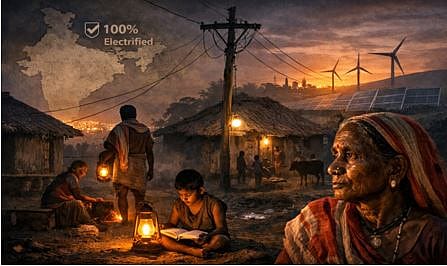
Numbers are often used to tell the story of India's electrification: villages getting electricity, homes getting connected, and megawatts being added. Based on these standards, the country has reached a major milestone. Government data shows that almost every village now has electricity, and major projects have connected millions of homes to the grid. India looks strong on paper.
But if you go to a village on the edge of the forest in West Bengal, a hamlet in Jharkhand, or an island in the Sundarbans that is prone to flooding, you will see things differently. In this case, electrification is not like a switch that has been turned on; it is a fragile, uneven, and often unreliable process. The disparity between official statistics and actual occurrences reveals a fundamental truth: our method of measuring electrification does not equate to energy accessibility for individuals.
The Problem with Numbers
How India defines "electrified" has a big impact on how well it does with electrification. A hamlet is considered electrified if it has basic infrastructure and a small number of homes are connected. In the same way, a house is considered electrified as soon as it has a connection, no matter how often electricity flows through it.
This definition gives you great numbers, but it doesn't show you all the important gaps. Even if a household has a meter but no regular supply, it is still considered electrified. A community that only gets a few hours of electricity each day meets the requirement. People forget about reliability, affordability, and quality, which are all important parts of meaningful energy access. Because of this, the statistical success story doesn't really show all the details on the ground.

Exclusive: To the Heavens and Back
19 Jun 2026 - Vol 04 | Issue 76
Shubhanshu Shukla relives the space odyssey that put India into orbit
Electricity that isn't reliable
For a lot of villages on the edges of forests and rural areas, electricity isn't always available. There are a lot of power outages, voltage changes, and limited supply that only lasts a few hours a day.
In these situations, electricity cannot sustain livelihoods. Electric pumps aren't reliable for farmers. Small businesses can't run machines. Students have a hard time studying at night. Health clinics can't count on having power all the time to offer basic services. In these situations, electricity becomes a symbol of progress rather than a useful tool.
The politics of giving out
In India, electricity is not fairly shared. Urban and industrial areas often get the best supply first, while rural and remote areas get lower-quality supply.
This isn't an accident; it has to do with political and economic goals. Power distribution companies, who are already having money problems, tend to like customers who make a lot of money. Some people think that rural areas are less profitable because there is less demand and more transmission loss.
The end result is a ranking of who can access what. Many rural towns still have unreliable power, even though cities are moving to 24/7 power and smart grids. In this sense, electrification is more than just a technological issue; it is very political.
Renewable Energy: Hope and a Problem
India's push for renewable energy adds another layer to the story. People have praised solar power as a possible solution to the problems of getting electricity to rural areas. Mini-grids and community solar projects are examples of decentralized solutions that could make energy access more reliable and local.
But using renewable energy doesn't guarantee fairness. Large solar parks often need a lot of land, which can cause problems for people who live nearby. Decentralized solutions still don't get enough support, though, because of legal and financial issues. If we don't make sure things are fair, switching to clean energy could make things even more unfair.
The Missing Middle: How to Run Things and Make Them Happen
A lack of governance is at the heart of these problems. India has a lot of plans and policies. The policy framework is broad and covers everything from efforts to bring electricity to rural areas to goals for renewable energy. The hard part is putting these rules into action and seeing how they affect the real world.
Local organizations often don't have the power or ability to deal with issues of reliability and affordability. There is not enough coordination between different agencies. People in the community don't often give feedback that leads to policy changes. This gap creates a "missing middle" in government, where national goals don't match what is really going on.
Not on the Grid
We need to do more than just work on the grid to fix India's energy problems.
Decentralized energy systems, especially those based in communities, could be a different way to go. By generating and managing power locally, these systems can make things more reliable and give people in the community a chance to get involved.
To make these kinds of solutions work on a larger scale, though, we need supportive policies, new ways to pay for them, and changes to institutions.
It also means changing the way you think about communities, from seeing them as passive recipients to seeing them as active participants in the energy system. Finally, India needs to make people's lives better in a meaningful way, not just by giving them electricity. This means that policy priorities need to change from building infrastructure to making sure services are good and people are held accountable. If we don't fix problems with reliability, cost, and local government, electrification could end up being a success in terms of numbers but not in terms of development. India's next step toward a cleaner energy future must put people who are on the edges—geographically, economically, and politically—first. If policy wants to bring about real change, it needs to focus on what people go through. Until then, the promise of electricity for everyone will only be partly kept. Homes will be lit up, but that doesn't mean the people who live there will be able to use it.