When Terror Isn’t Just Violence
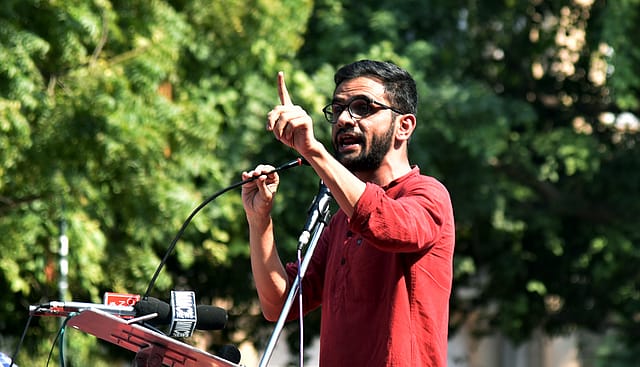
ACCUSED IN THE 2020 Delhi riots and ‘poster boys’ of dissent Sharjeel Imam and Umar Khalid have been denied bail. The Supreme Court’s decision rejecting the bail pleas filed by Imam and Khalid took many by surprise.
Of late, in 2024 and 2025, the apex court had clarified that even under strict statutes like the Unlawful Activities (Prevention) Act (UAPA) or the Prevention of Money Laundering Act (PMLA), constitutional courts retain the discretion to grant bail if trial delays are undue or if allegations lack a prima facie basis. In Imam’s and Khalid’s case, pre-trial detention was a serious constitutional concern. The duo had already spent five years in prison. Liberty once lost can never be gained back.
So, the expectation was that the Supreme Court would release the duo. Incidentally, there was no dearth of pressure applied on the court by self-styled ‘libertarians’.
But clearly, the apex court was not going to be pressured. A Bench denied the duo bail, observing that “where the prosecution has placed prima facie material of deliberate action affecting the security of the nation, the court cannot turn a Nelson’s eye on such material merely because incarceration is prolonged or liberty is invoked in the abstract.”

Losing Memory
16 Oct 2026 - Vol 05 | Issue 42
The making of a medical and social emergency
The court appeared to suggest that delay in trial cannot be treated as a trump card by accused persons to secure bail.
While headline writers are prioritising the denial of bail on the ground that prima facie material suggesting culpability exists, the hinge of the judgment lies elsewhere. On a closer reading of the order authored by Justice Aravind Kumar, who led the Bench, the court cites an additional and far more consequential reason for denying bail. It remarks that a “threat to society may arise even in the absence of physical violence,” further observing that a “terrorist act also constitutes disruption of essential services.”
For the court, a terrorist act is not limited to the final act of violence but also includes the build-up through conspiracy and abetment. The Supreme Court appears to have clarified the provisions of UAPA to conclude that the statutory intent of the law was never to confine the definition of terror to the mere use of weapons.
This reasoning potentially raises the bar for granting bail. In the eyes of the Supreme Court, an act of terror now extends to conduct that threatens national integrity and sovereignty.
One of the key arguments advanced by the petitioners was that they did not participate in the actual acts of violence in February 2020. Delhi Police, on the other hand, argued that the accused had conspired towards regime change through armed rebellion and the deliberate disruption of essential commodities—conduct that would amount to a terrorist act under UAPA.
The apex court has clearly held that, on balance, there was reason to believe the duo had “conspired to disrupt essential supplies, leading to economic insecurity and the destabilisation of civic life, even if direct violence was not committed in the process.”
If one were to extend the court’s logic, theoretically even a peaceful chakka jam—if organised with the intent to deliberately disrupt essential services, destabilise civic life, and create economic insecurity—could attract scrutiny under UAPA. The trigger, however, would not be dissent per se but the scale, coordination, and intent.
In drawing this link, the court has put on notice self-styled ‘Gandhians’ who, in the name of dissent, have often planned blockades without accounting for the constitutional limits of protest. Several examples litter the political firmament. The most prominent was the prolonged Singhu border blockade during the farmers’ protest that witnessed rioting, deaths, and sustained disruption of civic life. Whether such conduct could, in an extreme case, attract scrutiny under UAPA is a question the judgment now implicitly raises.
What implications the court’s decision may have for the future contours of lawful dissent remain to be seen. But there is little doubt that the apex court has made it easier for anti-terrorism agencies to argue against bail where they allege threats to national integrity and sovereignty.