When Music Meets the Algorithm
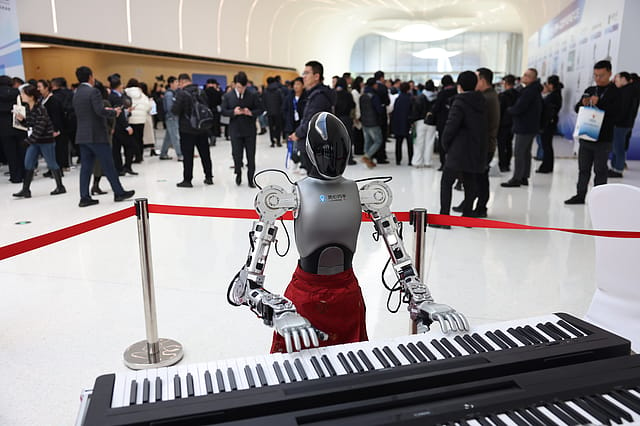
There was a time when music arrived with ritual—through radio programmes awaited at fixed hours, cassettes rewound with care, treasured records, or live performances in sabhas, temple courtyards, and festival grounds. Music was not merely consumed but absorbed, demanding patience, presence, and often community. Today, by contrast, music arrives instantly—summoned by a tap, curated by algorithms, and increasingly anticipated even before desire is consciously formed. This shift is not merely technological; it is civilisational. Importantly, this is not a story of artistic decline; India continues to generate world-class musical talent and extraordinary creative output, even as the structures through which music is created, distributed, and experienced undergo profound change.
As we mark World Music Day on June 21, nostalgia alone is inadequate. A more urgent question confronts us in 2026: what becomes of music in the age of algorithms? Not merely music as sound, but music as culture, labour, memory, identity, and human expression.
Technology has undeniably democratised music. The barriers to recording, production, and distribution have collapsed. A bedroom producer in a small town can now upload a track and potentially reach listeners across continents without ever securing a record deal. The global recorded music industry reached $31.7 billion in 2025, its eleventh consecutive year of growth. Paid streaming now accounts for over half of recorded music revenues, with 837 million paid subscribers worldwide. Humanity is listening to more music than ever before. Yet abundance has produced a strange new scarcity: attention.
The Modi Years
02 Oct 2026 - Vol 05 | Issue 40
A Nation Rebuilt
The paradox of the streaming era is stark. Almost anyone can publish music; very few can truly be heard. The old gatekeepers—radio stations, labels, television networks—have not disappeared. They have merely been dominated by algorithmic systems whose logic is more opaque and powerful. Our listening habits are increasingly shaped not by deliberate choice or trusted curation, but by recommendation engines optimised for engagement. This matters because algorithms do not merely reflect taste; they actively produce it.
A generation raised on “Discover Weekly” and mood-based playlists encounters songs differently. Music is increasingly organised by utility—music for studying, sleeping, focusing, relaxing. One no longer asks, “What album shall I immerse myself in?” but “What should play while I work?” Music shifts from an object of contemplation to an ambient productivity tool.
The album, once a coherent artistic statement, has steadily yielded to the single. Intros are shorter. Hooks arrive faster. Songs are increasingly engineered to survive the first fifteen seconds because those seconds determine whether the listener skips and whether the algorithm rewards or buries the track. The platform is no longer merely distributing art; it is shaping form itself. In that sense, the algorithm is becoming an invisible collaborator.
There was a time when being a musician meant, primarily, making music. That time has quietly passed. Today’s musician must be composer, performer, producer, marketer, content creator, and brand manager—often simultaneously, often without institutional support. The Carnatic vocalist who spends hours in riyaz may also need to spend hours creating short-form video. The folk singer carrying an oral tradition may feel compelled to compress that inheritance into fifteen seconds for an audience already scrolling away. The two demands sit uneasily together. One requires perpetual visibility. The other demands solitude and interiority.
The economics offer little comfort. Streaming solved distribution, not livelihood. A track may earn millions of streams yet generate modest income after platforms, distributors, and labels take their share. Visibility and viability have sharply diverged; one may be widely heard yet remain economically precarious. But the deeper loss is not economic—it is contextual. Music did not begin as content but as community. The qawwali at a dargah was collective devotion, Baul singing in Bengal philosophy in sound, and Bihu songs, markers of agricultural rhythm and seasonal renewal. Music moved between guru and shishya, performer and listener, ritual and memory. When such traditions enter streaming platforms, the melody, rhythm, and voice survive, but something intimate fades. It is the difference between hearing a lullaby and knowing it was sung to you, in that room, by that person, at that exact hour. This matters profoundly in India—a civilisation of immense sonic diversity, home to two classical systems, hundreds of folk traditions, and film music that has shaped the emotional vocabulary of generations across languages.
Consider the raga system: a raga is not merely a scale but a philosophy of time and consciousness, shaped as much by atmosphere—light, silence, mood, and the listener’s inner state—as by notes, which is why such knowledge cannot survive in archives alone but must be performed to stay alive. This is evident during the Chennai Margazhi Season, when Chennai becomes a living archive of Carnatic tradition, with concerts, corridor conversations, debates over renditions, and students observing masters together sustaining the cultural inheritance. Yet this ecosystem is under pressure: younger audiences are thinning, and the guru-shishya tradition, once rooted in proximity and shared life, is increasingly mediated through screens. Online learning may transmit information effectively, but it often conveys formation less fully—a student may learn what to sing, yet absorb less of how to inhabit the discipline.
The deeper problem with algorithmic culture is that recommendation systems are inherently retrospective: they learn from what has already been played, liked, and repeated, making genuine discovery rarer. The accidental encounter—a child stumbling upon Kishori Amonkar on the radio and experiencing transformation—becomes less likely because algorithms do not produce accidents. What performs well gets promoted, and what gets promoted performs better. Efficient for platforms, this is troubling for traditions dependent on audiences not yet formed. Heritage need not disappear to die; it can survive in archives while vanishing from lived consciousness. The danger of the algorithmic age is not erasure, but invisibility.
Now comes AI. No longer limited to mixing or mastering, AI can compose melodies, generate harmonies, synthesize voices, and create full songs from text prompts. Platforms such as Suno and Udio have dramatically lowered barriers to music creation. This raises urgent questions: if anyone can generate convincing music in seconds, what becomes of musical labour? If AI can mimic a classical vocalist or compose in the style of a maestro, who owns the style, credit, and royalties? Yet panic alone is misplaced. Like notation, recording, radio, and synthesizers before it, AI may become a tool for augmentation—supporting education, accessibility, preservation, and experimentation.
Still, one truth remains human: music is not merely pattern recognition but meaning organised in sound. An algorithm may understand pitch, tempo, and harmony, even compose something beautiful, but beauty in music lies equally in intention, vulnerability, memory, and lived experience. A mother’s lullaby matters because of love; a protest song because of collective emotion; a dawn raga because it carries consciousness no dataset can fully encode.
The defining challenge of the algorithmic age is therefore philosophical: what kind of musical culture do we wish to preserve? One optimized for frictionless engagement, or one rooted in attention, encounter, and shared humanity? We need not reject streaming, algorithms, or AI, but we must resist treating convenience as the sole measure of cultural value. Platforms must ensure fairer compensation, policymakers stronger artistic protections, and audiences deeper listening. Music has always been more than an industry—it is memory made audible. In an age when machines increasingly predict our preferences, music may remain one of the last sanctuaries of human unpredictability, and that may be precisely why it matters more than ever.