The Delightful Lightness of Law: The Solicitor General of India visits the courtrooms of the world
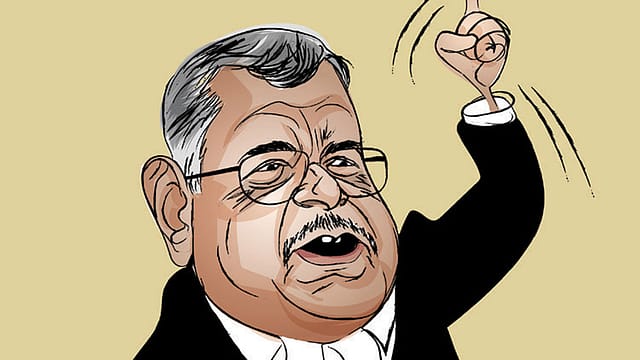
LET ME BEGIN WITH a confession. When someone told me that the Solicitor General of India—who has argued some of the most consequential cases before the Supreme Court and defended the state in matters that will shape the constitutional future for generations—had written not one but two books about courtroom humour, my first reaction was disbelief. After reading them, I can report with considerable admiration that Tushar Mehta has done something genuinely rare in Indian public life: he has been funny on purpose and it has worked. That is far harder than it sounds. India produces lawyers by the millions and prose stylists by the dozen, but the combination is sufficiently exotic that it deserves not merely a book review but a standing ovation.
The Lawful and the Awful: Quirky Tales from the World of Law (Rupa Publications, 336 pages, Rs995) focuses on moments from courts across the world where the solemnity of law gave way to the unexpected—a deliberate departure from the usual pedantic recital of legal statutes and critiques of judgments, offering instead a study of the human element of law, populated as it is by judges with their own quirks, eccentricities and personal failings. Its companion volume, The Bench, the Bar and the Bizarre: The Unfamiliar, the Curious, and the Extraordinary in Law (Rupa Publications, 328 pages, `995) is, if anything, even more gleefully unhinged—a fascinating blend of wit, absurdity and insight drawn from unconventional judicial behaviour and cases that stretch imagination, capturing the unpredictable human side of law. Together, the two books constitute something I would call the most entertaining double-act in recent Indian legal publishing.
In The Lawful and the Awful, Mehta takes the reader into the lesser-known corners of the legal world, where personality presses against principle and the law reveals a side of itself rarely seen—recounting judges who brandished loaded pistols inside courtrooms, penned poetry instead of judgments, or pronounced sentences from improbable places, as well as the sharp wit and wisdom of the inimitable Justice Scalia, and memorable instances of the British art of courtroom humour. I want to pause here to note what a formidable sentence that is to unpack: pistol-wielding judges. Poetic verdicts. Scalia. British wit. In lesser hands this would be a listicle. In Mehta’s, it becomes a meditation on what the law actually is when no one is performing its sanctity for an audience.
The book is prefaced with a declaration from Mehta that it punctures the pomposity, intellectual arrogance and scholarly hypocrisy that often afflict the legal profession. Now, I have known pomposity in all its variations—in Delhi drawing rooms, in television green rooms, in the corridors of South Block—and I can confirm that the legal profession has historically held its own in that particular sweepstakes. Mehta, to his enormous credit, knows this. He knows it because he has spent four decades inside the temple, and the insider’s eye is always the sharpest instrument for demolition.
But here is where we must address the elephant in the courtroom. Mehta consciously keeps Indian courts, judges, and legal incidents out of both books, because he continues to practise before those very courts, candidly admitting this was in the interest of professional self-preservation. This makes the books so deliciously readable— completely honest about what they are doing. Mehta is not pretending neutrality. He is cheerfully announcing his conflict of interest and then proceeding with extraordinary élan to be devastating about everyone else’s judiciary.

This enables Mehta to simultaneously offer a spectator’s detached view of justice administration. By choosing to write about foreign courts, about American judges and English barristers and the occasionally deranged proceedings of legal systems from continents where he has no skin in the game, Mehta has given himself the freedom to say what he presumably thinks about courts in general—about the vanity of judges, about the theatre of advocacy, about the gap between what the law claims to be and what it demonstrably is—without triggering a contempt notice before breakfast.
I call this the masterstroke of the books. The ostensible subject is foreign legal absurdity. The actual subject is the universal human comedy of institutional power. Anyone who has sat in any courtroom in any country—and I have sat in a few, though mercifully never in the dock—will recognise that the anecdotes Mehta serves up are not quirks of the American or British experience. They are mirrors. They are mirrors held up to the species of homo juridicus everywhere, including on the banks of the Yamuna.
The Chief Justice of India, Justice Surya Kant, who recently presided over the book launch, put it rather well when he observed that reading these two books back-to-back is like bingeing a courtroom drama that accidentally wandered into a stand-up special—wondering who could have guessed that dusty case files, legal jargon, and solemn judicial proceedings could turn into fodder for hilarity. Coming from the country’s highest judicial officer, this is not merely a compliment. It is institutional permission to laugh—and in India, that is rarer and more precious than any reported judgment.
What makes Mehta particularly good is his anecdotal precision. The best raconteurs understand that the anecdote is not decoration. The anecdote is the argument. Mehta has clearly understood this. He does not use a story to illustrate a point; he builds the point from the story, which is the classical method and the correct one. Written with wit, measured sarcasm, and the practised eye of a courtroom insider, these essays do not seek either to scandalise or to sermonise. That restraint and the decision not to preach are what separate good humour from smug satire.
There is also something quietly revealing about Mehta the man in these pages. He noted at the launch that while he is well known for not quoting foreign laws or cases in court, he has chosen precisely that subject for his books—an irony he acknowledges openly. This kind of meta-commentary tells you something about the private intellectual life of a man who is, in his professional avatar, one of the most formidable litigators this country has produced. There is a Tushar Mehta who argues Article 370 and sedition law before nine-judge benches. And there is a Tushar Mehta who apparently spends his off-hours collecting stories about a judge who delivered a verdict while out hunting. I find the second man as interesting as the first.
As Home Minister Amit Shah noted at the launch, the books highlight the unique styles and original approaches of several judges, recount incidents such as twin sisters in a country where one became a lawyer and the other a judge and played with each other’s roles, and an instance where a judge delivered a verdict while out hunting—accounts that compel us to think while also providing relief from the otherwise serious atmosphere of the courts.
And that, ultimately, is the quality that rescues both books from being merely clever. They are, beneath their considerable wit, quite serious about the proposition that justice is administered by human beings, not by institutions, and that human beings are fundamentally comic creatures. The judge who pulls out a pistol is not a freak. He is merely a judge who has momentarily stopped pretending. The barrister who loses control in cross-examination is not an aberration. He is Everyman in a wig.
My one lament is that the India chapter of this taxonomy remains unwritten. Mehta’s decision to exclude Indian courts is entirely rational. It is also an act of magnificent cowardice dressed up as professional prudence. The stories that exist within living memory of the Indian Supreme Court and the various high courts—the wit and the eccentricity and the occasional outright theatre—would fill not two but twenty volumes.
Mehta has written two books that, in making you laugh, will make you think. In 2026, when the Indian judiciary faces challenges that would have seemed fantastical even a decade ago—the intersection of artificial intelligence with jurisprudence, the democratisation of access to justice, the question of what courts are actually for in a digital republic—that ability to step back, to see the comedy in the tragedy and the humanity in the institution may be exactly the corrective lens we need.
Bravo, Mr Solicitor General. Now please, for the love of the Constitution, write the Indian edition.