For Art’s Sake: Why are they India’s most influential cultural entrepreneurs?
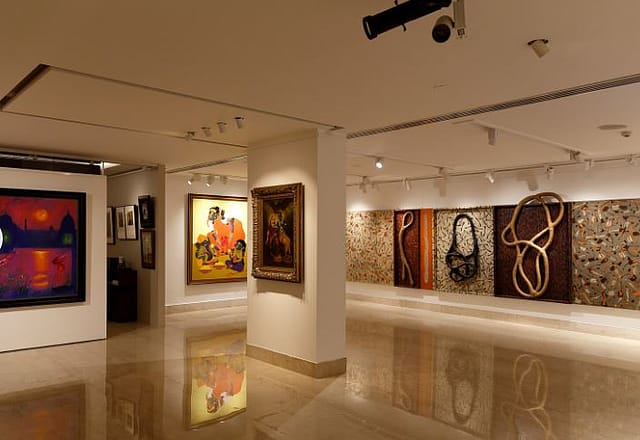
LET ME SAY something that needs to be said without qualification or caveat: Minal and Dinesh Vazirani have done more for Indian art than almost any government ministry, cultural policy, or institutional behemoth that routinely congratulates itself at black-tie dinners for doing precisely nothing.
Saffronart, the platform they built from conviction and courage rather than committee consensus, has changed the landscape of Indian art—democratised it, globalised it, and given it a dignity that the market had long denied it.
I have known enough people in this country who talk about India’s cultural renaissance with the enthusiasm of someone who’s just discovered chai. The Vaziranis didn’t talk. They built. And in building, they changed the conversation entirely.
Saffronart arrived at a moment when Indian art was either being hoarded in the drawing rooms of old money or being dismissed by international auction houses as a niche curiosity. Minal and Dinesh saw what others couldn’t or wouldn’t. They saw a civilisational asset that was being chronically undervalued. They understood that Husain and Souza and Raza weren’t just artists; they were chapters in a larger story of post-Independence identity, and that story deserved a global stage. Saffronart gave it exactly that.
What makes their achievement remarkable isn’t just the platform: through the platform, pioneering online auctions for Indian art at a time when most of the art world was still wedded to the paddle and the gavel, was visionary in itself. What makes it remarkable is the ecosystem they created around it. The scholarship. The archiving. The rigorous provenance research. The commitment to making serious art accessible to serious collectors who didn’t necessarily have old family connections or gallery relationships. They brought transparency to a world that had historically thrived on opacity, and they did it with a grace that never once felt like disruption, for disruption’s sake.
And then there is the Annual London Summer Soirée which is, if you haven’t attended, your loss, and one that should embarrass you into making amends immediately. This is not another evening of warm Prosecco and hollow networking. This is a curated, immersive celebration of what Indian art means today: its range, its ambition, its capacity to surprise even those of us who think we know it well. The Summer Soirée is Saffronart distilled into an evening: intelligent, aesthetically impeccable, warm in the way that only genuine hospitality can be, and animated by a curatorial sensibility that is entirely Minal’s own.
Minal Vazirani is, and I say this without the slightest hyperbole, one of the finest curatorial minds in the Indian art world today. She has an eye that is simultaneously disciplined and instinctive: the rarest of combinations. She doesn’t just select works; she creates a conversation between them. At the Summer Soirée, that conversation fills a room, and it lingers long after the evening ends. Dinesh, for his part, brings to the enterprise a strategic clarity and a commercial integrity that have made Saffronart not just culturally significant but genuinely trustworthy: a word that is harder to earn in this business than most people admit.
Together, they have made something extraordinary. In an age where cultural entrepreneurship in India is often a euphemism for branding exercises dressed in khadi, Saffronart is the real thing. It is a platform built on scholarship, sustained by passion, and elevated by an unshakeable belief that Indian art is world art and not regional, not ethnic, not a subcategory, but a full and equal participant in the global conversation about beauty, identity, and what it means to be human.
I left the Summer Soirée this year the way one leaves the best evenings: slightly reluctant to step back into the ordinary world, and deeply grateful that people like Minal and Dinesh Vazirani exist. India is richer culturally, intellectually, and yes, financially because of what they have built. And they built it without waiting for permission.
That, in the end, is what separates the truly consequential from the merely celebrated.