Cry, the Beloved City: Religiosity alone cannot save Amritsar
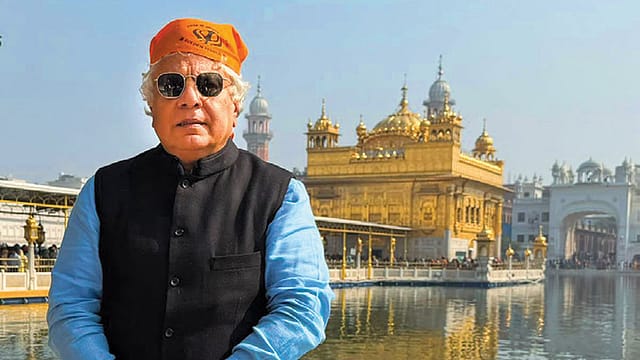
I GO TO AMRITSAR every year to savour the serenity of the Golden Temple, and to see the kind of calmness it exudes.
Over the last few decades, I have only seen Amritsar in decline. Many years ago, I was a contributor to the setting up of the Partition Museum there. People in Amritsar during Partition felt the pain but lived their life with purpose, ingenuity, fortitude, grit and determination. And that is what Amritsar is all about.
Many refer to it as Guru di Nigri, which basically is where the Gurus reside. The Golden Temple has not just been a symbol of the absolute truth of Sikhism, which is Ek Onkar, in other words, one universe, but is also a testament to the indomitable human spirit.
I remember when we were children, we used to come to Amritsar every year from Calcutta, during both summer and winter, and I recall the time when preparations were being made in 1984 for Operation Blue Star, and how the city recoiled and felt the absolute pain of the storming of the Golden Temple.
But a lot has been written on that, both favouring
and disfavouring the storming, and I don’t want
to go into it, except to say the anguish was borne by every person in Amritsar, regardless of whether he was Sikh, Hindu or Muslim, because that is what the Golden Temple is all about. It is the citadel of secularism and the epitome of seva. And the Golden Temple to this day remains exactly that. It

Global By Design
29 May 2026 - Vol 04 | Issue 73
Is the future of fashion Indian?
remains a symbol of the spirit that is truly Indian.
So why has the city come to this level of decline? Because the politicians of Punjab in successive governments have done very little for Amritsar. Industry in Amritsar died several years ago. At one time, Amritsar produced woollens and blankets, dry fruit was traded, and the markets were brimming. All of that has been replaced by tourism, not high-value tourism but patchy tourism where people are more into spiritual tourism than anything else, and the fleeting few make that trip to Wagah.
That apart, Amritsar has been left to its own devices, which is what makes matters sadder. Not one government in Punjab, or for that matter any government at the Centre, has taken care to preserve both the historicity as well as the spirit of Amritsar.
And that is Amritsar’s enduring tragedy. It is almost a child in perpetual neglect, with no one wanting to hold out a hand of hope or provide succour which Amritsar desperately needs. One doesn’t really know where it’s headed. When I was in Amritsar earlier this week talking to people, I was told that the young are fleeing, and it was reminiscent of Bengal during the communists’ reign. At that time, Bengal had an exodus of the young because they saw no opportunities that they could explore in Bengal.
Today, Amritsar is witnessing the same exodus
and the same level of decline. I would appeal to governments both in the state and at the Centre to save the city of the Golden Temple from such neglect. It’s not as if religiosity alone can solve the problems that Amritsar faces. It needs better development, it needs to be a cleaner city. Sewage remains an enduring problem. And no one seems to be able to do anything about it. There is no resolve and there is no outcry.
You see the emptiness of Amritsar in such a
stark manner that you begin to think that this is the city which in many ways offers hope to the world, and yet is hopeless in its heart.