What Is CEPA? Inside India and South Korea’s Plan to Fix $27 Billion Trade Gap
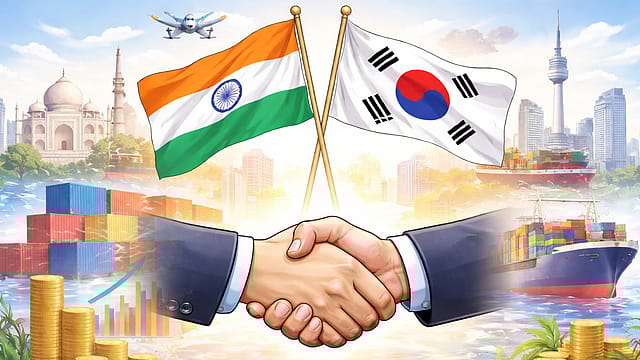
India and South Korea have decided to resume and accelerate negotiations to upgrade their Comprehensive Economic Partnership Agreement (CEPA), signalling a renewed push to unlock untapped trade potential between the two economies.
The decision came during South Korean President Lee Jae Myung’s visit to India, where he held talks with Prime Minister Narendra Modi. Both sides are now looking beyond traditional trade to expand cooperation into emerging sectors such as digital trade, supply chains, and the green economy.
The broader goal is to make bilateral trade more balanced and future-ready, while also strengthening investment flows and economic collaboration.
What is the problem with the current CEPA?
The existing CEPA, which came into force in 2010, has led to significant trade growth—but not evenly for both sides.
As Ministry of External Affairs Secretary (East) P Kumaran explained, “The CEPA, as you know came into force in 2010. The bilateral trade is close to 27 billion. But it is quite unbalanced in the sense that our exports are in the range of about six and a half billion, while Korea's is about 18 and a half billion.”
This imbalance has become a key concern for India, prompting calls for recalibration of the agreement to ensure more equitable benefits.

Open Minds 2026
26 Jun 2026 - Vol 05 | Issue 26
The power of ideas and arguments in 50 portraits
How do both countries plan to fix the imbalance?
The focus of the upgraded CEPA will be to increase India’s exports and address structural barriers that limit trade.
Kumaran highlighted the approach, saying, “So, there is a need to rebalance the CPA, try and find ways to increase our exports to match that of Korean exports. Non-tariff barriers are also a subject, as you expect in all left field negotiations, because it is CEPA, they're also looking at enhancing investment, finding ways to facilitate investment and also enhance services exports from India, an area of particular strength for us.”
This suggests that negotiations will go beyond tariffs and include regulatory hurdles, investment rules, and services trade—areas where India has competitive advantages.
What role will investment and financial cooperation play?
Beyond trade, both countries are also deepening financial cooperation as part of their broader economic partnership.
The two leaders welcomed the successful holding of the ‘ROK-India Financial Cooperation Forum,’ which brought together financial authorities and institutions from both countries. The aim is to strengthen ties in banking, capital markets, and fintech.
South Korean financial institutions are already playing a notable role in India’s growth story, particularly in infrastructure and manufacturing investments.
“In this context, the two leaders noted the successful operation in India by the Korea Investment Corporation, and welcomed the interest of Korea Development Bank to open an office in India. Prime Minister Modi also invited the National Pension Service of the ROK to explore opening of its office in India,” the statement said.
What about skills and development cooperation?
The partnership is also expanding into development cooperation, especially in building skilled industrial human resources in India.
Both countries acknowledged the potential of ongoing projects, including those implemented by the Korea International Cooperation Agency (KOICA), and agreed to deepen collaboration in capacity-building initiatives.
This reflects a shift toward long-term economic partnership, rather than just transactional trade ties.
Why does this matter now?
The decision to fast-track CEPA upgrades comes at a time when global trade is being reshaped by supply chain disruptions, digital transformation, and sustainability goals.
By modernising their trade agreement, India and South Korea are attempting to stay competitive, reduce dependency risks, and create new growth avenues.
If successful, the upgraded CEPA could significantly boost trade volumes, correct imbalances, and position both countries as stronger economic partners in the Indo-Pacific region.
(With inputs from ANI)