#UNTOLD | The Cockroach, the ₹2,500 Room & Why Nobody Would LISSUN
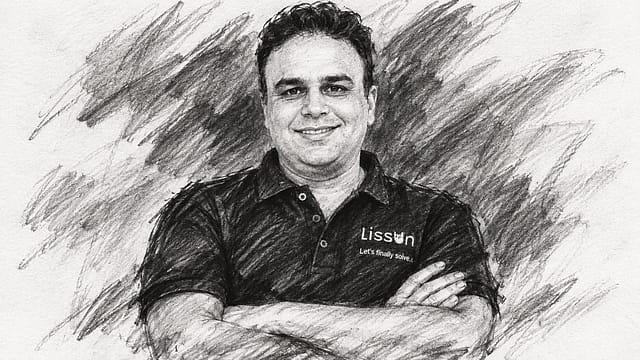
SAKI NAKA, MUMBAI. SEVEN MONTHS IN.
The cockroach is climbing.
Halfway up the damp wall, it freezes. Its antennae twitch, sweeping the peeling paint like a health inspector who has seen worse rooms than this—and expects to see worse still.
From the edge of an unfamiliar mattress, Krishna Veer Singh watches it go.
The room costs ₹2,500 a night. Through the open bathroom door, a scarred plastic bucket sits beneath a dripping tap. Outside, the relentless hum of Andheri East refuses to die down. Inside, the ceiling fan clicks on every third rotation.
There is nothing wrong with a bucket. Krishna knows that. Growing up in Uttar Pradesh, he bathed out of one every morning. Millions of Indians still do. Nobody cheated him tonight; he paid ₹2,500 and got ₹2,500 worth of shelter. To call this "suffering" would be an insult to the country he grew up in.

The Wealth Issue 2026
06 Nov 2026 - Vol 05 | Issue 45
Portraits of Dreamers and Doers under 35
The problem isn't Saki Naka. The problem is twelve kilometres away, in Bandra Kurla Complex.
The Trident.
Only a few years ago, that was his Mumbai address. As Uber’s regional general manager for Maharashtra, Madhya Pradesh, and Gujarat, Krishna moved through the country on corporate expense accounts—chauffeur pickups, business-class boarding passes, and high-floor suites where someone else worried about the plumbing. Somewhere in his wallet—or buried in the apps on his phone—are still the digital ghosts of his Taj InnerCircle and Hyatt loyalty tiers.
The man who checked into the Trident was paid to make decisions that moved entire cities.
The man in Saki Naka spent his afternoon begging receptionists for five minutes of a doctor's time.
He is forty-one. IIT Delhi. A PhD from California. IIM Ahmedabad. Intel. Flipkart. Uber. Twenty years of relentless, upward-mobility pedigree have delivered him to this mattress, staring at a bug.
What the f*** am I doing?
The cockroach inches higher.
Krishna has been asking himself that question for months. He and his co-founder, Tarun Gupta, built LISSUN on a premise that looked bulletproof on a pitch deck: India was facing a silent mental-health crisis, and people needed structured, accessible care. Former bosses and colleagues believed in Krishna enough to wire their own savings into the seed round.
But Krishna was learning a brutal startup truth: being right about a problem does not mean anyone will pay for the cure.
Direct consumers were hesitant. So Krishna pivoted to B2B, knocking on the doors of hospitals and fertility clinics. And that is how a former Uber GM became an expert on waiting rooms.
Plastic chairs. Steel chairs. Cushioned chairs with worn armrests.
He would arrive at 10:00 AM for a scheduled meeting. By noon, patients were still filing past him into the doctor’s cabin. By 3:00 PM, his lunch was cold and his phone battery was red. Sometimes, at 5:30 PM, a junior administrator would finally step out to tell him the clinic didn't need what he was selling.
It took four months to close their first IVF clinic account. Four months of fluorescent lights and plastic chairs.
Back in Saki Naka, the cockroach reaches the ceiling molding.
Krishna could end this tomorrow. One phone call, one updated LinkedIn status, and his credentials would buy him back his old life—the salary, the flights, the Trident.
Except the money keeping LISSUN alive isn't anonymous venture capital. It has faces. It has names. His old managers from Uber. Engineers he worked alongside at Intel in Oregon. People who bet on Krishna Veer Singh before there was a product to bet on.
They had said yes. He had taken their money. You cannot un-take a yes.
And then there was Kanika.
A psychologist herself, his wife knew what forty-one meant. If he didn't take the leap now, mortgages and school fees would lock the golden handcuffs forever. "Karna hai toh abhi karlo," she had told him. If you’re going to do it, do it now.
She had backed his dream without flinching. Now, she and their children were living inside its fallout. For eighteen months, the family hadn't boarded a single flight. Krishna knew how privileged that sounded—complaining about economy seats while sitting in a budget hotel—yet it felt like watching a twenty-year edifice dissolve brick by brick.
In the quiet of the ₹2,500 room, Krishna realizes he has nobody left to pitch. No investor. No clinic director. Just himself.
And behind it all—the real reason he can't walk away—is a little boy in Bengaluru. A child struggling to find his words, and a father who had built safety systems for millions of strangers across South Asia, yet couldn't navigate the maze to find a single speech therapist for his own son.
THE POLICEMAN’S SON... UTTAR PRADESH, 1986
A ribbon is pinned to a khaki uniform.
The medal is for honesty and distinguished service—a piece of metal that, in the rough-and-tumble reality of 1980s Uttar Pradesh, is almost a contradiction in terms.
"UP Police mein aise generally nahin hota," Krishna says decades later, his voice carrying the quiet pride of a son who remembers what it cost his father to keep that uniform clean. (Such things don't generally happen in the UP Police.)
Growing up in police quarters across Agra, Vrindavan, and Lucknow, young Krishna watched his father walk a daily tightrope. It was the era of Mandal and Kamandal, when caste and religious fault lines were tearing North India apart. In that pressure cooker, an honest officer didn't get rewarded with plush postings; he got transferred.
From his father, Krishna inherited two things that would define him in that Saki Naka hotel room thirty-five years later.
The first was an obsession with education as the only bulletproof exit ramp. Crack the exam. Get the rank. Enter the gate. In 1998, Krishna walked into IIT Delhi to study chemical engineering.
The second was his name—and the quiet surrender baked into it. Devoted to Vrindavan’s Bankey Bihari, his father had named him Krishna, raising him on a simple, stubborn philosophy: do your best, and leave the rest to Him.
By 2003, Krishna was ten thousand miles from UP, inside a nanotechnology lab at the University of California, Riverside.
If policing taught him integrity, a PhD taught him how to bleed slowly. In nanotech, you can spend six weeks calibrating an experiment only to watch it fail on a Tuesday afternoon. You cannot bluff a microscope; you cannot charm a thesis into existence. Krishna endured four years of invisible, granular grind—emerging with eleven research papers, three patents, an IBM internship in New York, and a coveted R&D role at Intel in Hillsboro, Oregon.
America laid out the red carpet. A Green Card was his for the taking.
He walked away from it. As an only son, the pull of aging parents in India was stronger than Silicon Valley. He came home, added an IIM Ahmedabad MBA to his war chest, and began collecting corporate crowns: Ericsson, Flipkart, and finally, Uber.
At Flipkart and Uber, Krishna became the guy they called when scale got messy. He built trust and safety architectures across India, Sri Lanka, and Bangladesh—designing systems to protect millions of riders and drivers when things went wrong in the dark.
He knew how to fix broken systems.
What he didn't know was how blind he had been to one hiding in plain sight.
Back in his Agra childhood, there was a word everyone threw around like loose change: pagal. Agra housed one of North India’s oldest mental asylums, and cousins teased each other with the word before they even knew what it meant. In India, Krishna realized much later, mental health didn't exist until someone was broken beyond repair. Until then, you simply didn't talk about it.
For forty years, it was someone else's problem.
Until his son, Shauryaveer, began growing up in Bengaluru—and the words refused to come.
THE BOY WHO COULDN’T FIND HIS WORDS
BELLANDUR, BENGALURU. 2015
The word is somewhere inside Shauryaveer Singh.
His parents are waiting for it.
He is three years old. Across apartment balconies and playparks in Bellandur, other children are turning words into demands, questions, arguments. They are discovering that language is a universal skeleton key—if you use enough of it, you can get almost anything.
Shauryaveer is taking longer.
At first, a delay is easy to rationalize. Children run on their own internal clocks. Someone in the family always knows a cousin who didn't speak a syllable until four and now refuses to shut up. It’s a phase. A quirky variation.
Then preschool begins.
The invisible barrier follows him through the gates. Teachers notice what home life forgives. In a classroom, a child is expected to sit, listen, decode signals, and make himself understood. When he can't, frustration becomes behavior.
Krishna knows how to handle corporate friction. Identify the bottleneck. Allocate capital. Establish a process. Measure the outcome.
This is his son. There is no dashboard. There are no metrics. Kanika, his wife, is a psychologist. She understands human minds well enough to know that passive waiting is not a strategy. They arrange assessments.
The heavy, unnameable question hanging over the household is autism.
When the test results finally arrive, they bring an immense wave of relief: Shauryaveer is not on the spectrum.
But the speech delay remains entirely intact.
A medical clearance has answered a fear, but it hasn’t produced a therapist.
Now begins the labyrinth.
Bellandur is a monument to modern Bengaluru convenience. It is a gleaming landscape of glass-fronted tech parks, high-rise gated communities, artisanal coffee shops, and hyper-local delivery apps. If you need groceries, an app brings them to your lobby in ten minutes. If you need a cab, a tap summons a sedan to your curb.
Krishna has spent the last decade building and scaling that exact frictionless economy. He knows what technology is capable of.
Yet, try to find a qualified pediatric speech therapist close to home, and the digital facade vanishes.
There are options, of course. Across town. In Jayanagar. Or deeper into the city's infamous gridlock.
The obstacle isn't that help doesn't exist; it's the geography of getting there. Anyone who has lived in Bengaluru knows how a ten-kilometre journey can swallow half a day. For a corporate executive rushing to a meeting, traffic is an irritation. For a three-year-old child who requires consistent, repetitive neural stimulation, the commute becomes a toxic tax on the treatment itself.
The calculation is brutal: There is the hour-long drive through exhaust fumes, the therapy session, the crawl back, the school schedule, and the parent's working day. How many times a week can a family run that gauntlet before everyone breaks?
Somewhere in the arithmetic of urban gridlock is a little boy who just wants to say what he's thinking.
Krishna's entire professional life is built around fixing access.
At Flipkart, he works on trust and safety architecture. At Uber, he will soon oversee driver and rider safety across India, Sri Lanka, and Bangladesh—designing systems that must function flawlessly for millions of strangers under wildly unpredictable conditions.
He can optimize safety protocols for a midnight ride in Dhaka.
He cannot easily secure a weekly speech therapy slot for his son in southeast Bengaluru.
The irony is sharp enough to draw blood.
It forces him to look at his career through a completely different lens. He had returned from America believing the hardest part of life was choosing the right corporate crest. He wanted to be closer to his parents in Uttar Pradesh and Kanika’s family in Jaipur. He was an only son; the distance had worn thin.
Now, his own child is flashing a warning light.
There are professional reasons to pull up stakes and move north. But the real weight tipping the scale is Shauryaveer.
Years later, looking back at the sudden pivot away from Flipkart, Krishna will strip away all corporate spin.
“One of the bigger reasons to move so early from Flipkart,” he admits quietly, “was my son.”
The boy's struggle has quietly altered the DNA of the father's decisions.
He doesn't yet know how far that alteration will take him. For now, he is still a corporate animal. In 2016, he accepts an offer from Uber.
His mandate expands. He steps up to regional general manager, overseeing three massive states. The titles grow shinier. The hotel loyalty tiers upgrade. The compensation packages swell.
Shauryaveer grows older too.
Krishna spends his days inside companies that promise to solve human friction at scale. Yet every time he looks at his son, the memory of that Bengaluru maze returns. He has seen firsthand how a family's education, privilege, and resources can still leave them stranded when the medical infrastructure breaks down.
He has discovered the one truth no management degree at IIM or PhD in nanotechnology could ever teach him:
When the problem belongs to your child, you cannot hand it off to another department.
Years later, LISSUN will open physical centres across India where children between two and ten can walk in for developmental assessments, speech therapy, and occupational care.
But none of that exists yet.
Right now, there is only Bellandur, a father hunting for answers, and a quiet, nagging question that will follow him all the way to a budget hotel room in Saki Naka:
Why should finding someone to help a child speak be this hard?
THE CALL HE NEVER EXPECTED
2020. THE WORLD IS SHUTTING DOWN
For twenty years, Krishna Veer Singh has sat on the right side of the conference table.
He has hired people, built departments, signed off on multi-crore budgets, and made decisions that altered the trajectory of other people’s working lives. At Uber, only the India head sits above him. Three massive states fall under his command.
Then COVID arrives.
Overnight, the highways empty. The cabs stop moving. Cities bolt their doors. A company engineered around human motion suddenly finds itself staring at a world where nobody is allowed to go anywhere.
And then comes the call.
Krishna’s role is impacted.
There is no promotion to negotiate, no new market to capture, no operational fire he can put out by assembling a war room. For the first time in two decades, he is on the receiving end of a decision that rearranges his life.
He knows the corporate choreography of a layoff by heart; he has been in the room when similar calls were made about other people. Knowing the script does not soften the blow.
An old Hindi proverb from his childhood surfaces in the silence after the call ends: “Jaake pair na phati bivai, woh kya jaane peer parai.” (How can someone whose own feet have never cracked understand another person’s pain?)
Krishna had understood the words for years. Now, he understood the cracks.
The timing is merciless. His father’s health is fragile. Financial obligations nobody had scrutinized too closely suddenly demand attention. Two children are growing up fast. The fortress of corporate security Krishna spent twenty years building has vanished in a single quarter.
He should have been entering his most lucrative professional years. Instead, he is staring at a screen, confronting the arithmetic of earning nothing. School fees. Household burn. Family responsibilities. The years ahead.
Krishna has spent his entire career fluent in numbers—revenue targets, unit economics, operating margins. Now, the spreadsheet belongs to his own kitchen table, and there is no finance team to hand it off to.
Until that summer, Krishna had always been a vocal "supporter" of mental health. He endorsed the policies. He believed in the science. He encouraged others to seek help.
Then the armor cracked, and he needed help himself.
He begins therapy.
There is a jarring, humbling reversal in being the person forced to speak rather than the executive paid to provide answers. In a boardroom, Krishna listened to problems and issued directives. In therapy, there is no deck to review and no action plan to approve—only uncomfortable questions that refuse to be solved by a spreadsheet.
What happens to a man when the career he thought he controlled evaporates? How much of his self-worth was quietly glued to the title on his visiting card? And what do you tell yourself when the next rung on the ladder isn't there?
Years later, Krishna will strip away all corporate polish when describing those sessions.
“I went from being a supporter of mental health,” he says, “to a believer.”
Mental health was no longer an HR initiative or a macro trend. He knew, viscerally, what it felt like to sit in a room and need someone to simply listen.
Meanwhile, inside Uber’s own corridors, another man was arriving at the exact same crossroads.
His name was Tarun Gupta.
Raised in Shimla, Tarun had followed a eerily parallel arc: a stint in America, a return to India in 2010, an MBA from the Indian School of Business, consulting at ZS, scaling at OYO, and finally landing at Uber. Like Krishna, he had spent his thirties building other people’s empires. Like Krishna, he had quietly navigated his own battles with mental health.
When the two men began talking, their histories overlapped like tracing paper. America. India. Top business schools. Corner-office stress. The creeping realization that they were approaching forty with young families whose financial gravity would only grow heavier.
The corporate ladder has a deceptive trap: the higher you climb, the more expensive it becomes to jump off. Wait another five years, and the golden handcuffs become permanent.
If not now, when?
Their conversations kept circling back to the same raw nerve. Krishna had felt the stigma and isolation firsthand in therapy; he had lived the logistical nightmare of finding speech care for Shauryaveer in Bengaluru. Tarun had seen the exact same fracture lines from his own life. Other startups had tried to digitize therapy and failed, treating mental health like just another on-demand delivery app.
Krishna had spent his life scaling technology platforms across South Asia. Now, he wondered what would happen if he pointed that operational firepower at a problem that had broken his own heart.
“Why don’t we do this?”
Five simple words. Neither man fully grasped the price tag attached to them.
They were men in their early forties, trading pedigree and predictability for a blank sheet of paper. Yet COVID had already taught Krishna the ultimate lesson: a "safe" corporate job is an illusion. And his son had taught him that the problems closest to home won't solve themselves.
They named the company LISSUN.
It sounded less like a brand and more like a quiet plea.
And as Krishna would soon discover from the edge of a ₹2,500 hotel bed in Saki Naka, getting the world to obey that instruction would be the hardest fight of his life.
FOUR MONTHS OF CHAIRS
2021. THE FIRST CUSTOMERS
The earliest cheques don't come from Sand Hill Road or Bengaluru venture funds. They come from people who have shared conference rooms with Krishna Veer Singh.
Former bosses at Uber. Engineers from his Intel days in Oregon. Friends who watched him build empires for other people and decided to bet their own savings that he could finally build one for himself.
One former manager wires so much money into the seed round that Krishna can't resist teasing him on the phone:
“इतना पैसा तो आपने कभी सैलरी में भी नहीं दिया था। (You never gave me this much money even as salary.)”
They laugh. Then the phone hangs up, and the clock starts ticking.
Krishna and Tarun have roughly six months of runway—just enough oxygen to build a platform, onboard therapists, and prove people will pay. On paper, the thesis is effortless. The pandemic has cracked India’s collective psyche wide open; demand is everywhere.
Within ninety days, reality dismantles the pitch deck.
Indians know they are hurting. They simply refuse to pull out a credit card for it. Some don't recognize the symptoms; others fear the social death of being seen walking into a clinic.
Institutional investors are even blunter. Krishna pitches nearly 80 percent of the Indian VC ecosystem, and the rejection starts sounding like a pre-recorded loop:
“मेंटल हेल्थ में बड़ा बिजनेस नहीं बनेगा।”(You cannot build a big business in mental health.)
Doors slam shut across Bengaluru, Mumbai, and Delhi. Then, one investor tosses out a stray suggestion that changes the company's DNA: Look at IVF.
Krishna and Tarun dig into fertility clinics. They find patients enduring brutal psychological stress while already spending lakhs on medical procedures. Instead of asking someone to buy therapy in isolation, what if mental health came bundled inside the medical journey?
The founders pivot to B2B—and enter purgatory.
For four straight months, a former IIT-IIM-Uber executive becomes a permanent fixture in clinic waiting rooms. Morning appointments stretch into afternoon silence. Receptionists avoid eye contact. Sometimes, after eight hours on a plastic chair, a junior administrator steps out to deliver a polite no.
It takes four months to close their very first IVF account.
In those waiting rooms, Krishna cracks the code on Indian healthcare psychology. A patient already paying ₹1,00,000 for fertility treatment won't blink at adding ₹5,000 for five sessions of emotional support—whereas selling that same ₹5,000 package standalone is nearly impossible.
Krishna has a blunt name for what LISSUN had to become to survive:
“We were icing on the cake. We were never the cake.”
Once the Trojan horse works, LISSUN embeds itself into maternity wards, dialysis units, oncology clinics, and elder care. They hire full-time clinicians and bring on Dr. Preeti Singh as Chief Medical Officer to write strict clinical protocols. Having spent twenty years as the guy calling the shots, Krishna makes a crucial vow: when Dr. Preeti draws a medical line, the business guys do not cross it.
Eventually, IvyCap Ventures steps up to lead a pre-seed round of roughly ₹7 crore. Even victory comes in slow motion. A term sheet arrives, followed by weeks of agonizing silence while legal paperwork drags on and bank balances dwindle.
“प्रॉमिस हो गया, टर्म शीट आ गई है, पैसा नहीं आया है,” Krishna remembers of that purgatory. (The promise has been made, the term sheet is here—the money hasn't arrived.)
By March 2022, six months after launch, the dam finally breaks. Clinics are signing. Revenue is moving.
The founders have pried open the first locked door. They have no idea that the real business is still hiding behind the next one.
THE CHILDREN CHANGED EVERYTHING
2023. A DIFFERENT KIND OF WAITING ROOM.
A toddler is old enough to speak, yet the house remains quiet. Another hasn't taken his first steps. A third cannot sit still through a twenty-minute preschool lesson.
A parent notices. A teacher pulls a mother aside after class. A paediatrician suggests an evaluation. And between that first whisper of worry and finding actual help, precious months vanish into thin air.
Krishna doesn't need a market-research report to understand that panic. He lived it in Bellandur with Shauryaveer.
When LISSUN begins partnering with paediatricians, the founders notice an immediate, dramatic shift in human behavior. Adults will endlessly postpone their own therapy, rationalizing away anxiety and burnout for years.
Parents will move mountains for their child tomorrow morning.
When a child misses a milestone, the problem is visible—and the urgency is absolute. Yet a single psychologist isn't enough. A struggling child needs an orchestra: a speech therapist, an occupational therapist, a special educator, all working off the same sheet music.
Krishna and Tarun overhaul the company again, launching dedicated child development centres under a new banner: Sunshine by LISSUN.
Children aged two to ten walk through the doors for comprehensive assessments and structured care. Some carry neurodevelopmental diagnoses; others simply have developmental delays that need early intervention—not a permanent label. Krishna is fiercely protective of that distinction. He knows how heavy a careless label feels when you are the parent hearing it.
Even as LISSUN expands into Kota in 2023—deploying therapists into the high-pressure hostels of Unacademy, PhysicsWallah, and Resonance—an unmistakable tectonic shift is underway inside the company's numbers.
At first, 65 percent of LISSUN’s revenue came from adults, and 35 percent from children.
By 2026, that ratio has flipped on its head: more than 90 percent of the business comes from pediatric developmental care.
The startup that began by trying to sell therapy to stressed adults had found its true calling helping children who were often too young to articulate what they needed.
For Krishna, watching parents walk into Sunshine centres carries an eerie, full-circle symmetry. Years earlier, he and Kanika had burned hours in Bengaluru traffic hunting for a single therapist for Shauryaveer. Now, he was building the exact infrastructure he had once prayed existed.
The business had travelled miles from its original pitch. So had the father.
Yet in startups, solving one crisis only buys you a ticket to a bigger one. The same investors who once doubted mental health could scale were now demanding exponential growth. The zeros on the balance sheet were larger—and so was the penalty for missing a target.
THE FOURTH SALE
OCTOBER 2026.
Krishna Veer Singh has a stark way of dissecting a founder's life.
An entrepreneur, he says, spends every waking hour making three relentless sales. First, you sell a vision to investors. Second, you sell a product to skeptical customers. Third, you sell a dream to prospective hires—asking them to take stock options because you cannot match corporate salaries.
Then comes the fourth sale. The hardest one of all.
“You are selling your life story to your family.”
Krishna knows every rupee and every missed weekend that transaction has cost. Krishna and Tarun had walked away from senior corporate careers just as two decades of experience were beginning to command their highest price. Instead of harvesting the rewards, they burned through savings, grounded family vacations, and swallowed the humiliation of budget hotels and silent waiting rooms.
And with every new funding round, the invisible weight on Krishna's shoulders grows heavier.
Today, LISSUN has raised roughly ₹85 crore and crossed into Series A territory, doubling its revenue year after year. What the company once fought tooth and nail to earn in an entire month, it now generates in three hours.
Yet the pressure never evaporates; it simply scales.
“पहले हमें दो करोड़ मिलते थे। अब चालीस करोड़ मिले हैं, तो चालीस करोड़ की एक्सपेक्टेशन दो करोड़ वाली तो नहीं होगी ना,” Krishna says dryly. (Earlier we raised ₹2 crore. Now we’ve raised ₹40 crore—you can't expect ₹2 crore expectations on a ₹40 crore cheque.)
He still goes to therapy religiously, leaning on three distinct layers of personal support to keep his head clear. He has also stopped romanticizing startup life. When young professionals ask him if they should take the plunge, he tells them to ask themselves why—and keep asking that exact question every day for three months. If the answer is money, he tells them not to bother.
Because beneath the headlines and valuation milestones lies a quiet irony: people assume founders build companies to buy freedom.
In reality, Krishna points out, he cannot transfer even a single share of his own company to his wife without formal investor consent. He understands the governance behind it—and he understands the truth it exposes about the illusion of control.
The boy from Uttar Pradesh who grew up watching his police-officer father navigate rigid institutions has spent his entire life inside institutions of his own making. IIT. Intel. IIM. Flipkart. Uber. And now, LISSUN.
At 1:39 PM on October 26, 2026, sitting across from the machinery of the company he built from scratch, Krishna returns to the quiet anchor his father gave him alongside his name—the devotion to Vrindavan's Bankey Bihari:
“You do your best and leave the rest.”
He doesn't offer it as a LinkedIn platitude. He says it like a man who has finally learned what happens when you try to force every outcome by sheer willpower.
The ₹2,500 hotel room in Saki Naka is years behind him now. The bill is settled; the cockroach on the peeling wall is long gone.
Yet that sleepless night remains the hinge on which everything turned—the twelve-kilometre chasm between the Trident and the room he could afford, the humbling silence of waiting rooms, and the little boy in Bengaluru whose words took longer to arrive.
LISSUN started out as a clever name for a startup.
For Krishna Veer Singh, it turned out to be a personal instruction. A father had to stop and listen before his son could find his voice. And an executive, after twenty years of telling the world what to do, finally had to learn how to listen to himself.