Timex India's ₹359-Crore Quarter Makes a Case for the Analogue Watch
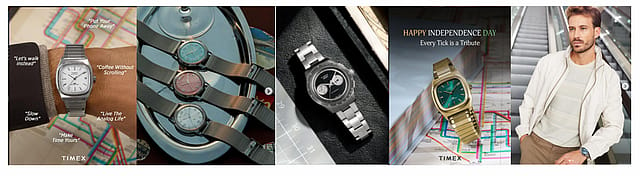
The obituary of the analogue watch was beginning to look rather convincing. The smartphone had taken over the business of telling time. The smartwatch went further, adding health tracking, notifications, calls and a growing list of functions to the wrist. Against these devices, a traditional watch, with its hands moving around a dial and little else to offer, seemed to belong to another era.
The industry, too, appeared to be moving in one direction. Smartwatches became the growth story, while traditional timepieces were increasingly associated with older consumers, formal occasions or collectors willing to pay for mechanical craftsmanship. But the latest numbers offer a reason to revisit that obituary.
Counterpoint Research estimates that India's smartwatch shipments declined nearly 20 per cent year-on-year in the second quarter of 2026. Longer replacement cycles and consumers becoming more discerning about reliability, design and differentiated features were among the reasons cited for the slowdown. The research firm also noted a gradual shift towards mid- and premium-priced smartwatches, suggesting that consumers are becoming more selective rather than simply buying more devices.

The Era of Forever Wars
30 Oct 2026 - Vol 05 | Issue 44
Coping with an explosive Middle East
This is not evidence that smartwatch buyers are abandoning connected devices for analogue watches. But it does challenge the assumption that the future of the wrist belongs exclusively to screens. And Timex Group India's latest quarterly results provide an interesting business counterpoint. The company reported total income of ₹359.17 crore in Q2 FY27, up 47 per cent year-on-year. EBITDA increased 52.6 per cent to ₹65.50 crore, while profit before tax rose 55.7 per cent to ₹63.34 crore. It was the company's highest-ever quarterly income in its 35-year history in India.
The question is no longer simply whether the analogue watch can survive. It is how a product that has lost its monopoly over timekeeping is finding new reasons to be bought.
The watch is no longer selling just the time
Timex's answer is to sell the watch as an expression of taste and identity. During the quarter, the company brought Tamannaah Bhatia on board as the brand ambassador for Guess Watches and Malaika Arora for Versace. It participated in Delhi Times Fashion Week and introduced a collaboration with Fender, the American musical-instrument maker.
The Fender partnership is particularly revealing. One of the special-edition watches borrows from the design language of the Stratocaster guitar, with a crown inspired by a tone knob and a second hand shaped like the instrument's headstock. Another uses a woodgrain dial and an automatic movement. The collaboration is aimed at consumers who may recognise the Fender name and its cultural associations, even if they are not necessarily watch enthusiasts.
It is a different proposition from that of a smartwatch. The latter has to demonstrate what it can do; a fashion-led analogue watch has to make someone want to wear it. The brand on the dial, the design, the celebrity associated with it and the cultural references it carries become part of the product.
The marketing bill is rising, and so are sales
This positioning comes at a cost. Timex Group India's advertising and sales promotion expenses increased 57.5 per cent to ₹25.75 crore in Q2 FY27, compared with ₹16.35 crore in the year-ago quarter. Royalty expenses also rose 47.3 per cent to ₹15.51 crore.
The increase in marketing expenditure is worth examining because it is not being accompanied by a deterioration in profitability. EBITDA rose faster than total income, and the EBITDA margin improved to 18.2 per cent from 17.6 per cent a year earlier. On the earnings call, managing director Deepak Chhabra said the company typically spends around 10-11 per cent of Timex brand revenue on marketing.
The brand numbers offer some indication of how the strategy is performing. Timex grew 67 per cent in the quarter, while Guess recorded 57 per cent growth. Both outpaced the company's overall growth of 47 per cent. The challenge now is to establish whether these campaigns are building lasting brand preference and repeat purchases, rather than simply generating short-term visibility.
From the first watch to the fashion watch
Timex is also trying to widen the market it can address. Its portfolio stretches from TMX watches priced below ₹2,000 to the core Timex range, fashion labels such as Guess, Nautica and Benetton, and luxury brands such as Versace and Ferragamo.
The company's biggest opportunity, according to Chhabra, lies in the ₹2,000-10,000 segment. The ₹2,000-5,000 range is growing faster than the ₹5,000-10,000 bracket, he said. This is an important part of the story because the analogue-watch revival is often discussed through luxury mechanical watches and collectors. Timex's growth strategy is rooted in a much wider consumer market.
The company is looking to sell watches as accessible fashion purchases, not merely as expensive objects to be collected. A buyer might want one for everyday use, another for a particular occasion and a third because of a brand or design they like. That creates the possibility of repeat purchases in a category where the basic function of the product has changed very little.
More stores, more watches and a bigger manufacturing bet
The ambition is being matched by a push to expand distribution. Timex's e-commerce channel grew 75 per cent in Q2, while traditional trade grew 34 per cent and exclusive retail expanded 48 per cent. The company currently operates around 44 exclusive stores and plans to take that number beyond 200 over the next three years through franchise-led expansion.
It is also preparing to manufacture at a larger scale. The Baddi facility, which produced around four million units last year, has increased its capacity to six million units in a single-shift operation. Timex is planning the infrastructure to eventually support capacity of 12 million units, with production expected to increase in stages.
The expansion is a bet on sustained demand, rather than a short-lived burst of interest in traditional watches. It also gives the company greater room to build its presence across price points and brands.
The obituary may have been premature
The smartwatch slowdown and Timex's growth are not necessarily two sides of the same consumer shift. There is no evidence yet that people who would have bought smartwatches are switching to analogue watches. The two can coexist: one serves a functional purpose, while the other can be an accessory, a fashion purchase or a marker of personal taste.
But that distinction may be precisely what gives the traditional watch room to grow. It no longer has to compete with a smartwatch on features. It can compete on design, brand, craftsmanship and the desire to own something that does not need to be upgraded every few years.
Timex's Q2 performance suggests that there is still a substantial business to be built around that proposition. The analogue watch may have lost the battle to be the most useful device on the wrist. It has not lost the ability to be the one people want to wear.