The Bet, The Long Game & Santosh Agarwal
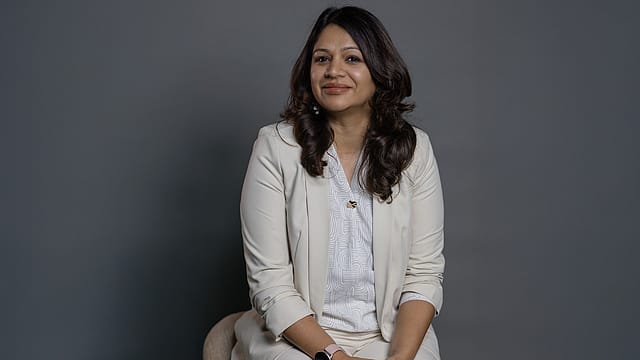
"Failing that person wasn't an option."
Santosh Agarwal doesn't say it for effect. She says it matter-of-factly, almost as if she's describing an ordinary day at work. Agarwal is talking about the moment Yashish Dahiya asked her to lead Paisabazaar.
"The moment he said it, I said okay. No questions asked."
No negotiation. No conditions. No, "Let me think about it." Just yes.
Most executives remember becoming CEO as the defining promotion of their careers. Agarwal remembers it differently. She remembers it as the moment someone placed extraordinary trust in her.
"I feel I owe so much to him in the person that I have become," she says.
The Identity Project
11 Sep 2026 - Vol 05 | Issue 37
Amit Shah leads the mission for a national demographic correction
When somebody trusts you blindly, she explains, it leaves you with an enormous sense of accountability.
"Failing that person wasn't an option."
It's a revealing choice of words. She doesn't describe the role as an opportunity. She doesn't see it as a reward. She doesn't even treat it as a challenge. To her, it’s a responsibility.
In March 2025, when Agarwal took charge of Paisabazaar, she wasn't walking into the business at its easiest moment. India's digital lending industry was entering a more demanding phase. Credit was tightening. Risk was back in focus. The assumptions that had powered years of rapid growth were beginning to change.
She knew all of that. She still didn't ask a single question. Why?
The answer lies far away from boardrooms, balance sheets and quarterly results.
It begins in a small garment shop in Darjeeling, where a little girl preferred counting the day's earnings with her father over playing with friends. Business wasn't an abstract idea. It was something you touched, counted and carried home every night.
Long before she learnt about lending, insurance or fintech, Agarwal had already begun learning how business really worked. Not from textbooks, but from customers.
Learning Business Before Learning Fintech
She grew up in Darjeeling, where her family ran garment stores. Childhood, as she remembers it, wasn't divided between school and play. It was divided between school and the shop.
"I was in the fifth standard," she recalls.
While most children came home from school and rushed out to play, Agarwal headed to the family business. The evenings ended beside her father, counting the day's earnings before they returned home. Business wasn't something she learnt from books. It unfolded across a shop counter every single day.
Those evenings taught her lessons that stayed with her long after she left Darjeeling. Business wasn't only about selling. It was about people.
The store stood in a town that welcomed tourists from across the country. Young Agarwal became fascinated by the way people spoke. She picked up Bengali, bits of Gujarati whatever she could learn. Not because anyone asked her to, but because speaking to customers in their own language made conversations easier.
"You can really make a connect," she says with a smile. She wasn't dreaming of becoming a CEO.
In fact, when I ask what she wanted to become as a child, she laughs before answering.
"I just wanted to earn a lot of money."
There is something wonderfully unpretentious about that answer. No rehearsed story about changing the world. No childhood vision of building a great company. Just the straightforward ambition of a girl who had watched business happen every evening across a shop counter.
Life, however, had other plans.
She studied zoology in Darjeeling before moving to Mumbai for an MBA. Her first job, in event management, paid the bills but never felt like home.
Financial services did.
When a common friend introduced her to a little-known startup called Policybazaar, she found herself drawn less by the company than by the audacity of the idea.
"Back then, people didn't really know Policybazaar," she says.
What excited her wasn't the brand—hardly anyone knew it then. It was the idea of building a place where people would willingly come online to buy insurance. She loved the energy. She loved the honesty. More than anything, she felt it was a place where she belonged.
She had no way of knowing then that she would stay for nearly fifteen years. Or that one day, the founder of that company would ask her to solve the biggest problem of her career.
Walking Into The Storm
If saying yes was easy, the first few weeks weren't.
Agarwal had spent nearly fifteen years inside PB Fintech. She understood digital distribution. She understood building businesses. She understood scale.
Credit was different.
"It wasn't an easy plunge," she says.
It was a new industry. She had to unlearn old assumptions even as she learnt a completely new business. The answers weren't waiting for her. She had to find them.
The timing couldn't have been more demanding.
India's unsecured lending market was slowing after years of extraordinary growth. Banks were becoming more selective. Regulators had tightened oversight. The easy momentum that had powered digital lending platforms was giving way to a far more disciplined environment.
Paisabazaar was feeling that shift.
The business had been built around credit, particularly unsecured credit, a category that naturally rises and falls with lending cycles. Numbers had softened. The market had become cautious. The job waiting for the new CEO wasn't to keep riding the wave.
It was to navigate after the wave had broken. But the market wasn't the first surprise. The people were.
Agarwal had expected to lean on the senior leadership team during her transition. Instead, within days of taking charge, three of the key people running the business left the organisation.
"Those were the people who were carrying a lot of the weight," she recalls.
She had expected them to help her settle into the role. Instead, the playbook she thought she would inherit disappeared almost overnight. Suddenly, there was a new business to learn, a slowing market to understand, and a leadership team to rebuild.
Looking back, she calls it a blessing in disguise. "I had no time to say we'll do this slowly," she says.
There was no luxury of easing into the job. She had to immerse herself in the business immediately, understand operations, strengthen partnerships and reassure the people around her that the company would find its way through. That last part may have been the hardest.
Inside the company, uncertainty travels faster than strategy.
A new CEO had arrived, senior leaders had left, and the market was slowing. Employees didn't need another presentation. They needed reassurance.
And reassurance, she would discover, doesn't come from a designation. On the day you're appointed CEO, everybody knows your title. Almost nobody knows you. For Agarwal, that gap felt especially wide. She was new to Paisabazaar. New to credit. New to many of the people now looking to her for answers.
Uncertainty has a way of filling silence. Agarwal decided not to leave any space for it.
The first thing she did wasn't announce a new strategy. She started talking. There was a town hall. Then another conversation. Then another. She travelled across offices, meeting employees not through video calls but in person, listening before speaking.
"I wanted to over-communicate," she says.
She didn't want rumours to fill the vacuum. Instead, she wanted people to hear directly from her that the company had a plan, the business would move forward and they should stay focused on their work.
She expected difficult conversations. She found something else. "I realised I was thinking about all of this far more than other people were," she says.
Outside the corporate office, many employees weren't obsessing over leadership changes. They were simply happy that the new CEO had shown up. Sales teams welcomed her into offices they felt senior leaders hadn't visited often enough. Conversations became less about organisational charts and more about everyday work. The symbolism of the visit mattered as much as the discussion itself.
"They were elated," she says with a laugh.
Those visits slowly changed something less visible than quarterly numbers. They changed distance.
Months later, a frustrated employee from the Mumbai office sent her a message saying promises made during his appraisal hadn't been kept. Instead of asking HR to respond, Agarwal picked up the phone herself.
"I called him," she says. He explained the issue. She promised it would be resolved the next day.
It was. To her, it wasn't extraordinary. To the employee, it was. The incident has stayed with her, not because it resolved one grievance, but because it reinforced something she had begun to believe over those first few months.
Trust doesn't arrive with a designation. It has to be earned again. And again. One conversation at a time.
By the time the anxiety inside the organisation had begun to settle, Agarwal had earned something every new leader needs before making difficult decisions. She had earned a hearing. She was about to spend it.
Choosing The Long Game
When she first started studying Paisabazaar's lending business, one question kept bothering her: What happened after a loan was disbursed? Not whether it generated revenue. Whether it was the right loan to make in the first place.
In lending, approval is often treated as the finish line. For Agarwal, it became the starting point. She discovered that while lending partners were approving customers based on their own underwriting models, Paisabazaar wasn't systematically asking another question. Should we also be comfortable with this loan? That distinction changed everything.
One of the earliest practices she introduced was an independent risk layer before the final disbursal. If Paisabazaar's own data suggested a borrower carried a significantly higher probability of early default, the company would step away.
Even if the bank was willing to lend. "Even if a lender was willing to give the customer a loan, we wouldn't," she says.
It wasn't an easy decision. It wasn't even a profitable one. The move deliberately cut nearly 10% of Paisabazaar's disbursals. Revenue fell. A profitable business knowingly slipped into losses.
"I was consciously dropping our revenue," she says. She knew the company would become unprofitable for a period. It was a trade-off she accepted because she believed the business had to be rebuilt on stronger foundations.
Most first-time CEOs spend their opening months trying to prove they can grow. Agarwal was trying to prove something else. That the company deserved to grow. She chose to explain the decision instead of hiding behind it.
There would be pain in the short term, she told investors and employees. The reset was deliberate. The business had to be rebuilt before it could accelerate again.
Over time, the logic became visible.
The loans Paisabazaar chose not to facilitate consistently performed worse than the broader portfolio. By refusing to chase every approved customer, the company strengthened the confidence of its lending partners. According to the company's analysis, the borrowers it filters out today exhibit roughly three times the six-month delinquency rate of the broader approved population.
The numbers mattered. But they weren't the real story.
The real story was that Agarwal had answered the first big question of her tenure. What kind of CEO was she going to be? The kind who would rather explain a difficult decision today than apologise for an easy one tomorrow.
The decision to slow down lending bought Paisabazaar something more valuable than higher margins. It bought time to ask harder questions.
Those questions extended far beyond lending.
If Paisabazaar wanted to become a stronger business, it couldn't depend only on credit cycles. Loans would always remain central to the platform. But customers' financial lives were much bigger than borrowing money.
Under Agarwal, Paisabazaar quietly began expanding its role in customers' financial lives. PBMoney became the foundation, giving users a consolidated view of their finances. Around it, the company added new wealth products, expanded its credit card ecosystem, introduced everyday payment services and built loyalty-led offerings. None of these launches was meant to stand alone. Together, they reflected a larger ambition: to transform Paisabazaar from a place people visited for a loan into a platform they relied on throughout their financial journey.
If the business was going to be rebuilt, Agarwal wasn't interested in cosmetic fixes. She wanted to understand how every part of the machine worked and where it quietly broke down.
"I had to get into the operations of the business," she says.
That meant understanding the partnerships, the technology and every lever that shaped the customer experience. It was as much an exercise in unlearning as it was in learning.
Coming from Policybazaar, she had spent years thinking about customers who bought insurance once every few years.
Credit behaved differently, customers returned, their financial needs evolved, and relationships mattered as much as transactions. That shift forced her to rethink Paisabazaar's role. Instead of asking: How do we help someone get a loan? She began asking: How do we stay useful after the loan?
That seemingly small change triggered dozens of others.
The company rewired its customer relationship systems so conversations didn't end after a single transaction. Technology teams built tools that could anticipate what customers might need next. Artificial intelligence moved closer to the centre of decision-making—not as a buzzword, but as a way to personalise journeys, improve servicing and make better use of the millions of customer interactions the platform had accumulated over the years.
Inside the organisation, another habit began to change. Earlier, different business verticals often worked like separate islands. Agarwal wanted them to behave like one company.
If a customer trusted Paisabazaar for a credit card today, why shouldn't that same relationship make it easier to discover insurance tomorrow? If someone came looking for a personal loan, why couldn't the company anticipate future financial needs instead of waiting for the next search?
The idea wasn't to sell more. It was to know the customer better. "We already have the customer," she says. The real question, she explains, was whether the company was making that relationship as valuable as it could.
Much of this work was invisible outside the company. There were no dramatic product launches. No headline-grabbing acquisitions. Just hundreds of operational decisions that slowly changed how Paisabazaar thought, worked and served customers.
Transformation, she discovered, is rarely cinematic. Most of the time, it looks like meetings, whiteboards, questions asked for the tenth time, and the patience to rebuild a machine that is already running.
The Hardest Decision
Spend enough time with Agarwal and you begin to notice something. She speaks with remarkable clarity about difficult business decisions. The personal ones take a little longer. Not because she is uncomfortable discussing them. Because they mattered more.
One of the hardest decisions of her life had nothing to do with lending, customers or balance sheets. It was about choosing herself.
For years, she tried to make every relationship work. At work. At home. With friends. With family. Somewhere along the way, she realised something wasn't adding up.
"I have consciously tried not to please people," she says.
Earlier, she measured herself by what everyone expected of her. Over time, she realised that trying to live up to every expectation wasn't sustainable. The sentence lands differently because she doesn't present it as a grand philosophy. It sounds earned.
There was a marriage. There was a separation. There was a young child. There were days when the emotional weight followed her into work. At one point, it became overwhelming enough that she decided she would resign.
"I had made up my mind that I would quit," she recalls.
She even informed Dahiya. His response surprised her. He didn't try to convince her with titles or incentives. He simply told her to go home. Take a week. Think. Then decide.
She did.
A week later, she came back. Not because her personal life had suddenly become easier.
It hadn't. But because she realised walking away from work wouldn't solve what she was going through. It would only take away one place where she still found purpose.
Looking back now, she speaks about that period without self-pity. If anything, it changed the kind of leader she became.
Pain has a way of softening certainty, judgement and, eventually, the way we listen. Perhaps that's why, when employees walked into her office with problems, her instinct wasn't to ask who was right. It was to ask what had happened.
To look at Agarwal today is to see the CEO of one of India's largest digital lending platforms. Someone responsible for strategy, risk, growth and thousands of employees.
As our conversation comes to an end, I ask her one last question.
"Who's the CEO at home?"
She smiles.
"I think it's me."
We both laugh.
For a moment, the designation disappears.
She's no longer talking like a CEO. She's simply the girl from Darjeeling who hurried to her father's garment store after school, counted the day's earnings late into the night, and learnt that the greatest satisfaction came from being useful.
Everything else came later. The CEO title came much later. And perhaps that's why, from the moment Dahiya asked her to lead Paisabazaar, she never saw the role as a promotion or a prize. She saw it as trust.
"Failing that person wasn't an option."