Special Forex Mechanism for Oil Companies May Reduce Rupee Volatility: SBI Report
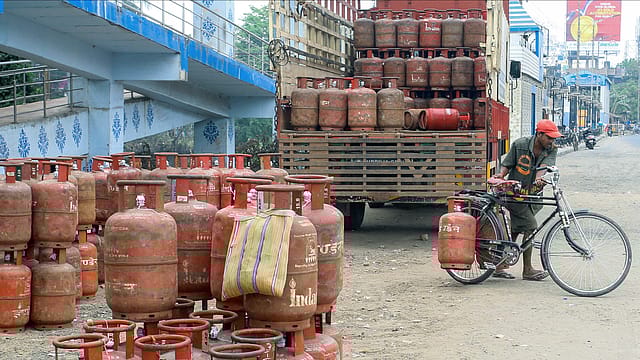
Amid heightened volatility in currency markets and sustained pressure on the Indian rupee, a report by the State Bank of India has recommended that oil marketing companies be provided a special foreign exchange window to stabilise the currency.
The report noted that the rupee has witnessed sharp depreciation in a volatile global environment, with the large and regular dollar demand from oil marketing companies adding to market pressure.
It suggested that regulators create a separate mechanism to isolate this demand from the broader market.
"OMCs need to be offered a special window by the regulator that separates their daily demand (around $250-300 mn) from the market chores," the report stated.
It explained that the annualised demand of oil marketing companies, estimated at $75-80 billion, could be taken out of regular market activity through such a window.
Why Does SBI Say Rupee Depreciation Remains in Line With Global Currency Trends?
This would reduce the noise created by large dollar purchases and provide a clearer picture of genuine demand and supply dynamics in the foreign exchange market.
The report also proposed that refinance or swap mechanisms could be built around this window to prevent immediate pressure on exchange rate movements and support the rupee in the near term.

Open Minds 2026
26 Jun 2026 - Vol 05 | Issue 26
The power of ideas and arguments in 50 portraits
According to the report, such a measure would enable regulators to better assess the effectiveness of policy actions aimed at curbing volatility while improving transparency in the functioning of the foreign exchange market.
The report further observed that the recent depreciation in the rupee after February 27, marking the start of the current conflict in West Asia, remains broadly in line with movements seen in other global currencies and does not indicate excessive weakness.
"The rupee depreciation post 27th Feb... is in fact in line with other currencies, and in fact better than currencies which appreciated significantly".
Why Does SBI Say the Rupee Cannot Act as a Shock Absorber Beyond a Point?
It added that the rupee’s movement reflects global uncertainty and noted that currencies which had appreciated earlier have corrected more sharply, suggesting that using the rupee as a shock absorber has limits beyond a certain inflexion point.
The report highlighted that the current situation differs significantly from earlier episodes such as 2013, when exchange rate volatility was high and the Reserve Bank of India introduced measures including the FCNR(B) window to stabilise the market.
"In the current scenario, overseas channelled debt mop-up does not look desirable," the report said, pointing to the decoupling of yields in developed markets from benchmark funding rates, which could distort borrowing costs.
It also noted that hedging costs for such exposures could be significantly high.
On structural challenges, the report pointed out that recent efforts by the Reserve Bank of India to rationalise banks' open positions have led to divergence between onshore and offshore markets.
How Do Onshore-Offshore Positions of Banks Impact Rupee Stability?
Domestic banks are generally long in onshore markets and short offshore, while foreign banks follow the opposite trend.
To manage currency and interest rate pressures, the report recommended that the regulator consider measures such as Operation Twist.
This would involve pushing up short-term yields while moderating long-term yields to keep reference rates aligned with policy rates.
It also stressed the need for active liquidity management to support the rupee and maintain stability in financial markets.
The report emphasised that India’s external position remains strong, offering confidence in managing currency pressures.
It noted that foreign exchange reserves exceed $700 billion, covering more than 10 months of imports, while short-term debt stands at less than 20 per cent of reserves.
Volatile capital flows account for 64.5 per cent of forex reserves.
"With over $700 billion in reserves, the buffer is sufficiently strong to deter speculative moves through market intervention," the report stated.
Overall, the report indicated that while global uncertainties continue to weigh on currencies, India’s strong macroeconomic fundamentals and adequate reserves position provide a significant cushion against volatility.
(With inputs from ANI)