RentoMojo IPO: Inside Gen Z’s Situationship With Ownership
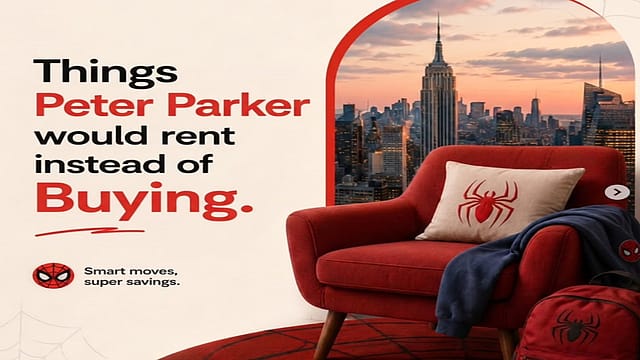
Even the sofa comes with an exit plan.
Imagine the first-job apartment. Two suitcases, a laptop and a salary that has already met the landlord. The security deposit has taken a bite. The kitchen needs a fridge. The bedroom needs something more persuasive than a mattress on the floor.
You would like to get your life together. Preferably without paying for all of it this month.
Then comes the complication. How long will you stay? Another job could mean another city. The flatmate could move out. That lovely wardrobe could become a logistical crisis in an apartment with a narrower staircase.
A sofa is suddenly a decision about the future.
On September 17, RentoMojo brought the business of furnishing such uncertain presents to Dalal Street. Its shares reportedly opened at ₹482.45 on the NSE against an IPO price of ₹404, a premium of roughly 19%.
The Modi Years
02 Oct 2026 - Vol 05 | Issue 40
A Nation Rebuilt
The company offers furniture and appliances on rent. Customers pay for their use while leaving ownership elsewhere. Investors, meanwhile, can buy a stake in the business supplying that access.
It is a delicious arrangement: somebody wants to own the company because somebody else would rather rent the fridge.
Welcome to subscription adulthood.
Why furniture rental speaks to a temporary address
There is a familiar idea of growing up in which possessions mark progress. Your first bed. Your first fridge. A dining table chosen with the expectation that years of meals will follow.
But for a young professional beginning a career away from home, the shopping list has a second column. Delivery. Assembly. Maintenance. Moving. Resale.
Ownership has an administrative department. You run it.
RentoMojo markets maintenance, relocation and flexible tenures alongside its products. Its proposition addresses the work surrounding a purchase as well as the purchase itself. Company service proposition
That helps explain the attraction of a furnished life with fewer things to transport. A person expecting another move may willingly pay for convenience. Someone starting a job might prefer to preserve cash until their circumstances become clearer.
“The aspiration is to feel settled today while keeping tomorrow open,” reckons Ashita Aggarwal, professor of marketing at SP Jain Institute of Management & Research. A rental brand makes that possible when the customer’s address, job or household is still evolving.
This is the situationship with ownership: comfort now, the long-term decision later. Its appeal does not require a philosophical rejection of possessions. You can want to own a home one day and have no enthusiasm for buying a washing machine this afternoon.
Gen Z’s appetite for access has global company
RentoMojo belongs to a wider family of businesses selling temporary access to physical products. Some operate in furniture, while others apply similar logic to electronics.
They are useful comparisons because they show different ways of solving the same problem: how to enjoy something now without paying its full purchase price upfront.
They are not interchangeable businesses, and their existence does not establish that all their customers are Gen Z. Furniture rental, device leasing and rent-to-own arrangements have different costs and contractual outcomes.
The distinctions are revealing.
In the US, Fernish advertises furniture rental alongside rent-to-own and outright purchase, with delivery and assembly central to the proposition. A customer can choose access, a path towards ownership or an immediate purchase.
That menu complicates the claim that ownership is becoming obsolete. A business can succeed by accommodating several degrees of commitment. Customers may be uncertain about an apartment, a particular product or how long they need it, without being permanently opposed to owning anything.
The lesson for the Indian story is straightforward. The important change may be the availability of more ways to furnish a home, rather than the disappearance of the desire to own one.
Raylo takes the subscription into your pocket
Britain’s Raylo offers subscriptions for devices including phones, laptops and gaming consoles. Its website says customers choose a term and pay a fixed monthly price. After that term, the arrangement rolls monthly; customers can upgrade, keep paying or return the device.
A phone carries a different emotional charge from a wardrobe. Its camera, performance and design may matter to how someone works, creates or presents themselves. Subscription pricing can make a premium device feel more accessible, while the return-and-upgrade cycle gives the provider another opportunity to serve the customer.
There is evidence of a youth connection here. In December 2025, The Times reported that Gen Z was Raylo’s fastest-growing customer segment. It also reported that the company remained loss-making in its accounts for the year to September 2024. That is a dated financial snapshot, rather than a statement about its current profitability.
Both details matter. Consumer interest can establish a market. It does not settle the economics of serving that market.
The consumer also has to distinguish a rental payment from an instalment towards ownership. Paying monthly describes the schedule. The agreement determines what you have when the payments end.
Grover shows what happens after the return
Germany-based Grover applies the rental model to electronics, including computers, cameras and gaming equipment. Its current website describes returned devices being cleared of data, cleaned, repaired and rented again.
The second customer is central to the story.
A device bought once by a rental business can earn revenue across several users. But that requires a system for retrieving it, establishing its condition, repairing it and finding the next person willing to pay.
In March 2023, Grover announced a reverse-logistics and refurbishment partnership with Ingram Micro. The arrangement covered regular returns, damaged products and undeliverable packages, among other work. It illustrates the operational machinery behind the promise of convenient access.
Financing matters too. Grover’s October 2025 announcement of a new chief executive explicitly followed a refinancing. Building this category involves funding and maintaining an inventory of physical products as well as attracting subscribers.
The inference for RentoMojo is that a smooth app is only one part of the proposition. A washing machine must survive the journey from one apartment to the next, and remain useful when it gets there.
A subscription button cannot make a wardrobe weightless.
Freedom, affordability and the danger of confusing them
The seductive version of this story casts young consumers as a generation that has evolved beyond ownership.
It is too tidy.
Someone renting a fridge might have substantial savings and expect to relocate. Someone else might lack the money to buy one after paying a security deposit. Their orders could look identical on an app. Their financial circumstances would be very different.
A transaction alone cannot explain the motivation behind it.
Financial pressure is part of the international backdrop. Reuters reported in June 2026 that a Bank of America survey found 42% of Gen Z respondents in the US living paycheck to paycheck. That is evidence about the surveyed American population, not a statistic that can be transferred to India.
It nevertheless provides a useful corrective to the glamorous language of flexibility. Access can be attractive because people want freedom, because they need a smaller immediate outlay, or because both are true.
“We should be careful about reading every rental as a rejection of ownership," says Aggarwal. The same transaction can express convenience for one customer and a cash constraint for another.
RentoMojo’s debut does not establish a nationwide generational verdict. Gen Z is a useful lens through which to examine early adulthood, but older customers can have the same needs.
You can be unsure where you will live next year and absolutely certain you would like cold water tonight.
The monthly price needs a longer attention span
RentoMojo’s app listing advertises Limitless packages starting at ₹2,699 a month. At an unchanged rate, that adds up to ₹32,388 over a year or ₹97,164 over three years. These are simple rental totals at an advertised starting price, before applicable additional charges. They are not a quote for every household or an equivalent-basket comparison with buying.
The point is how much the answer changes with time.
A sensible comparison needs the same products, comparable quality and the same period of use. Buying involves upfront expenditure, possible financing costs, repairs and moving expenses, offset partly by any eventual resale value. Renting involves cumulative payments and the services and charges specified in the agreement.
A refundable deposit ties up cash, but should not automatically be counted as a permanent expense. A non-refundable exit fee is an expense. A bundled maintenance service has value, but its coverage matters.
“When a price is presented monthly, the immediate decision becomes easier,” says Aggarwal. The customer still needs to consider the total commitment and what happens when the need changes.
There is no universal month at which buying becomes the winner. A person who stays put and uses the same furniture for years faces different arithmetic from somebody expecting two moves.
“For now” needs an approximate end date.
Your furniture breakup comes with paperwork
RentoMojo’s published prepaid agreement provides for early-closure charges before the selected minimum tenure ends, subject to stated waivers. It also provides for automatic monthly renewal after the minimum tenure until termination.
Unused advance rental can be forfeited if products are returned before the selected advance-rental tenure ends. Relocation depends on serviceability; a move to an unsupported address during the minimum tenure can be treated as early closure. These are provisions of the prepaid agreement, and the applicable order terms matter.
The sofa has an exit plan. That does not make every exit free.
This is where the quality of the service becomes particularly consequential. The consumer’s experience includes the return, the final invoice and the handling of any disputed damage. Those moments determine whether the flexibility felt useful in practice.
Can subscription adulthood pay its own bills?
For a rental company, the challenge is to earn enough over an asset’s working life to cover acquisition or financing, delivery, maintenance, retrieval, refurbishment and periods without a paying user.
More customers help only if the service can meet their needs at workable costs. A city with dense demand can produce different delivery economics from a scattered service area. A durable product can offer a different earnings runway from one requiring frequent repairs.
The sustainability argument also needs that practical scrutiny. Reusing a product can extend its useful life. The environmental outcome depends on the purchases displaced, the repair burden, transport and eventual disposal. A subscription is a payment arrangement; the real-world product cycle determines its wider impact.
Fernish, Raylo and Grover illuminate different parts of this equation: choice over ownership, access to aspirational devices, and the machinery required to keep products circulating.
RentoMojo’s listing brings that conversation to Indian public markets. Its premium captures an opening response, while the longer assignment remains operational.
Back in the imagined first-job apartment, the resident has a less elaborate objective. A bed. A fridge. A place that feels like theirs without requiring a five-year answer about the future.
The desire to own things can wait. Daily life cannot. For now, the relationship status is furnished.