OpenAI Is SoftBank’s Investment, Customer and Collateral. What Could Go Wrong?
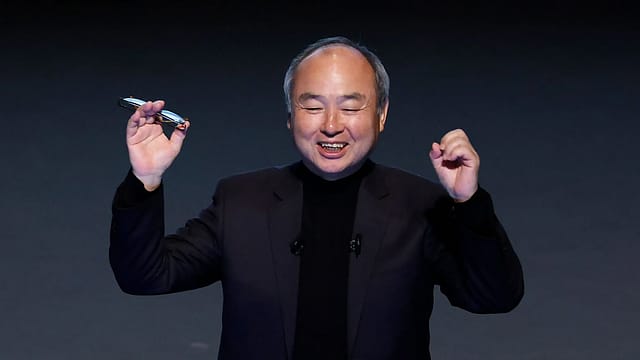
Masayoshi Son’s biggest AI investment is also becoming the customer for his biggest AI infrastructure project.
The investment is helping SoftBank report enormous gains. The shares have helped it raise fresh money. The customer contracts are helping justify billions of dollars of expenditure on data centres and power.
At the centre of each transaction sits the same private company: OpenAI.
SoftBank has invested a cumulative $64.6 billion in the maker of ChatGPT and owns approximately 13 per cent. At September-end, before the final $10 billion tranche was completed, it valued its $54.6 billion investment at $99.6 billion. That produced a cumulative unrealised gain of about $45 billion.
SoftBank has also raised $10 billion through what it calls a “loan using OpenAI shares”. The phrase requires an asterisk. The shares themselves are not formally pledged. The borrower’s cash account is the stated collateral. However, a significant fall in the value of the OpenAI preferred shares referenced in the agreement can require additional cash collateral or mandatory repayment.

The Wealth Issue 2026
06 Nov 2026 - Vol 05 | Issue 45
Portraits of Dreamers and Doers under 35
OpenAI is simultaneously the customer under long-term leases for SoftBank-backed data centres in Texas and Ohio. At the PORTS-Pike campus in Ohio, SB Energy is expected to build, own and operate an eight-gigawatt AI complex under a 20-year lease to OpenAI.
This is more than concentration in a promising startup. OpenAI has become an investment, valuation engine, borrowing reference and infrastructure customer inside the same SoftBank strategy.
When each part rises together, the structure can be exceptionally powerful. If the assumptions weaken together, the links can transmit pressure from one part of SoftBank to another.
How large is SoftBank’s OpenAI bet?
SoftBank completed three follow-on investments of $10 billion each in April, July and October 2026. The shares were acquired at a pre-money valuation of $730 billion, taking its cumulative investment to $64.6 billion.
That is an extraordinary amount to place behind one unlisted company. It is larger than the annual economic output of several countries and represents a sharp departure from the original Vision Fund idea of distributing capital across hundreds of technology businesses.
The size becomes more striking inside Vision Fund 2. At September-end, the fund reported cumulative investment returns of $144.4 billion from a cumulative investment cost of $122.6 billion. OpenAI alone accounted for $99.6 billion of that return value.

SoftBank’s own figures, therefore, show how much the apparent recovery of Vision Fund 2 rests on one mark. OpenAI’s value was unchanged from the previous financial year-end during the reported half-year, meaning the $45 billion gain was cumulative rather than newly created in the latest quarter. It also remained unrealised.
The distinction matters. A private-company valuation can create reported wealth without producing cash. SoftBank must either sell shares, wait for a listing or find another way to turn the holding into usable capital.
It chose the third route.
Is OpenAI really collateral for SoftBank’s borrowing?
Functionally, yes, although the legal structure is more precise than the headline suggests.
In August, a Vision Fund 2 subsidiary borrowed $10 billion for the general corporate purposes of SoftBank and the fund. SoftBank Group guaranteed the loan, which is due in August 2028.
The OpenAI shares are not pledged to the lenders. The loan is secured by a cash collateral account belonging to the borrower. Yet the agreement contains safeguards linked directly to the fair value of OpenAI’s preferred shares. A significant decline can trigger a demand for additional cash collateral or compulsory prepayment.
OpenAI’s valuation is therefore not merely a number on SoftBank’s investment ledger. It can affect how much cash the group must place behind a $10 billion borrowing and whether that loan remains outstanding.
This is the central contradiction of the strategy. SoftBank can use the rising value of an illiquid private investment to obtain liquidity without selling it. That preserves the upside Son believes OpenAI will generate. It also makes the financing sensitive to the same valuation whose future upside SoftBank is trying to preserve.
The relationship stops short of a conventional margin loan, where the underlying shares are formally pledged and may be seized or sold. But its economic message is similar: if OpenAI’s value falls far enough, SoftBank may have to supply cash or repay debt at precisely the moment its reported asset value is also declining.
How did OpenAI become SoftBank’s customer?
Son is not content to own part of the intelligence layer. He wants SoftBank to help supply the electricity, land and buildings on which that intelligence runs.
SB Energy’s proposed PORTS-Pike technology campus in Ohio is the clearest example. OpenAI has signed 17 leases covering approximately eight gigawatts of IT capacity. Each carries an initial term of 20 years, with phased rent commencement tied to the completion of the required buildings, generation resources and interconnections.
OpenAI says it will begin paying only when completed capacity becomes available. It expects to fund the commitments through revenue, cash flow and capital raised from investors. The first 800 megawatts are expected to become available in 2028, while the wider project is scheduled to develop in phases.
Nvidia adds another layer. It is the exclusive computing-infrastructure provider and has agreed to invest $1.5 billion in SB Energy. It is also providing credit support for land, power and shell infrastructure associated with the initial 4.25 gigawatts.
According to SB Energy’s regulatory filing, Nvidia has provided residual-value guarantees connected to OpenAI’s lease obligations on that initial capacity, with an aggregate guaranteed value of as much as $105 billion under specified conditions. The protection is not unconditional. It is triggered by events such as tenant insolvency or an uncured monetary default, and the guaranteed value declines over the life of the leases.
The structure illustrates how the AI boom is being financed. SoftBank supplies investment capital and develops infrastructure. OpenAI supplies long-term demand. Nvidia supplies the chips and part of the credit support. Each participant strengthens the commercial case for the others.
Where does the loop become risky?
The first risk is valuation.
OpenAI has to justify an enormous private-market price while spending heavily on computing capacity. A lower valuation would reduce SoftBank’s net asset value and could activate protections in the $10 billion loan agreement. It would also weaken the paper gain that has transformed Vision Fund 2’s reported performance.
The second risk is customer concentration.
OpenAI is expected to be the customer at both PORTS-Pike and SB Energy’s Milam County project in Texas. Long-term leases improve the projects’ ability to obtain financing, but they also place considerable importance on one tenant’s ability to meet very large commitments for decades.
Nvidia’s support reduces some of the risk at PORTS-Pike. It does not eliminate the requirement to secure permits, transmission, generation, project finance and completed facilities before rent begins.
The third risk is execution. SoftBank’s latest results already contain a warning.
A subsidiary paid approximately $9.48 billion to reserve manufacturing capacity and power-generation equipment for American data-centre projects. After project requirements changed, SoftBank recognised a $3.73 billion loss, including non-refundable advances and contract-modification costs. Approximately $6.6 billion of related advance payments remained on the balance sheet at September-end.
That loss does not prove that the data-centre strategy has failed. It proves that in the race to secure scarce equipment, SoftBank committed capital before every long-term specification had settled.
The fourth risk is financing. SoftBank raised a record $56.5 billion during the quarter through borrowing, bond issuance and asset monetisation. Its finance costs more than doubled year on year in the first half. Consolidated interest-bearing debt increased by approximately ¥7.9 trillion in six months.
SoftBank reports a loan-to-value ratio of 15.9 per cent, comfortably below its 25 per cent internal threshold, and a cash position of ¥5 trillion. Those figures provide a substantial buffer. They do not change the direction of travel: more of the AI strategy is being funded with debt, asset-backed arrangements and long-dated capital commitments.
Is this circular financing?
That description goes too far if it implies that money is simply being passed around to manufacture revenue.
OpenAI is a genuine operating company with users, enterprise customers and rapidly growing revenue. The leases are contracts for physical infrastructure that is intended to be built and delivered. Nvidia’s participation introduces an independent strategic investor and credit-support provider.
The more accurate description is a closed-loop exposure.
SoftBank’s equity investment benefits if OpenAI grows. OpenAI’s projected growth supports demand for SoftBank-backed infrastructure. Those infrastructure contracts can attract project financing. The rising value of SoftBank’s OpenAI holding can support separate borrowing. That borrowing gives SoftBank more capacity to continue investing across the same AI ecosystem.
There is commercial logic at every link. The vulnerability comes from the links increasingly depending on a common assumption: OpenAI will grow fast enough, raise enough capital and generate enough cash to justify its valuation and absorb enormous quantities of computing capacity.
Has Masayoshi Son built a flywheel or a pressure chain?
At this stage, it can still be either.
If OpenAI’s revenue keeps rising, its valuation can lift SoftBank’s NAV and support future financing. Its demand can fill SoftBank-backed data centres, helping those projects raise non-recourse debt and generate long-term cash flows. Arm and Nvidia can benefit from expanding computing requirements. SoftBank would own stakes across several layers of a new industrial system.
If OpenAI’s growth or valuation disappoints, the movement can travel the other way. The investment mark falls. Loan safeguards become more demanding. Data-centre financing becomes harder. SoftBank may have to contribute cash when its own borrowing costs and leverage are already under scrutiny.
This is why SoftBank’s latest loss is not the most important result in its filings. Quarterly profits have always moved violently with the value of Son’s holdings.
The more consequential change is structural. SoftBank is no longer simply investing in companies that may benefit from AI. It is arranging capital, power, property and computing capacity around the fortunes of one company in which it is already the largest financial believer.
Masayoshi Son has spent $64.6 billion buying OpenAI’s upside. He is now building part of SoftBank’s financial architecture around the assumption that the upside arrives.