India's low-carbon transition enters execution phase as business, policy and capital converge
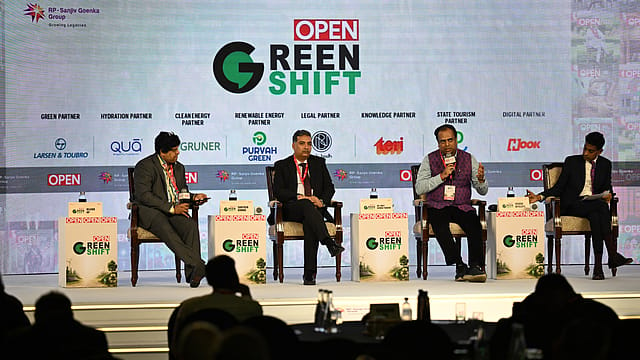
India's low-carbon transition is entering a new phase where execution, rather than ambition, will determine success, with sustainability increasingly becoming a core business strategy backed by policy, investment and long-term planning, experts pointed out during a panel discussion at OPEN Green Shift.
The discussion, titled Building India's Low-Carbon Future: Infrastructure, Mobility & New Energy, brought together Santosh Kumar, chief sustainability officer at L&T; Amit Kumar Thakur, associate director and head (CSR) at TERI; and Joshua Wycliffe, director at the Global Biofuels Alliance. Together, they argued that India's green transition has evolved beyond regulatory compliance into an economic and strategic imperative.
Opening the discussion, Kumar said sustainability has undergone a fundamental transformation within corporate India.
"Sustainability initially started as compliance. Then it moved to reporting. Today, it is becoming a business imperative," he said, adding that decisions made during the design stage of infrastructure determine their environmental impact for decades. "The greenest resource is the resource which is never consumed."

The Identity Project
11 Sep 2026 - Vol 05 | Issue 37
Amit Shah leads the mission for a national demographic correction
He underlined companies are increasingly being driven not only by regulation but also by investor expectations, customer demand for carbon transparency, access to green capital and a new generation of employees seeking responsible employers. At L&T, sustainability targets such as carbon neutrality and water neutrality have been embedded across business operations rather than remaining the responsibility of a standalone sustainability department.
Thakur said a similar shift has taken place in corporate social responsibility, which has matured from a compliance obligation into a structured framework for long-term development.
According to him, annual CSR spending has grown from around ₹8,000 crore when the law was introduced to nearly ₹40,000 crore, reflecting both greater corporate participation and a stronger focus on measurable impact. He added that climate change should no longer be viewed purely as an environmental issue because it directly affects economic productivity, labour welfare and social development.
He also stressed that India's transition to a low-carbon economy must remain people-centric, with businesses integrating environmental goals alongside community development and long-term planning.
From the perspective of clean energy, Wycliffe argued that biofuels should not be seen as competitors to other renewable technologies but as part of a broader energy ecosystem.
"Biofuels are not in the business of competing," he said, describing clean energy as a "mosaic strategy" where biofuels, electric mobility and hydrogen each address different segments of the energy transition.
He maintained that the biggest challenge for scaling biofuels is not technology but policy certainty. Clear blending mandates and long-term legislation, he said, reduce investment risk and encourage private capital, citing an example where a biofuel policy framework attracted a $378 million investment within weeks of being introduced.
The discussion also touched upon the risks of greenwashing, with Kumar arguing that credible sustainability claims require robust measurement, reporting and verification systems to maintain investor confidence and corporate credibility.
While the speakers represented infrastructure, sustainability, CSR and biofuels, they converged on a common message: India's climate goals will depend less on announcing ambitious targets and more on integrating sustainability into business decisions, public policy and investment frameworks that can deliver measurable outcomes over the coming decades.