G-SHOCK Goes G-CHIC: Can the Tough Guy Dress Up?
Once you have engineered a watch to survive a fall, the next challenge is getting someone to fall for it.
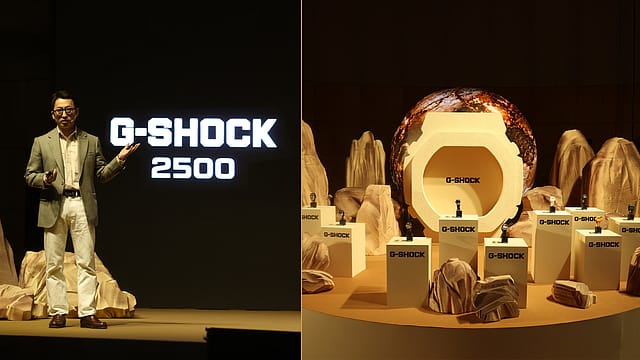
G-SHOCK’s new 2500 Series arrives with softer contours, sculpted surfaces and a design philosophy called “Depth in Shadow”. Its India introduction includes artistic installations and a vocabulary rich in refinement, craftsmanship and sophisticated aesthetics. The watch built to withstand a knock now wants to knock ’em dead.
The tough guy has dressed for dinner.
Priced between ₹9,995 and ₹26,995 in India, the resin GAC-2500 and metal-clad GMC-2500 carry the familiar promises of shock resistance and 20-bar water resistance. The proposition around those promises is more revealing: a durable watch that can also satisfy the consumer choosing an accessory for its appearance.

Losing Memory
16 Oct 2026 - Vol 05 | Issue 42
The making of a medical and social emergency
That is a legitimate ambition. But it also changes the examination. Once a brand asks to be judged on refinement, it enters a much more crowded room.
THE RIVAL IN THE SAME SHOWROOM
Before looking across the market, look across Casio’s own counter.
The GA-B2100-1A is listed on Casio’s Indian website at an MRP of ₹11,995. It offers Tough Solar power, Bluetooth time adjustment, world time, alarms and 200-metre water resistance. It combines hands with a digital display.
The new GMC-2500-1A’s international specification sheet lists mineral glass, a replaceable battery rated for approximately two years, accuracy of ±15 seconds a month and a 30-minute stopwatch. Its attraction is a fully analogue presentation with a different case, dial and material treatment.
These are different propositions, rather than a neat ladder in which each extra rupee buys another function. The entry-level 2500 costs less than that solar model; the collection’s more expensive versions must make their own case through the complete design and construction. Solar power and Bluetooth are not prerequisites for a desirable watch. Their availability elsewhere in the family does, however, make “advanced functionality” a claim worth unpacking.
The customer deserves to understand the trade: which practical conveniences, materials and visual qualities come with each model?
Marketing and branding experts reckon that a premium can come from design, identity and the pleasure of wearing a product. But the brand has to make that value specific. "Calling something sophisticated does not tell the consumer why this particular watch deserves the money,” says Ashita Aggarwal, professor of marketing at SP Jain Institute of Management & Research.
The 2500 has actual engineering to discuss. Its Multi-Mission Date uses a three-cell window for the date, stopwatch minutes and setting information. Once configured, the calendar accommodates month lengths and leap years. Casio also describes a magnetic Shock Release Hand construction designed to dissipate impact, with a displaced minute hand returning to position after a shock.
Those details give the pitch substance. They also provide a better account of craftsmanship than another adjective about light falling on a dial.
WHOSE HERITAGE IS ON THE WRIST?
Casio traces the collection to the DW-5000C, the original G-SHOCK introduced in 1983. The official story is continuity: the functional beauty of that digital original translated into an analogue watch.
Enthusiasts have supplied a second reference point. The “CasioNaut” nickname connects the new case to Patek Philippe’s Nautilus. GQ discusses the resemblance, including the projecting sides of the case, and places it alongside the earlier “CasiOak” association between G-SHOCK’s 2100 family and Audemars Piguet’s Royal Oak.
These comparisons are interpretations of design, not findings of copying or claims of a commercial relationship. Patek Philippe is not a like-for-like competitor for a ₹10,000 watch. Its relevance here is the visual association that enthusiasts bring to the product.
That association can be useful. A nickname makes a model easier to discuss, search for and recognise. It can also complicate a brand’s own account of originality. Casio says “our first G-SHOCK”; part of the conversation says “that famous luxury sports watch”.
For a brand with such a recognisable identity, this is an interesting negotiation. How much does the new watch gain from its own history, and how much from the luxury-watch vocabulary consumers see in it?
A familiar design association can help people notice a new product. The stronger position is when they also recognise a reason to want your version on its own terms. "Otherwise, the comparison becomes more memorable than the brand’s contribution,” says Aggarwal.
INDIA IS ALREADY DRESSING UP
The opportunity in India is visible in a competitor’s performance.
Titan’s provisional business update for the July–September 2026 quarter showed its watches business growing approximately 30% year-on-year. Analogue watches grew in the early thirties, supported by premiumisation. The division added 34 net stores, taking its network to 1,379.
This is competition for a purchasing decision: what kind of watch deserves a larger share of someone’s discretionary budget? A G-SHOCK buyer may value resilience and a distinctive case; another buyer may prefer the design, associations or wearing experience offered elsewhere. Rising expenditure gives several brands room to grow. It does not establish that one is taking customers from another.
The same Titan update also recorded a recovery to high-single-digit growth in smartwatches. That is an inconvenient detail for a sweeping obituary of the connected wrist.
Nor is analogue territory new to G-SHOCK. Casio’s first analogue-digital combination model, the AW-500, appeared in 1989. The 2500’s particular display and construction deserve explanation; the existence of hands on a G-SHOCK is not the breakthrough.
The useful story is, therefore, about differentiation within a growing field. “Consumers like traditional watches again” cannot explain why they should choose this one.
THE INVESTOR PRESENTATION HAS FEWER SHADOWS
Casio’s financial disclosures make the commercial logic clearer.
In April–June 2026, its global timepiece sales increased 29% to ¥51 billion. The business reported a 23.1% operating margin, including a US tariff refund; excluding that benefit, the margin was 20.7%. Both G-SHOCK and CASIO WATCH contributed to the strong performance.
More revealing is the strategy. Casio identifies improving G-SHOCK’s profit margins, concentrating promotion on iconic models, strengthening its appeal to younger consumers and extending that appeal to medium-priced metal models.
The 2500 can be read against that stated direction. Design gives Casio a way to encourage consideration beyond a list of functions, while metal treatments and a different appearance create additional choices within the brand. The new collection’s contribution to sales or margins is yet to be established.
This is an expansion effort by a growing watch business. It deserves scrutiny on those terms, without an invented rescue narrative.
THE CASE FOR G-CHIC
There is a persuasive argument for the change. A customer can appreciate G-SHOCK’s resilience and want a quieter dial or a watch that suits more clothes. Making the product appropriate for more occasions can increase its usefulness without adding a sensor.
Casio says the analogue movement developed for this collection is made at Yamagata Casio, its G-SHOCK mother factory. Its design account connects the proportions, hands, dial and materials to readability and everyday wear. Those are product claims to assess through use, rather than conclusions established by launch photographs.
The opportunity is to give existing customers more occasions to wear the brand and new customers a reason to consider it. "The test is whether refinement makes G-SHOCK more useful and desirable while keeping its identity recognisable,” says Aggarwal.
G-CHIC is a promising addition to the wardrobe. Its commercial value will depend on how often it leaves the drawer. A watch can keep perfect company with a suit, sit comfortably beside a shirt cuff and still carry the reassurance that an accidental knock will not end the evening.
For the buyer, that is a more tangible version of sophistication than finding the correct angle at which to admire a shadow.