Empathy Deficit, the Business of Selling Hope & Sense International India
The PowerPoint had barely reached the final slide when the conversation took a familiar turn.
There were questions about scale. Questions about reach. Questions about outcomes. Then came the one Biju Mathew had learnt to expect.
"Your cost per beneficiary seems high."
Or, on another day, from another boardroom: "₹1 lakh per child?"
The words changed. The question never really did.
For nearly three decades, Mathew has sat across corporate leaders, CSR committees and philanthropists, asking them to invest in children they cannot see and a disability many have never heard of. Every meeting begins with hope. Almost every meeting, sooner or later, arrives at cost.
Freedom Issue 2026
14 Aug 2026 - Vol 05 | Issue 33
Shashi Tharoor on being radical liberal | Ram Madhav on how Gandhi used his Hinduism | TCA Raghavan on a diplomat's travels in history | Sumana Roy on the novel beyond the Booker | Carlo Pizzati on the dissolution of Borders
How much?
How many?
What's the return?
Across the table, the chief operating officer of Sense International India rarely argues. He explains patiently--again and again--that some children cannot hear. They can’t see. That learning to recognise their mother's touch can take months. That progress isn't measured in quarterly targets. That the hardest work happens long before anyone can count an outcome.
Sense International India works with children and adults with deafblindness, one of the country's least understood disabilities that is invisible not just to the eye, but often to public consciousness itself.
Yet, long before corporate India began asking him to justify the cost of changing a life, someone else had asked a version of the same question. Only the setting was different.
Ahmedabad. Early 1990s.
A young man had just finished studying biochemistry at St. Xavier's College. His professors imagined laboratories. Research. Maybe a doctorate. His family imagined stability. A government job, perhaps. His future looked respectable, predictable and comfortably middle class.
Instead, he had decided to pursue a master's in social work. The announcement landed exactly as one would expect.
"Social work?"
"NGO?"
"What kind of salary does that even pay?"
The toughest conversation wasn't with his own parents. It was with the family of the woman he wanted to marry. Her parents had spent their lives in government service. They had a simple dream for their future son-in-law: security. A stable job. A predictable income. A career they could explain to relatives without hesitation.
Why Biju Mathew Chose Social Work Over a Government Career
Standing before them was a young man who had voluntarily walked away from science, wasn't interested in the government jobs that had come his way, and wanted to build a career in a sector most people associated with cloth bags, idealism and shoestring salaries.
Mathew remembers trying to reassure them the only way he could. Maybe, he said, there would still be a government job after his master's. Maybe the Ministry of Social Justice. Maybe a social welfare officer's post. He even appeared for examinations that could have taken him into government service. At one point, he cleared the selection process for the Intelligence Bureau. The timing couldn't have been better. Marriage discussions were underway. A central government job would have answered every question.
He never joined.
Instead, he accepted an offer from a little-known organisation working on a little-known disability: Sense International India. He thought he was choosing a career. Reality? He was really choosing a life.
For the next three decades, he would keep encountering the same question: What does a life cost? The question would be asked by families, by CSR committees, by procurement teams, by donors. Sometimes directly, more often indirectly. The question remained the same: What does a life cost?
The questions from his future in-laws weren't entirely unfair. For a young man who had just walked away from a conventional career, certainty had become an increasingly rare commodity.
The decision had begun two years earlier. In 1992, while still studying at college in Ahmedabad, Mathew joined a rural exposure camp in the tribal belt of south Gujarat. For ten days, the students lived with tribal families, helped build roads, shared simple meals and spent their evenings listening to stories that rarely found their way into classrooms.
Something shifted.
"Science can wait," he remembers thinking. "People can't."
It wasn't a dramatic epiphany. There was no single incident that changed everything. Just a quiet conviction that grew stronger with every passing day. By the time he returned to Ahmedabad, the career he had imagined for himself no longer felt like the one he wanted. He enrolled for a Master's in Social Work.
The reactions came quickly. Friends thought he was wasting his education. Relatives questioned the decision. His future in-laws worried about something more practical: How would he support a family?
Looking back, Mathew smiles at how hard he tried to reassure everyone around him. There were government jobs after an MSW, he would explain. The Ministry of Social Justice recruited social welfare officers. There would always be options. Just in case, he kept some of those options alive. He appeared for competitive examinations. He received an offer linked to the Ministry of Rural Development. He cleared the selection process for the Intelligence Bureau. A corporate opportunity followed. Each one promised what everyone around him wanted: stability, a respectable salary and a predictable future.
He walked away from every one of them. Not because he was chasing uncertainty. Because certainty no longer excited him. "I've never been comfortable inside templates," he says. "I've always wanted to explore. Experiment."
How Sense International India Changed Biju Mathew's Life
That instinct eventually led him to Sense International India. At first, the attraction wasn't even the cause. It was the possibility. An international organisation, a chance to build something almost from scratch, and an opportunity to return to Ahmedabad, where the woman he loved still lived.
The deeper conviction would come later on his first visit to the field.
When Mathew joined Sense International India in 1999, deafblindness was little more than a phrase. He knew about blindness. He knew about hearing impairment. He had never stopped to imagine what life might look like without either. His education began not in a classroom, but in a village in Gujarat.
One of his first field visits took him to meet a young girl, barely ten or twelve years old. She couldn't see. She couldn't hear. She couldn't speak. Her world ended where her fingertips did. The only person she trusted was her mother. When Sense's field workers first visited the family, the girl wouldn't let anyone come near her. She refused to wear clothes. Every unfamiliar touch frightened her. Every new sensation pushed her further into herself.
The breakthrough didn't come from a psychologist or a researcher or an international expert. It came from a young field worker from a nearby village. He watched. He waited. Then he asked the girl's mother for one of her old saris. The fabric was stitched into a simple dress. The girl wore it. For the first time, the explanation was almost embarrassingly simple. She recognised her mother's smell, the scent she had trusted all her life travelled with the cloth.
"So much research," Mathew says, still sounding amazed after all these years. And this young field worker, who wasn't even highly educated, understood something the others couldn't. Mathew realised that her world wasn't built around sight or sound. "It was built around touch," he recounts.
Mathew often returns to that memory. Not because it was the most dramatic case he encountered. But because it changed the way he understood intelligence itself. Solutions didn't always emerge from laboratories or textbooks or conference rooms. Sometimes they emerged from observation, from patience, and from empathy.
Until then, he had thought he had joined an organisation. That afternoon, he realised he had entered an entirely different way of seeing the world. Or perhaps, a different way of helping people who couldn't. He would spend the years that followed travelling across India, meeting children and families whose lives rarely entered public conversation.
There was another challenge. Helping them was difficult but convincing others they even existed was harder.
One board meeting in particular has stayed with Mathew.
The company was among India's largest. The presentation had been carefully prepared. Ten minutes to explain an invisible disability and another ten to explain why children who could neither see nor hear deserved a place on the company's CSR agenda.
Inside Sense International India: The Business of Fundraising
The board was running behind schedule. By the time Mathew's turn arrived, someone glanced at the clock.
"You have two minutes."
He smiled politely. There wasn't much else to do. Years in fundraising had taught him that boardrooms rarely moved according to agenda.
He began anyway. The introduction had barely ended before the questions started. No, they were not about deafblindness or children. Not even about outcomes. One of the directors wanted to know why one project cost more than another. The discussion had lasted less than five minutes. It had already become a conversation about money.
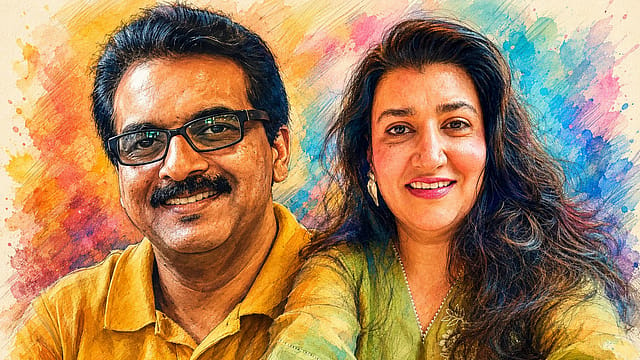
Sitting beside Mathew was Nafeeza Pavri, a philanthropy strategist who has spent years working with nonprofits, philanthropists and corporate CSR teams. Unlike Mathew, whose instincts were shaped by years in the field, Pavri has spent much of her career helping organisations answer a different question: how do you convince someone to invest in a problem they cannot see?
She didn't look surprised. "This happens all the time," says Pavri, who head of strategic Partnerships at Sense International India.
Spend enough time with the two of them and a pattern begins to emerge. Mathew almost always begins with people. Pavri almost always begins with systems. He remembers the deafblind girl who recognised her mother by the smell of her sari. She remembers a procurement manager who insisted specialised hearing aids could only be purchased through the company's approved vendors. He instinctively reaches for stories. She instinctively reaches for structures. One builds trust. The other explains why trust matters.
Together, they reveal something much bigger than Sense International India. They reveal how social change is actually built. For years, Mathew believed fundraising meant exactly what the word suggested: Raise money. Pavri remembers believing the same thing until a friend challenged her. "He told me, 'This is sales and marketing."
She laughed. Then argued. "How can you call this sales?"
Today, she laughs at her younger self. "It is sales and marketing." Not because nonprofits are selling products. They're selling belief.
Every proposal asks somebody to care about a problem they have never experienced. Every presentation asks somebody to imagine a life they have never lived. Every funding conversation begins with empathy. It usually ends with spreadsheets.
That, perhaps, is the hardest translation of all.
The contradiction sits at the heart of India's philanthropic ecosystem. Companies increasingly ask for measurable outcomes, greater scale and lower costs. The organisations trying to deliver those outcomes need something far less visible: stronger leaders, better technology, robust monitoring systems, trained teams and institutions capable of surviving long after a project ends. Those investments rarely make it into a CSR dashboard.
Pavri has seen the disconnect play out countless times. Only a day before our conversation, she had walked into another corporate office. The company wanted to support children with hearing impairment but insisted that all equipment be purchased only through its approved procurement vendors. When she explained that specialised hearing aids required specialised suppliers, the response was procedural.
Why CSR Must Invest in Institutions, Not Just Projects
Then came another surprise. She mentioned project monitoring, field visits and evaluation. The HR executive looked puzzled.
"What is admin cost?"
Pavri smiles while narrating the episode, but the question still lingers. Every organisation is expected to monitor projects, to hire people, to build technology, to train leaders, and to measure outcomes. Yet very few donors want to pay for the very systems that make those outcomes possible.
"Who funds that?" she asks. It isn't a rhetorical question. Leadership development, technology, a CRM, middle management, institution building...these aren't overheads. They are the organisation.
Mathew has learnt not to take rejection personally.
He has heard every version of it. The cause is too niche. The numbers are too small. The project is too expensive. The company is focusing elsewhere this year. "You develop rhino skin," he says. Not because rejection stops hurting. Because the next meeting may be different or it may not.
Either way, another boardroom is waiting.
Pavri believes the problem runs deeper than CSR. India, she says, still understands philanthropy through the language of daan. The expectation is simple: every rupee should reach the beneficiary. Administration becomes a dirty word. Fundraising becomes an overhead. Leadership development sounds indulgent. Technology feels optional.
It is an instinct born out of generosity. But generosity alone does not build institutions.
There is an irony neither of them misses. When a startup invests in technology, leadership or organisational capability, it is called building for scale. When a nonprofit does exactly the same thing, it is often asked to justify the expense. Most people assume organisations like Sense International India are asking for charity. They aren't. They are asking people to invest. Not in projects, proposals or organisations. But in the possibility that every child, however invisible, deserves to be seen.
The longer Mathew speaks, the less this feels like a conversation about fundraising. It becomes a conversation about society.
For nearly three decades, he has worked with children who cannot see, cannot hear and often cannot speak. Yet he insists the biggest disability he encounters isn't always deafblindness. It is indifference or perhaps, invisibility.
"We often think people with disabilities are the ones who need to change," he says quietly. "But many times, it is society that needs to change."
It is an observation that sounds simple until you replay the conversations that brought him here. The father-in-law wondering whether social work could ever become a career. The corporate board measuring impact through cost per beneficiary. The procurement department trying to buy specialised hearing aids through standard vendors. The hesitation around funding technology, leadership and people. Different rooms, different decades but the same question: How much is enough?
Somewhere along the way, Mathew stopped trying to answer it with numbers. He began answering it with stories.
Why Empathy Matters More Than Charity
Pavri sees the same pattern from another vantage point.
The social sector, she says, doesn't merely need more funding. It needs a different imagination. One that understands institutions have to be built before they can create impact. Leadership matters, technology matters, and fundraising is not a necessary evil but the bridge between generosity and change.
Most importantly, she believes the conversation has to move beyond sympathy.
"Sympathy donates," she says. "Empathy stays."
The distinction is subtle but profound. Sympathy responds to a moment. Empathy commits to a journey. One gives. The other builds.
For Mathew and Pavri, fundraising is only a small part of what they do. Every day, they translate lives into language that boardrooms can understand. They translate silence into stories. They translate invisible disabilities into visible priorities.
Some days the translation succeeds. Many days it doesn't. They return anyway, carrying the same stories into the next meeting, hoping that one more conversation might help someone see what they had missed before.
Towards the end of our conversation, Mathew recalls a seminar where a blind man walked up to the podium after listening to an animated discussion on the "right" words to describe disability.
Should people say blind?
Visually impaired?
Specially abled?
The speaker listened patiently before offering his own answer.
"Call me blind. Call me visually impaired. Call me whatever. It doesn't matter," he said. "But understand my problems. That's what matters."
Mathew still remembers the silence that followed. The remark cut through years of well-meaning debates about language. Labels could evolve. Terminology could become more sensitive. But unless understanding changed, very little else would.
Perhaps that is also the answer to the question that has followed him for three decades: What does a life cost?
The answer was never meant to be found in a CSR budget, a cost-per-beneficiary calculation or an annual report. It is found in something far less measurable. The willingness to understand a life before trying to value it. That may be the real empathy deficit. Not that society cares too little but that it still struggles to see beyond what is immediately visible.
Until that changes, people like Mathew and Pavri will keep walking into boardrooms, not merely asking companies to fund another project, but inviting them to look at the world a little differently.