Centre Rolls Out Rs 497 Crore RELIEF Scheme to Shield Exporters from West Asia Crisis
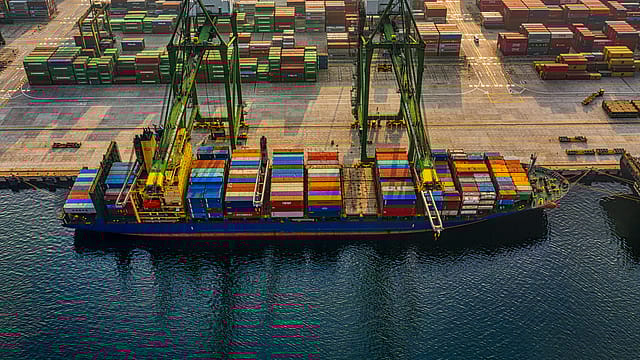
The Centre on Thursday announced the Resilience & Logistic Intervention for Export promotion (RELIEF) scheme to support Indian exporters impacted by the ongoing conflict in West Asia, with a calibrated package aimed at stabilising export flows and protecting India’s market share during the crisis period.
The initiative focuses on mitigating the sharp rise in logistics costs and insurance premiums for shipments heading to the Gulf and West Asia.
It comes amid disruptions in key maritime routes, particularly around the Strait of Hormuz, where conflict conditions have led to additional war risk premiums and emergency conflict surcharges.
The details were shared during a press briefing by Commerce Secretary Rajesh Agrawal, who stated that the "Middle East conflict has an impact" and noted there are significant "challenges due to this conflict."
"The government has come together to set up two inter-ministerial group in the Department of Commerce. We are meeting daily to assess the challenges. We are trying to listen to them and respond to them,” he added.
What is the RELIEF scheme under the Export Promotion Mission and its Rs 497 crore outlay?
Structured under the Export Promotion Mission, the RELIEF scheme has a total financial outlay of Rs 497 crore.

Youth Issue 2026
24 Apr 2026 - Vol 04 | Issue 68
50 Portraits of Icons and Achievers
The Secretary said the government is "trying to build an export package" and that "in this conflict we are trying to help export keep going."
The urgency for intervention stems from disruptions in maritime logistics, which have led to steep increases in freight and insurance costs.
According to briefing data, freight rates on key routes rose by nearly 90 to 100 per cent within a short period during the Red Sea crisis of 2023-24.
Vessel diversions and congestion at trans-shipment hubs have further increased outbound logistics costs, placing pressure on Micro, Small, and Medium Enterprises with limited working capital.
How is the RELIEF scheme structured and what role does ECGC play?
The RELIEF scheme is divided into three components, with the Export Credit Guarantee Corporation of India acting as the nodal and implementing agency.
Component I provides export credit support for exporters already insured by ECGC for consignments issued between February 14 and March 15, 2026.
The government will top up compensation for war and political risk losses beyond ordinary policy cover while keeping premiums at pre-disruption levels.
The estimated support for this component is Rs 56 crore.
Component II targets upcoming exports from March 16 to June 15, 2026. It offers stable premiums and enhanced cover of up to 95 per cent for fresh shipments to countries including the UAE, Saudi Arabia, Kuwait, Qatar, Oman, Bahrain, Iraq, Iran, Israel, and Yemen.
The estimated support for this component is Rs 159 crore.
How does RELIEF scheme Component III support non-ECGC MSME exporters?
Component III allocates the largest share, Rs 282 crore, for non-ECGC-insured MSME exporters. It provides reimbursement of up to 50 per cent of the additional freight and insurance burden for consignments to the same set of countries.
The package also includes automatic extension of export obligations, logistical support, and potential financial measures to manage shipping delays.
To ensure transparency, ECGC will maintain a real-time monitoring dashboard for claims processing and fund utilisation.
An Export Promotion Mission Steering Committee will oversee the scheme and will have the authority to reallocate funds based on evolving conditions.
How are ports and logistics being managed alongside the RELIEF scheme rollout?
Special Secretary in the Shipping Ministry Rajesh Kumar Sinha said, "The additional war risk premium is being imposed now. Under normal circumstances, it is very low around 0.01 per cent or 0.02 per cent."
"If a ship enters a war zone, is on a voyage through such an area, or enters any high-risk region, the war risk premium increases," Sinha said.
He further said that insurance companies assess and determine these premiums based on prevailing security threats in the region.
Amid uncertainty over energy supplies due to the ongoing conflict, officials said no congestion has been reported at any port across India, with maritime operations and cargo movement remaining smooth and under close monitoring.
Additional Secretary Sinha said the Visakhapatnam Port Authority has created approximately 2,250 square metres of additional storage space to handle any potential surge in cargo.
He cited Mundra Port as an example, where, against a total container handling capacity of around four lakh TEUs, current occupancy stands at approximately 25 per cent.
(With inputs from ANI)