Can PhonePe Make India’s ‘Dumb Phones’ Smart Again?
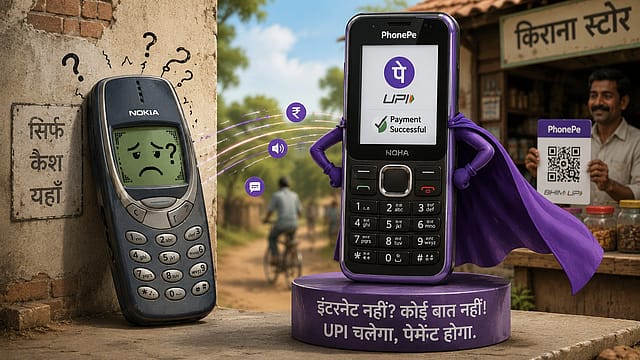
The dumb phone has been refusing to die.
It has watched smartphones acquire bigger screens, sharper cameras, artificial intelligence and the alarming ability to consume an entire working day. It has responded with a torch, an FM radio, a physical keypad and a battery that appears to have negotiated immunity from death.
Now it is getting UPI.
PhonePe has launched UPI payments for feature phones, allowing users to send money, pay merchants and check their bank balances without mobile internet. The service, called PhonePe UPI 123Pay, will come pre-installed on select handsets manufactured by Nokia, HMD, Lava International and itel, which is owned by Transsion Holdings. More manufacturers are expected to join later.

Zeroing In on ECI
09 Oct 2026 - Vol 05 | Issue 41
Constitutional legitimacy versus political opportunism
The company says the service opens its payments ecosystem to more than 200 million feature-phone users. It uses an SMS-based architecture designed to work with limited 2G connectivity. Users can transfer money through mobile numbers and UPI IDs, while compatible phones equipped with cameras will allow them to scan merchant QR codes.
Bill payments, mobile recharges and Aadhaar-based UPI onboarding are expected to follow. PhonePe has also built a voice-based AI helpline in English and 12 Indian languages to guide users through activation. “Bringing UPI to feature phones through PhonePe UPI 123Pay extends the benefits of digital payments beyond smartphones to every corner of the country,” PhonePe Founder and CEO Sameer Nigam reportedly said while announcing the launch.
This sounds like a financial-inclusion story. It is also a bet on a device category that much of the technology industry had already consigned to history. PhonePe is not turning the feature phone into a smartphone. It is asking a more subversive question: what if millions of Indians do not need a smartphone to perform one of the smartest and most useful functions on it?
The Missing 200 Million
India’s digital revolution is usually narrated through the rise of the smartphone. Cheap mobile data put entertainment, shopping, banking, education and social media inside the pocket. UPI then turned the camera into a wallet.
But that revolution has never been universal.
More than 200 million people continue to use feature phones, according to PhonePe. Many live in rural or semi-urban markets, where the price of the handset, cost of repair, battery life, network reliability and familiarity matter more than screen size or processing power. Others include elderly consumers and workers who want a durable primary or secondary phone without the complexity of an app-filled device.
The shrinking numbers themselves tell an important story. When the Reserve Bank of India launched UPI 123Pay in March 2022, it estimated that India had more than 400 million feature-phone subscribers. PhonePe is now addressing a base of over 200 million.
The category is declining. It is simply declining too slowly to be dismissed.
Its endurance has repeatedly unsettled the assumption that every feature-phone user is waiting to upgrade. In 2023, feature-phone shipments in India reportedly grew 10 per cent after falling 31 per cent the previous year. Although 4G models were gaining ground, 2G phones still constituted three-fourths of feature-phone shipments.
The persistence is partly economic. Entry-level smartphones may have become cheaper, but the purchase price is only one part of ownership. Data plans, charging frequency, screen repairs, software complexity and the fear of damaging an expensive device all influence the decision.
Feature-phone users are not necessarily consumers waiting impatiently for a smartphone. For many, the feature phone already solves the jobs that matter most: calling, battery life, durability and affordability, reckons Faisal Kawoosa, Chief Analyst at Techarc. If payments become easy and reliable on the same device, one of the biggest reasons to upgrade weakens. "This may not revive feature phones as a growth category, but it can certainly extend their useful life,” he adds.
That distinction matters. PhonePe may not reverse the migration towards smartphones. It could make the long goodbye considerably longer.
PhonePe Did Not Invent Offline UPI
The technology behind the announcement is not new. The RBI and National Payments Corporation of India launched UPI 123Pay in 2022 to take digital payments beyond smartphones. The system offered four routes: an embedded application, an interactive voice-response call, a missed-call service and proximity payments using sound.
The RBI itself acknowledged that an earlier USSD-based service using the *99# short code had been “cumbersome and not popular”. UPI 123Pay was intended to remove that friction. Its transaction ceiling was subsequently increased from ₹5,000 to ₹10,000 to encourage wider adoption.
Yet UPI 123Pay never acquired the cultural visibility of the QR code. The difference illustrates a recurring technology problem. Availability is not adoption. A service can technically reach millions of people and still remain practically invisible to them.
A smartphone user generally downloads an app, sees a QR code, enters a PIN and receives an instant visual confirmation. The feature-phone experience has involved greater cognitive labour: discovering that the service exists, locating the correct number, following voice prompts, entering information through a keypad and trusting a process that may be unfamiliar.
PhonePe’s potential breakthrough, therefore, is not the payment rail. It is distribution. UPI 123Pay supplied the track four years ago. PhonePe is trying to place the train at the passenger’s doorstep. By embedding the service in new handsets, PhonePe removes the first barrier to adoption: discovery. Its partnerships also spread the product across several manufacturers instead of tying it to a single telecom network or handset ecosystem.
The camera could become the second breakthrough. The QR code succeeded in India because it made an invisible financial network visible. A customer did not need to remember an account number or type a long UPI ID. The act of pointing a camera at a square became nearly synonymous with paying. Replicating that ritual on selected feature phones could prove far more powerful than asking users to memorise an IVR journey.
The Interface is Trust
PhonePe’s biggest rival here may not be another payment company. It may be cash. Cash does not require network availability, a linked bank account, a correctly registered mobile number or confidence in a four-digit PIN. It also produces immediate, physical confirmation. For a first-time digital user, the message confirming a successful transaction must compete with the certainty of money changing hands.
Then comes the fear of getting something wrong.
What happens when an SMS arrives late? Who helps when money is debited but the shopkeeper does not receive it? Can a first-time user distinguish a genuine support call from a fraudster? Will entering a UPI ID through an alphanumeric keypad feel easier than paying cash?
These are not peripheral customer-service questions. They will decide whether the product is used after the first demonstration.
That explains PhonePe’s voice-based AI helpline across 13 languages. In the smartphone economy, AI is frequently sold as intelligence. On a feature phone, its most valuable role may be reassurance.
PhonePe is not merely designing for a smaller screen. "It is designing for a consumer who may be entering digital finance for the first time,” says Ashita Aggarwal, Professor of Marketing at SPJIMR. For this user, trust is the interface. Language support, a familiar handset brand, simple confirmation and the ability to get help immediately will matter more than the sophistication of the technology.
Aggarwal believes pre-installation will give PhonePe an important advantage, but warns that being present on the device does not guarantee regular use. “The first transaction will probably require assisted adoption," she reckons. A retailer, family member, bank representative or local merchant may have to demonstrate it. If that first experience is smooth, the product can build habit. "If it fails or creates anxiety, the consumer will return to cash very quickly,” she adds.
The company will consequently need an offline education network for its offline payment product. Retailers selling the phones may become technology tutors. Merchants displaying QR codes may become adoption agents. PhonePe’s existing network across tens of millions of merchants could be as important as its software.
The Jio Question
PhonePe is not the first company to recognise that the feature phone can be made smarter without turning it into a conventional smartphone.
Reliance Jio has spent years constructing a bridge between the two categories. Its JioPhone and JioBharat devices brought 4G connectivity, entertainment, cameras and JioPay to keypad phones. JioBharat phones support UPI payments and, on compatible models, QR scanning. The company has also added sound alerts for merchants receiving UPI payments.
HMD already markets feature phones in India with built-in UPI functionality, while its wider plans for 2026 include digital wallets, remittances, video calling and AI-enabled services.
This means PhonePe is joining an emerging contest over the future of the “smart feature phone”.
Jio’s advantage is vertical integration. It can combine the handset, telecom network, data plan, entertainment and payment service. PhonePe’s advantage is neutrality and scale. Its system can potentially travel across brands and work without forcing the customer into one telecom ecosystem.
The four initial handset partners are strategically significant. Nokia and HMD carry familiarity and trust. Lava supplies an Indian distribution presence. itel has historically competed aggressively in affordable devices. PhonePe is spreading its bet across the shelf.
That also turns the handset box into a new customer-acquisition channel. Instead of spending heavily to persuade an existing smartphone owner to switch UPI apps, PhonePe can become the default payment brand for somebody entering digital payments for the first time.
Inclusion First, Monetisation Later
PhonePe dominates India’s UPI market with more than 45 per cent of transaction volume. It has hundreds of millions of registered users and a merchant network spread across the country. Yet the zero merchant-discount-rate regime on most UPI transactions means payments alone do not automatically generate attractive revenue from every additional transaction.
So, why pursue users who may initially make small, infrequent payments? Because payments can become the front door. Once activated, a feature-phone user could recharge a mobile connection, pay an electricity bill, purchase insurance, receive credit or access other financial services. PhonePe has already expanded beyond UPI into insurance, lending, wealth and stockbroking. The company does not need every offline payment to produce revenue if payments establish identity, habit and a route to future products.
“Financial inclusion creates social value, but a private company will also look for lifetime value,” says Aggarwal. The commercial opportunity begins when the payment relationship develops into a broader financial relationship. The danger is pushing complex products too quickly at consumers who are still learning to trust the basic service.
That is the tightrope beneath the halo. The feature-phone population may be large, but it is also unusually sensitive to price, fraud and complexity. A service designed to include these consumers could lose their confidence if it becomes an aggressive channel for loans, insurance or cross-selling.
PhonePe must first make sending ₹100 feel safer than handing over a ₹100 note.
Dumb No More?
The smartphone swallowed the camera, music player, television, map, newspaper, bank branch and shopping mall. The feature phone survived by refusing to compete on that battlefield.
PhonePe is now giving it one carefully chosen superpower. If the experiment works, the feature phone will not defeat the smartphone or return to its former glory. It will become something more relevant: a low-cost financial terminal with a keypad, a camera and a battery that lasts.
For India’s technology industry, the lesson would be uncomfortable and useful. Innovation does not always mean persuading the consumer to buy a more expensive device. Sometimes it means making the device already in her hand capable of doing one more important thing.
The feature phone is still dumb by the standards of artificial intelligence, streaming video and app stores.
But if it can pay the vegetable seller, send money home and settle the electricity bill without the internet, perhaps intelligence needs a new definition.