Masaba, Rimzim Dadu and Tarun Tahiliani offered their distinctive vision at India Couture Week 2026
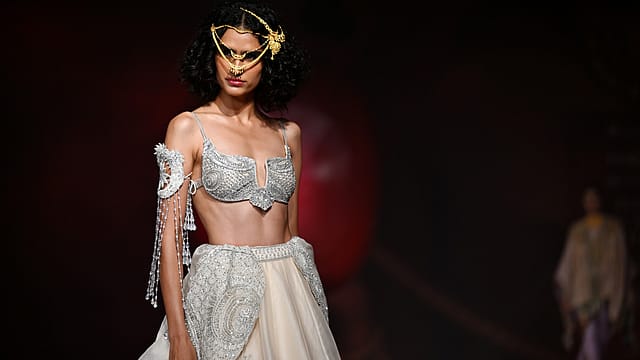
Perhaps it was the events of the past week, but India was on the lips, sleeves and minds of many a designer showcasing their collections at the ongoing edition of India Couture Week. The Jantar Mantar protests, followed by similar gathering around the country, had slowed down the fervour around the event which began on July 23 with Anamika Khanna’s show in Hyderabad followed by a six-day calendar which concludes on July 29. Bollywood showstoppers have been notably absent—to the delight of some and the chagrin of others—and ancillary celebrations have been comparatively muted. There were also calls to cancel the event entirely, but many rightly argued that fashion is as much a business as any other sector and a lot of time, finances and effort has gone into mounting the collections. Instead, as the protests came to an end, designers expressed their jubilation with their collections and presentations in their unique style.

Serving Optimism with Masaba
Masaba Gupta marked the big debut of India Couture Week 2026, showcasing ‘Chardi Kala’ a bridal wear collection inspired by India—not merely as a place but as a “way of seeing the world”. Sarojini Naidu’s famous 1928 speech in the US started the show and the Indian map sparkled on ensembles and accessories. At House of Masaba, Gupta has been turning her attention to bridalwear for some seasons now but this marked her first runway showcase and she brought colour, pomp and a generous serving of gold to the collection. Supersized patterns were drenched in shine—think pineapples and tropical plants, motifs drawn from jewellery as well as architectural and festive patterns. The colour palette was another hero of the showcase, ranging from pastels to jewel tones in bold blocks and combinations. The collection moved from traditional wedding-ready ensembles to resort luxe garments that carried traces of Masaba’s Indo-Caribbean heritage. If the ornamentation was intense, it was also innately Masaba—youthful, irreverent and head-turning. The words, chardi kala, translates to a feeling of joy and optimism, particularly in the face of adversity—here was a collection that expressed the thought in a joyful expression of womanhood, and serendipitously found its place in the current zeitgeist.

The Vanguard
21 Aug 2026 - Vol 05 | Issue 34
BJP Rearmed for 2029
Rimzim Dadu: A Luminous Gaze
A year away from clocking her eponymous label’s 20th anniversary in Indian fashion, Rimzim Dadu has built her brand on the foundation of an entirely original vocabulary of design and material innovation. Her collection ‘INLAE’ continued her experiments in this direction, drawing inspiration from tradition Mughal inlay work and the texture of mother-of-pearl in contemporary couture. Part of Dadu’s success has always been rooted in her ability to translate unusual materials into clothing with both statement and wearability in mind. Across ‘INLAE’, the luminosity of mother-of-pearl came alive—stones were custom cut, buffed and set on the garments in intricate detail that instantly brought to mind the decorative traditions of the country which inspired the collection. In some ensembles, the stonework shone on its own and in others, Dadu married it with her label’s signature steel wire textiles and metallic cords to create new conversations between textures and materials which moved to the rhythm of the 80-foot kinetic installation at the centre of the runway designed by Anuj Anjaria, founder of Studio Motionworks. Dadu took the runway at the end, walking past the models quietly in a black dress—a small badge of the Indian flag gleaming on her sleeve.
Tarun Tahiliani’s Intimate Couture
Tarun Tahiliani was among those who argued for fashion to continue operating last week, but also expressed his joy at the end of the protests. Having hosted couture shows for as long as the concept has existed in Indian fashion, he has spent the last few seasons elevating the format’s immersive quality. Even by that measure, ‘Navaratna’ was singular. Away from the runways at Taj Palace, New Delhi, Tahiliani turned to the galleries of the city’s Bikaner House for a hybrid fashion offering. In the central gallery of the building, flanked by mannequins clad in white on either side, a fashion presentation (not quite a runway show) reiterating Tahiliani’s strengths in corsetry, draping and sculpting to the proportions of the body. With each garment made in a single solid hue—be it ivory and golden beige or bright red and green—and subtle embellishments, the spotlight brightened on construction and silhouettes defined with anatomical details. Next door, in another gallery, Tahiliani mounted a museum-like display of his couture—new and old—showcasing different aspects of his practice, from embroidery and corsetry to experiments with Ajrakh and Pichhwai among others. It was a couture showcase like no other—allowing visitors to not only see the designs but touch and feel them. A pity that the exhibition, mounted with such care and attention to detail, was on display for only a single day.