True to Sound: The bold reinvention of Ghatam, a traditional musical instrument
SOMETIME IN THE late ’90s, in the middle of a concert in Chennai, N Guruprasad’s ghatam broke in his lap. “Suddenly, boom. That’s it,” he recalls. A friend of his fetched a pot of the same pitch from home and the emergency was handled. Every ghatam player has had an evening like this one. The ghatam is one of the most visible objects on the Carnatic music stage and one of the easiest instruments to overlook: a clay belly tucked behind the violin and the mridangam, traditionally enlisted as secondary percussion. The pitch of a ghatam is set by its size, the composition and compression of its clay, the thickness of its walls, and the contingencies of the kiln. Once fired, it cannot be changed, except for some minor coaxing that players manage. A player must therefore keep a family of 25-40 pots across the range of pitches in which vocalists and instrumentalists perform, often more than one at each pitch because no two pots sound or respond identically—and, of course, to account for breakage.
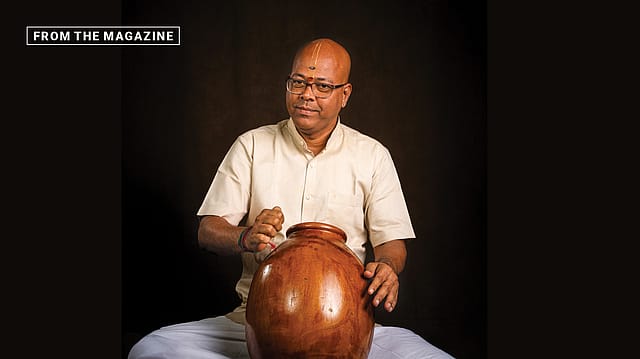
Breakage was not the problem Guruprasad set out to solve. The deeper tyranny was pitch. “The dream was to develop a ghatam that could perform across every shruti,” he tells Open ahead of the launch of One Ghatam in Chennai on August 19. One Ghatam (One G) is an instrument that can be tuned across the concert range, including to the increments between conventional pitches. One Ghatam looks like a regular ghatam, except it weighs 3-4kg, about half the weight of a traditional ghatam. And it is made of wood. Contact transducers convert the wooden shell’s vibrations into an electrical signal, which a processor pitch-shifts and equalises to reproduce the timbre of a clay ghatam. Guruprasad started developing it over 15 years ago, when he began by asking whether the resonance of a clay ghatam could somehow be altered after it was made. It could not. He tried fibre, which did not give him either the resonance or the natural physical response he wanted. Eventually he arrived at jackfruit wood, the resonant hardwood traditionally used for mridangam shells. Because wood also has its intrinsic harmonics, he had to find the right wood, the right thickness and the right processor settings—the ideal patches that will bring its sound closest to the clay ghatam.
One Ghatam could potentially replace a roomful of pots and make it easier for touring musicians and for students to handle the instrument. It may also be more welcoming of a constituency that the old instrument and the culture around it have largely kept at a distance, says Sumana Chandrashekar, a Bengaluru-based ghatam player and author, who calls One G “an invention of necessity”. “As a woman percussionist, one conversation I keep hearing is: this is so difficult for women to play, what will happen to their hands?” she says. “If One G can be played with much less physical effort, and without having to bother about whether it will break or how to keep it safe, it might invite many young women to start playing it.”

Chandrashekar places One G in a longer history of reinvention, each advance called forth by a specific property of the pot. “Every evolution in the journey of the ghatam has addressed a certain aspect of its intrinsic quality,” she says. “When concerts started happening on big stages, the ghatam could not be heard, and normal microphones never addressed its amplification requirements. Therefore the contact microphone became important. Another aspect was the size. Pots have become progressively smaller over the years in response to the demands of travelling musicians. The other two very important aspects of the instrument that we have had to contend with have been its fragility and the fact that, because it is not tunable, one has to keep a lot of them. One Ghatam tackles both problems.”
For decades, players coaxed fixed-pitch ghatams towards the note they needed, lining the inside of the neck with children’s modelling clay or pressing damp pieces of washing soap against it. These were makeshift negotiations with the pot. One G dispenses with the material from which the instrument takes its name—ghata, a pot—and the physical grammar of its playing. Every earlier refinement remained within the potter’s repertoire: the right clay and admixture, the right wall thickness, the right firing. Guruprasad pursued the sound of fired earth by leaving earth behind.
“You will never hear the wood. It is as close as you can get to the ghatam sound,” says Carnatic vocalist and author TM Krishna, who heard the instrument through its years of prototyping. Krishna’s Sumanasa Foundation has backed the project, carrying One G from Guruprasad’s long private experiment to its public launch. Krishna calls it the most radical innovation in the recent history of Indian classical music instruments. Carnatic vocalists increasingly sing between the conventional pitches, “making it that much harder for ghatam artists”, as he points out. One Ghatam answers to any shruti, including the slivers between.
For a touring ghatam artist, the baggage carousel carries a particular unease. Ghatam Karthick, who like Guruprasad trained under TH Vinayakram, remembers flying home from a concert in Kolkata a year or two before the pandemic. The pot had sounded “heavenly” that evening. When he opened the case after his return, it looked, he says, as though it had been chiselled into pieces. Krishna recalls travelling with Vinayakram to Calicut, opening the box after landing and finding the instrument in 10 pieces. Meanwhile, makers of these precious musical pots have all but disappeared. Where several centres, including Panruti in Tamil Nadu and Devanahalli near Bengaluru, once made ghatams, Manamadurai remains the only flourishing centre today. “Until we are able to revive some of the older traditional places—or even beyond that— One G gives some respite. I am not saying it is a replacement,” Chandrasekhar says. Guruprasad too has said that One G was never meant to replace the ghatam. I ask him what he sees himself playing at a Chennai concert a few years from now. “One G, without a doubt,” he says.
Pot percussion is ancient, but the pitch-specific ghatam of the Carnatic concert took shape only in the late 19th century. Charles Russell Day described an ordinary earthen “gatha” accompanying the veena in 1891, while Umayalpuram Sundara Iyer’s 1930 account traced its evolution from local pots to purpose-made Panruti and Manamadurai ghatams. The Music Academy allowed the use of the secondary percussion only in 1947, when Alangudi Ramachandran accompanied MS Subbulakshmi at a concert. Despite TH Vinayakram taking the instrument onto the global stage, the old order survives: the conventional kutcheri still places the ghatam below both the principal performer and the mridangam.
One G was built within—and across—that hierarchy. Guruprasad brought together violinists, mridangam players, sound engineers and a succession of woodworkers accustomed to fashioning percussion shells. Sundaramurthy, from the Panruti region, made the present version. It helps that One G enters concert world accustomed to electronic mediation: tamburas have migrated into boxes and phones, pickups are common on violins and ghatams, and some musicians now hear themselves through in-ear monitors.
The larger question is: can One G, by virtue of it being amplified, go further and open up more delicate fingering techniques, enlarging the ghatam’s expressive vocabulary? Guruprasad did not set out to create a separate voice. He set out to reproduce the old one faithfully. Instruments, however, are not obliged to remain within the intentions of their makers. What they become will depend, finally, on the hands that play them.