Yucatán Peninsula: Four Weddings and a Pyramid
AT CANCÚN AIRPORT, I get into the van that the resort has sent. A woman gets in and looks at me for two seconds.
“I know you,” she says.
I am pretty sure that is not true. Mexico is at the other end of the world, and even though she has obviously come from the US, that is no closer to India either.
“You look like the priest who will do the wedding. We are with the bride,” she says.
“Oh,” I tell her. “So am I. How do you know her?” She mutters something that I don’t understand. She rattles off names that mean nothing to me.
The daughter quietly says, “Mom, he’s at a different wedding.”
As it turns out, the resort I finally reach has not two, but four, marriages. What Rajasthan is to wealthy Indians who want a destination wedding, Cancún is to Americans, especially American Indians.
The resort, Moon Palace, is a resort within a complex of resorts. To go to my room, I have to take a buggy at a stop where signs for the different residential blocks are colour-coded. At check-in, a band is fixed on my wrist. It is the room key and must remain there till check-out. Inside, there are no charges for the mini-bar. Over it, there are four bottles of premium alcohol propped upside down that a guest can pump drinks out of. That is also not charged. There is a jacuzzi, not in the bathroom, but in the living room. A balcony looks out to a water park. Room service has global cuisine. No charge for that, too. You can head to any of the many restaurants and bars, and you don’t have to pay anything. The reason for such benevolence is the way the resort operates. A wedding brings in high-end volume business, of which the room tariff is one part, and that is also steep enough to include everything.
That night we go for a Hibachi dinner and even though it is in the same complex, we have to take a bus.. The chef does acrobatics with a knife, makes a flame jump out of the flat cooking station before him. Meats, seafood, vegetables, and rice all come one by one out of it to the many plates around. He keeps the spectacle going with fire and knife. Alas, the show is better than the food. The place is teeming, and every table has its own performance by a chef. No need to pay the bill here either.
Early next morning, I head to the lobby where a van waits for a few of us. It takes us to the highway where a bus picks us up. It is a 200-kilometre drive over three to four hours, and our destination is Chichén Itzá. This region is the Yucatán Peninsula, and Cancún is the modern high point of it. But this was also once an epicentre of the Mayan prowess, they made a pyramid, and that is Chichén Itzá. The plan is to first get there and then, on the way back, stop at a town called Valladolid, and then see a cenote. But, for some reason, Sergio, the tour guide inside the bus, says the order has changed. The pyramid will be the last stop. Outside, the highway has very few vehicles, and a vast growth of woods extends to the horizon from it. Sergio keeps a monologue going, but the audio system is not good, and I can only make out that he is giving a backgrounder on the Mayans. The heat is beginning to beat the earth, and we only feel it once the bus rolls inside what looks like a park, and we get out.

This is the Ki’ichpam Xunáan eco-park. We enter a circular structure with a tented wooden roof and walls. A man stands, his face painted yellow with black dots, chains of beads around his neck, and on his body leopard stripes. He is a shaman, says Sergio, a real one and he will now do a ritual. The shaman chants and sprinkles water on us. Sergio translates the prayer: “The heart is full of joy because you are here today. This is my home, but now I open the gate for you. From this very moment, you are no stranger. You are a brother. This is my home, but it is also yours. I ask the Great One that your life be full of blessings and joy.” He adds that whatever you spend will multiply. All around, I can see souvenirs for sale, from obsidian knives to tequila bottles. Nothing like a small incentive to make you shop.
We go inwards. There is a shop full of bottles of tequila and mezcal. We walk on and come to a little path that winds downwards into a wide hole in the ground, and that is my first look at a cenote. The water is bluer than turquoise, burnished by the sun streaming its yellow rays into the hole’s innards. Some go into it for a swim. It looks like a pond but is actually a sinkhole that, says a sign, goes 47 metres into the earth and brings up the water. I dip my feet; it is cold. Around me, the walls are green, and stalactites jut out from the roof. This setting could be right out of a movie, but much of it seems staged. Sure, the cenote is real, but how is there a shower coming from the top of the roof? Cenotes are dotted all over Mexico. It is particularly sacred in Yucatán and for the Mayans. Even without the manmade additions, this would still be magnificent.
BACK TO THE bus and from there a brief stop at Valladolid, a beautiful small town with neat streets and picturesque shopfronts. And towering over it is a cathedral, which began as one of the earliest on the continent, first constructed in 1545. That was demolished but the new one built over it is still a little over 300 years old.
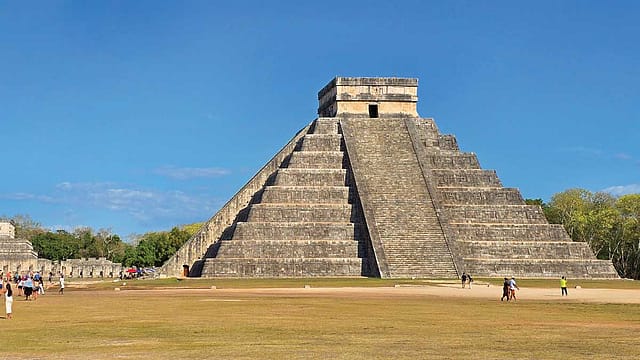
The bus moves on, and an hour later, when the sun is raging hot, we see the pyramid suddenly spring to the horizon. The entrance is an enormous tiled pavilion with multiple security checks. This is the most important heritage monument of Mexico, their Taj Mahal. It is a half-kilometre walk to the pyramid, but before that, Sergio stops.
“If you want to build an empire, you need three things. A big army—yes or no? Second, commerce. Yes or no? And third and most important: roads. Yes or no? Where we walk, this is one of the paths that lead into Chichén Itzá. In fact, this is the main one. Do you notice how elevated we are? Look down there. That’s the land. What that means is we are not on the ground. Chichén Itzá is not on the ground. First, they build up a basement—see, a foundation? Two kilometres by two kilometres, six metres tall. Only to do that took 300 years. Then, 500 to 600 years to build up the temple. And then, 300 years more for the rest. They took 1,000 years to build up Chichén Itzá,” he says.
The Mayan civilisation lasted over 3,500 years, starting around 2000BCE, continuing even after the arrival of the Spaniards. Chichén Itzá began to come up around 600CE. It means “at the mouth of the well of the Itza”, the name of the people of the region. The well is still there, as if someone took a giant drill and made a hole into the earth. Sergio stops, points to it and says it is not a cenote because the water is green. This, he says, told the Mayans it was not connected to an underground river. Instead, they believed it was the mouth of the underworld, the land of the dead.
We reach the pyramid, and it rises in tiers, at an angle to the sky, the centre a line of steps jutting out like a ramp running from top to bottom. We are asked to clap, and it rebounds back altered, supposedly the sound of the quetzal bird, which the Mayans revered. The acoustics also made it possible for the high priest’s voice to be carried. I shout loudly, but it doesn’t really work as well as the clap did. The priests had more practice. They stood on the pyramid and spoke to the people below when tens of thousands would gather for an annual festival, which included human sacrifices and psychedelics.
To the right, we are taken to a rectangular arena with walls on the side. This is a court where the Mayans would play their version of a ball game, using elbows, knees and hips. There are many such courts; this is the largest in the country. On both walls, high up, is one hollow ring each. The ball had to be shot through it for a team to win. Someone would have to die at the end of it. Sergio says either someone from the winning team or the losing, and they wouldn’t know who until the game was over.
I come back to the pyramid again to stand before it. It is elegant, spectacular. I walk around it. In the back, the stones have chipped away with time. It doesn’t look as smooth as the front that, I realise, must have been restored. It doesn’t look as immortal from here. All things erode, even if made to survive forever.