World's skinniest house? This home is just 72 cm wide — and people actually live in it
You have probably complained about a cramped apartment.
Maybe you've bumped into a coffee table, struggled to fit a wardrobe into a bedroom, or wondered why architects enjoy playing tricks on human movement.
Now imagine living in a house that is just 72 centimetres wide at its narrowest point.
That's narrower than many front doors.
Yet somehow, this tiny structure in Warsaw, Poland, manages to squeeze in a kitchen, a bathroom, a workspace and a sleeping area. It is called Keret House, and it has earned a reputation as one of the narrowest homes ever built.
How do you fit an entire house into a gap?
The story begins with a gap most people would ignore.

Zeroing In on ECI
09 Oct 2026 - Vol 05 | Issue 41
Constitutional legitimacy versus political opportunism
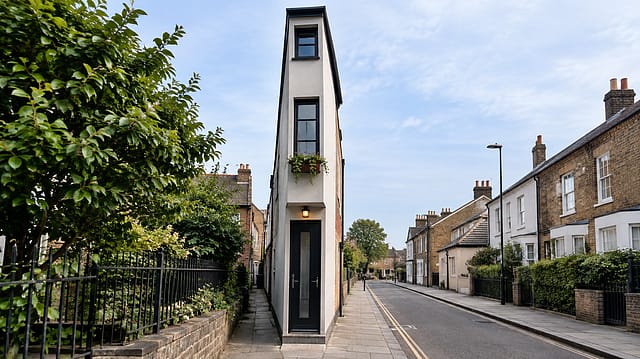
Polish architect Jakub Szczęsny spotted a sliver of unused space wedged between two buildings in Warsaw — one a pre-war tenement, the other a post-war apartment block. Instead of seeing an awkward gap, he saw a challenge.
The result was Keret House, a three-level structure measuring 72 cm at its narrowest point and 122 cm at its widest. Built in what was essentially an urban leftover space, it occupies roughly 150 square feet.
Think less "house" and more "architectural magic trick."
What's actually inside?
This is where things get weird.
Despite looking like a vertical corridor from the outside, the house contains almost everything a normal home would.
There is a kitchenette with a sink and cooking area. There is a bathroom complete with a shower and toilet. There is a workspace, seating area and even a bedroom tucked away on an upper level. A ladder replaces traditional stairs to save precious space.
Every centimetre has a job.
Nothing is wasted.
Even the lighting is built into the structure itself, while a skylight brings natural sunlight into the impossibly narrow interior.
Why is it called Keret House?
The house was created for acclaimed Israeli writer Etgar Keret, whose family history is closely tied to Poland.
Originally conceived as an art installation, it also functions as a temporary residence and creative workspace. Because its dimensions were so unusual, Warsaw authorities reportedly classified it as an art installation rather than a conventional residential building.
In other words, the house was so strange that city regulations didn't quite know what to call it.
Can you actually live there?
Technically, yes.
Comfortably?
That depends on your relationship with personal space.
You cannot spread out. You cannot host a dinner party. And if you enjoy pacing while thinking, you'll run out of room after about one step.
But the house was never meant to compete with luxury apartments. Instead, it asks a fascinating question:
How little space do humans really need?
Why has the internet become obsessed with it?
Because it feels impossible.
At first glance, the structure looks too narrow to hold a person, let alone a functioning home. Yet visitors who step inside discover a carefully designed miniature world where every corner has been engineered with astonishing precision. Recent walkthrough videos shared by architecture enthusiasts and travel creators have once again pushed the house into the spotlight.
In a world obsessed with bigger homes, larger plots and extra rooms, Keret House offers a completely different fantasy.
Not a mansion.
Not a penthouse.
Just a 72-centimetre-wide reminder that sometimes the most fascinating homes are the ones hiding in the cracks.