Wiser on Khalistan: Canada has finally understood domestic politics cannot be allowed to derail relations with India
IN THE LAST week of June, Canada’s Prime Minister Mark Carney issued a statement marking the National Day of Remembrance for Victims of Terrorism. The day marks the terrorist attack on Air India Flight 182 on June 23, 1985. Carney’s statement was explicit in condemning terrorism “in all its forms” and went on to say, “We stand with the survivors, families, and communities who carry this loss.”
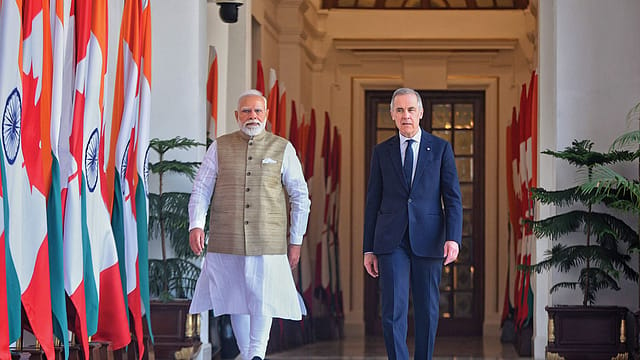
For anyone following Canada’s domestic politics and its relations with India, this is a sea change in the perspective in Ottawa. These changes are now visible in bilateral relations between India and Canada. Prime Minister Narendra Modi and Carney have met four times in the past one year and those meetings were not restricted to mere statements pleasing to India. There is active engagement with India on trade, diplomacy and restoring political relations that had nosedived under former Prime Minister Justin Trudeau. Canada is also undertaking measures that have the potential to address the problem in a structural fashion. One example is the squeeze on asylum seekers from India to Canada, mostly from Punjab. This was not just an irritant for India but a source of propaganda carried out by Khalistanis that India was “victimising” Sikhs in Punjab.
Canadian appreciation of India’s concerns dates to the end of the Trudeau era. The change was evident right from the first meeting between Modi and Carney at Kananaskis in Canada in June last year on the sidelines of the G7 summit. In a statement issued at the time, Carney had said the two prime ministers “reaffirmed the importance of Canada-India ties, based upon mutual respect, the rule of law, and a commitment to the principle of sovereignty and territorial integrity. The leaders agreed to designate new high commissioners, with a view to returning to regular services to citizens and businesses in both countries.” The statement was a reflection of the desire for change as well as the baggage of the past, with respect for sovereignty and territorial integrity reflecting Indian concerns. The “rule of law” formulation was a Trudeau remnant. Trudeau had repeatedly criticised India for violating “rule of law”, an allusion to allegations of India’s involvement in the killing of Hardeep Singh Nijjar—a Khalistani terrorist—in Surrey, British Columbia, a hotbed of Khalistani separatists.
Carney’s predecessor, Trudeau, too, made routine statements on the National Day but they were hedged and worded in a manner that would all but exculpate the key source of terrorism: Khalistani activists with roots in Punjab. In 2024, the last such occasion on which Trudeau issued a statement, he said the Islamic Revolutionary Guard Corps (IRGC) of Iran was listed as a terrorist organisation in Canada. The last time a suspected terrorist plot attributed to an Islamic organisation took place in Canada was in 2013. No Sikh extremist organisation was proscribed by Trudeau who defended Sikh extremism as an expression of freedom cherished in Canada.
The worst in this race to the bottom came when Indian diplomats were openly threatened with violence by Khalistani terrorists and the Trudeau government could not care less. Allegations of Indian involvement in terrorism on Canadian soil were made without evidence and even upon repeated Indian requests to share evidence. There was, in fact, no credible evidence that could be presented in a court linking Nijjar’s killing to Indian agents. Any other form of ‘evidence’ hinting at Indian complicity, such as material gathered by Canadian intelligence agencies that could be shown to Indian diplomats or officials in New Delhi, was not forthcoming. This did not deter Trudeau from continuously making wild allegations against India. Matters came to such a pass that high commissioners of the two countries were recalled.
All of that is in the past. The one-sided rule-of-law formulation has been quietly discarded for a “joint” commitment. Even that is mentioned only in passing; the focus now is on early conclusion of the Comprehensive Economic Partnership Agreement (CEPA) by November this year, a step expected to boost bilateral trade when both countries have been at the receiving end of US ire on trade and other matters.
In this context it is interesting to note the number of applications from India—a large part of which originates in Punjab—for refuge in Canada. Data from the Immigration and Refugee Board of Canada from 2022 to 2026 (until March-end) tells a story of its own. A direct comparison between the total number of applications in 2022 (3,237) and 2026 (3,299) is misleading as the full data for 2026 will be available only next year. But some trends are unmistakable . The number of such claims that have been abandoned has gone up dramatically from 261 in 2022 to 3,914 in 2025. The abandoning of such claims is an indicator that applicants realise attempts to enter Canada by this route are likely to end in failure. In 2024, at the peak of the campaign against India by Trudeau, there were 32,563 applications for refuge from India that were referred to the board, the highest in this five-year period.
This high number of applications makes little sense as Punjab is no longer an insurgency-wracked state where individuals living there could have made claims, however questionable, of victimisation to the point where seeking refuge in Canada became necessary. Terrorism came to an end in Punjab in the mid-1990s. The high number of applications referred to the board in 2024 makes no sense. Not just Punjab but almost no other state in India was in a condition where such a step would even be considered necessary from a human rights perspective. Clearly, something else was at work. Happily, in the last one year this trend of using refuge as a tool for propaganda against India has been witnessing a discernible downward trend.

What led to these changes? Three events spread over the past one have made a big difference. For one, Trudeau has finally exited the political stage and with his departure, the campaign against India has also come to an end. This was due to a mix of his personal pique against Delhi as well as the larger political circumstances in India. For another, as soon as Carney became prime minister, India reached out to him. The two prime ministers broke the ice at Kananaskis and later met in Johannesburg in November. The realisation was that two countries with a history of cordial relations and people-to-people ties could not be hostage to the whims of a single errant politician. Finally, the rapidly changing geopolitical circumstances require that ‘middling’ powers gather together to ward off threats to free trade and security. Carney’s much-lauded speech at Davos in January this year made this clear. By that time, efforts to reset India-Canada ties had already been set in motion.
The key domestic driver of Canada’s infatuation with Khalistanis was political. In the 2021 parliamentary elections, the Liberal Party of Canada—Trudeau’s party—had won 160 seats out of 343 in the House of Commons, 10 short of a majority. The required support came from the New Democratic Party (NDP) led by a Sikh politician named Jagmeet Singh. NDP had 25 members in the Commons. In the previous general elections, in 2019, virtually the same constellation had prevailed: the Liberals had 157 seats and Singh’s NDP had 24. This made the ties of dependence durable in nature. What made this political alignment even more combustible was Trudeau’s disastrous visit to India in 2018 for the G20 summit. That visit was controversial for the inclusion of Khalistani sympathisers in Trudeau’s entourage and his lack of tact in dealing with the Indian leadership. His visit to Punjab, visibly geared to appease a domestic constituency back in Canada, did not go down well in India either. Trudeau’s reactions after the visit set him on a collision course with India and its leaders.
In 2025, the Liberals won again but under Carney’s leadership. They won 169 seats, just one short of the majority mark. At the same time, NDP received its worst drubbing and lost the tag of an official party. Singh lost from Burnaby Central in British Columbia.
Under these changed circumstances, the Khalistani factor no longer exists in the way it did during the Trudeau-Singh era. Carney, by training and temperament, is a politician very different from Trudeau’s showmanship. A former central banker, he is at once a cautious statesman even as he is bold when required. His response to US President Donald Trump’s jibes and threats has not only been measured but has led him to explore alternatives to Canada’s heavy dependence on the US.
This is where Modi and India’s diplomatic apparatus missed no chance in pushing for a renewal of ties. Modi congratulated Carney on his election and reached out to the new Canadian leader. Canada, too, reciprocated and within months of the election results, the two leaders held a meeting. The initial approaches were cautious given the scale of damage to bilateral ties under Trudeau. Modi explicitly assuaged Canadian sentiments in his congratulatory post on X for Carney where he mentioned, among other matters, “a steadfast commitment to the rule of law”. This was a Trudeau-created shibboleth but the Indian leadership understood that the issue had to be approached delicately. Even Canada knows India is not on the list of countries that carry out illegal operations on the soil of friendly states.
Finally, the Trump factor, too, played its part in Canada and India understanding that all middling powers need to cooperate with each other in a world where geopolitical risks and wars are facts to be lived with. In his speech at Davos, Carney made this point explicitly. He said, “The question for middle powers, like Canada, is not whether to adapt to this new reality. We must. The question is whether we adapt by simply building higher walls—or whether we can do something more ambitious.”
The results are something that no one could have predicted even a year ago. Canada is sensitised to India’s concerns about separatists and terrorists abusing its territory. India’s approach towards building better relations—by enhancing trade opportunities and people-to-people contact—have found a resonance with the new prime minister there. The changes stem, in part, from a realisation that the two countries need each other in an unpredictable world and in part from the realisation in Ottawa that bilateral relations cannot be sacrificed on the altar of domestic politics. The Khalistani lobby in Canada will try its best to throw a spanner but the conditions that made it successful do not exist anymore.