What Did Balen Shah Say? Nepal Parliament Disrupted Over Border Controversy
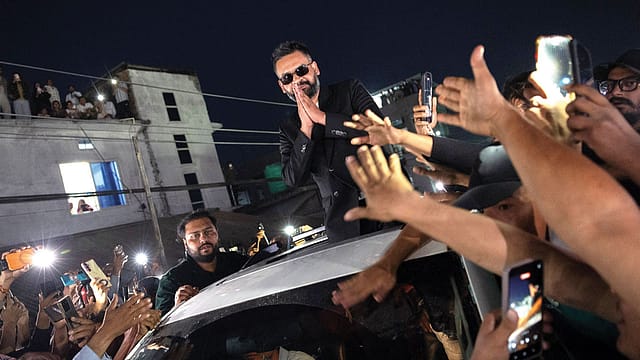
Proceedings in both houses of Nepal's Parliament were disrupted on Monday after Prime Minister Balendra "Balen" Shah's recent remarks regarding border-related issues with India sparked widespread criticism from lawmakers.
Members of both the House of Representatives and the National Assembly staged protests, demanding that the Prime Minister apologise for his comments and that the disputed remarks be removed from parliamentary records.
The opposition, which had already obstructed parliamentary proceedings a day earlier, continued its protest, insisting that Shah withdraw the statement and provide evidence to support his claims.
Why are opposition lawmakers objecting to the Prime Minister's remarks?
Opposition leaders argue that statements made by a Prime Minister carry official weight and must therefore be grounded in verifiable facts.
Gyan Bahadur Shahi, a lawmaker from the Rastriya Prajatantra Party, said: "When a Prime Minister makes any statement or claim, then it becomes the official announcement; the international community perceives it as the official view; the public accepts it as the ultimate truth. Any statement given by the Prime Minister should be based on the facts, evidence and reality. A nation can never moves ahead based on projections but on the facts and figures; emotions might draw applause, but it is the facts that win the trust."

Exclusive: To the Heavens and Back
19 Jun 2026 - Vol 04 | Issue 76
Shubhanshu Shukla relives the space odyssey that put India into orbit
Shahi also urged the Speaker of the House to remove the Prime Minister's remarks from the official record.
What happened in the National Assembly?
The controversy spread beyond the lower house and also disrupted proceedings in Nepal's National Assembly.
National Assembly member Ranjit Karna demanded that the government provide evidence supporting the Prime Minister's claims. He said: "I want to send a request to the government via the Chairman of the (upper) house about the places where Nepal has encroached on the land of our neighbour India within 24 hours. If he (the Prime Minister) cannot give the evidence about it, then he should apologise to the public, and I also demand the formation of the investigation committee to look into the scenario where the Prime Minister got to make such a statement from the National Assembly."
Several other lawmakers, including Rajendra Lakshmi Gaire, Ram Kumari Jhakri and Tula Prasad Bishwakarma, also called for an official explanation from the government.
As protests intensified, lawmakers stood in opposition inside the chamber, effectively halting proceedings.
What exactly did Prime Minister Shah say?
The latest controversy stems from remarks made by Prime Minister Shah on Sunday concerning Nepal's border situation.
While the specific statement immediately drew criticism from opposition lawmakers, they argued that the claims lacked supporting evidence and demanded that the government clarify its position.
The remarks quickly evolved into a major political issue, prompting repeated disruptions in Parliament.
How has Nepal's government responded?
In an attempt to defuse the controversy, Nepal's Ministry of Foreign Affairs issued a clarification.
Foreign Ministry spokesperson Lok Bahadur Paudel Kshetri stated that the Prime Minister's comments were linked to issues involving boundary pillars, the no-man's land area known as "dashgaja," and cross-border land usage.
According to the ministry, technical studies have identified areas where land currently being used by Nepal may technically fall on the Indian side of the border, while some areas used by India may fall on Nepal's side.
The ministry reiterated that Nepal remains committed to resolving all outstanding border issues through diplomatic engagement based on historical treaties, maps and bilateral agreements.
What is India's position on the issue?
India has maintained a consistent stance on the boundary dispute and related territorial claims.
Last month, responding to media questions regarding comments from Nepal's Foreign Ministry in the context of the Kailash Mansarovar Yatra, Ministry of External Affairs spokesperson Randhir Jaiswal said:
"Lipulekh Pass has been a long-standing route for the Kailash Manasarovar Yatra since 1954, and the Yatra through this route has been going on for decades. This is not a new development."
Addressing territorial claims, Jaiswal added: "Such unilateral artificial enlargement of territorial claims is untenable."
He further reiterated India's willingness to continue diplomatic engagement with Nepal, stating: "India remains open to a constructive interaction with Nepal on all issues in the bilateral relationship, including on resolving agreed outstanding boundary issues through dialogue and diplomacy."
What happens next?
The controversy has added fresh political tension to the already sensitive issue of India-Nepal border relations. With opposition lawmakers demanding evidence, an apology and even an investigation into the Prime Minister's remarks, the government is likely to face continued pressure in Parliament.
At the same time, both Nepal and India have reiterated their commitment to resolving outstanding boundary concerns through dialogue, suggesting that diplomatic channels remain the preferred route for addressing the dispute.
(With inputs from ANI)