‘We’ll Bomb the S*** Out of Them’: Trump Turns on Oman as Hormuz Deal Takes Shape
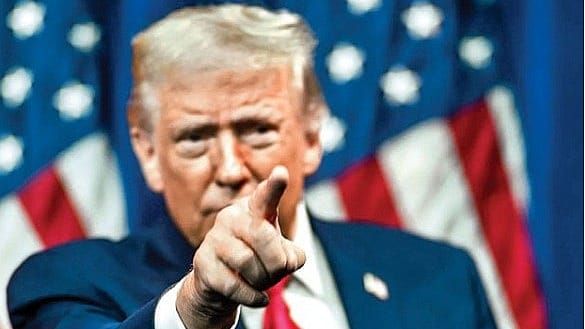
Donald Trump has spent months threatening Iran. On Monday, he turned his fire on the mediator.
The US president warned that America could bomb Oman if Muscat obstructed Washington’s position on the Strait of Hormuz, unleashing an extraordinary threat against a longstanding US partner as Oman and Iran worked towards a mechanism to restore secure commercial navigation through the strategic waterway. “If Oman gets in the way, we’ll bomb the s*** out of them,” Trump told Fox News correspondent Trey Yingst during a phone conversation.
The threat landed just as a 60-day diplomatic window created under a June memorandum of understanding between Washington and Tehran expired without a settlement to end the war in West Asia.
Trump appeared willing to wait. “I’m not in a hurry,” he said, adding that Iran should “raise the white flag of surrender”.

Losing Memory
16 Oct 2026 - Vol 05 | Issue 42
The making of a medical and social emergency
The Strait of Hormuz has emerged as the war’s most dangerous pressure point. The narrow passage links the Persian Gulf with the Gulf of Oman and carries a crucial share of the world’s oil and gas trade. Its disruption has rattled shipping, squeezed energy supplies and handed Tehran enormous leverage over the global economy.
Oman has traditionally acted as a diplomatic bridge between Iran and the West. This time, Muscat has found itself negotiating with Tehran over shipping routes and navigation safeguards while Washington pushes its own demands over control and access. According to Sky News, Iran said on Monday that it had reached an understanding with Oman over the coordinates of a transit route through the strait, although the details of a joint statement were still being finalised.
Trump’s response transformed the mediator into a potential target.
‘Good Poker Players, but They’re Dying’
Trump insisted that the US naval blockade was tightening the economic noose around Iran, brushing aside Tehran’s public claims that it remained capable of resisting American pressure.
“They’re good poker players, but they’re dying,” Trump said. He rejected suggestions that the approaching US midterm elections in November were shaping his calculations. He also played down concerns that months of combat in West Asia had drained American weapons stockpiles. “What we’ve used so far is peanuts,” Trump said.
The president claimed the US retained large stocks of mid-level weapons, while blaming former president Joe Biden for transferring many advanced systems to Ukraine. Those systems, Trump argued, included air-defence weapons now needed in West Asia. The message was blunt: Washington still has the arsenal, the appetite and the time to keep fighting.
Iran is signalling the opposite
A senior Iranian official told Reuters that Tehran could escalate military action in the Strait of Hormuz and across the region if the United States failed to implement the interim agreement within weeks. The official said Iran could take “timely and precise” steps to break the American naval blockade. That leaves Oman squeezed between an impatient Iran, an armed United States and a waterway capable of shaking the global economy.
Why Has the Iran-Oman Deal Stalled? Iran acknowledged on Monday that negotiations with Oman had taken longer than expected.
Iranian Foreign Ministry spokesperson Esmail Baghaei blamed the delay on the complexity of the issue, the number of parties trying to influence the talks and what he called the “destructive efforts” of unnamed hostile actors. “Insecurity in the Strait of Hormuz was imposed on us, on the region and on the entire world,” Baghaei said, blaming what he described as illegal US military action.
He said the proposed mechanism sought to protect the sovereignty of Iran and Oman, the two coastal states, while allowing commercial vessels to pass safely. “One factor is the complexity of the issue,” Baghaei said. “The second factor is the multiplicity of actors who are trying to be influential in this process.”
The third, he claimed, was interference by parties seeking permanent chaos in the region. Despite the delays, Baghaei said Iran and Oman remained committed to developing a framework that addressed their respective interests and security concerns.
Trump has now placed a bomb threat over that process. His warning also sharpens the contradiction at the centre of the crisis. Oman has spent years carrying messages, hosting negotiations and opening channels when Washington and Tehran refused to speak directly. Yet as Muscat inches towards an arrangement with Iran over Hormuz, the White House appears to view its diplomacy as interference.
The strait remains contested. Iran is threatening escalation. Oman is attempting to broker safe passage. Trump says he has no deadline. But he has supplied a warning. If Muscat crosses Washington, America could make the mediator its next target.
(With inputs from ANI)