War on Iran: The Persia Hidden Inside Iran
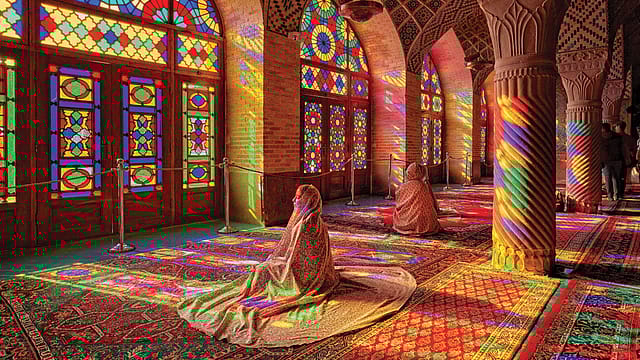
In my small night, ah/ the wind has a date with the leaves of the trees/in my small night there is agony of destruction/ listen—do you hear the darkness blowing?
—Forugh Farrokhzad
I know the olive groves in the village of Koker by the White River near the Caspian Sea. I can see with eyes shut the hilly outskirts of Tehran, as I imagine the taste of cherries in my mouth. I can feel the wind on my face in the arid, barren land of the village of Siah Dareh, near the Iraqi border. I remember the green of the North, the sands of the West. Yet, I’ve never set foot in Iran. All I can talk about is Persia.
This is not just an Orientalist’s dream. These are words trying to explain why some countries are able to exist in words and images, capable of becoming a homeland for those who have never even been there, seduced by history, poetry, and landscapes that have been conjured with such longing by their artists and exiles that you can fall in love. And you feel like you know. Yet, I know nothing of Iran. But I like Persia.
I do know something of Iran. That it’s a political entity, an Islamic Republic, a regime defined by borders, ancient powerful land, the Shah, then Khomeini all the way to Khamenei, the Pasdaran (Islamic Revolutionary Guard Corps or IRGC), the sanctions, the nuclear programme, the UN resolutions, the Strait of Hormuz, the bombs thrown and received. That’s Iran. But Persia is a civilisation carrying the weight of more than three thousand years of poetry, mathematics, architecture, gardens, delicious cuisine, carpet weaving, mysticism. Here we find Hafez and Rumi, the Achaemenid Empire, Persepolis, miniature paintings and Chahar Bagh, the garden divided in four sections which became the template of paradise for three religions. This is not ‘about’ Iran. It’s ‘around’ Persia.
Persia is a Western projection. The very word is how foreigners, especially Europeans, have called it since the Greeks defined the people of the province of Fars as “Persis”. Iranians have always called their country “the land of the Aryans”—Iran. There is a poetic irony in the fact that a country which has given so much importance to words, creating a homeland of poetry, has a paradox tied to its name. In 1935, the Shah himself officially requested the international community to stop using that dated definition of “Persia”, insisting everyone should switch to calling it “Iran”. Now the Pahlavi descendants’ circles, along with some other exiles, have orbited back to using “Persia” and “Persian” with deliberate nostalgia and political intent. Many of them now declare “I’m Persian” rather than “I’m Iranian”, rejecting identification with the Islamic Republic, trying to reach back before 1979 to something that felt more continuous with the identity of a civilisation.
I always gaze longingly at Iran from the window seat of a plane taking me back to Abu Dhabi, where I spend some months in autumn. Just like when I was a boy on my first flights gazing at the geography in order to understand the world, my heart races faster as I look for Tabriz surrounded by volcanic peaks, Tehran’s Alborz mountains and, beyond, the Caspian coast, the Zagros mountains, magic-sounding Isfahan sitting on the Zayandeh River plateau and finally Shiraz, where I look for vineyards, knowing it gave its name to a wine. The names themselves sound like one-word poems to me. Now they are bombing targets.
The forbidden country, Iran. You can’t get an easy visa to America if you go to Iran: I confess this has been a discouraging barrier. All that cinematic propaganda making you think you could get arrested for no reason, used as ransom with your government by the ayatollahs and the Pasdaran (it did happen to an Italian journalist not too long before the war). And yet I have plenty of friends who have visited and loved it, no issues. I remained cowardly cautious. Far away, so close. Up there, beyond the peninsula of Ras Al Khaimah, lay Iran, but also my imaginary Persia. You can glimpse the shimmers of Bandar Abbas from the shores of Oman. There used to be a ferry not so long ago. And that dreamy side of me thinks that, at the end of all this dreadfulness, the ferry will come back, and I will go on a brief, meaningful voyage aboard one of them, to see for myself where Persia meets Iran.
For now, all I have been able to do is remember the images of Abbas Kiarostami, Jafar Panahi and many other Iranian directors who have brought me to Persia with my mind, etching their views into my memory, so much so I feel I have been there, although I know I haven’t. I blur the memories of my journeys across the Middle East—in Urfa on the Turkish border with Syria, across the Jordanian canyons, into Palestine, the mountains of Oman, the souks of Qatar, and the deserts of the Emirates—with a mix of Kiarostami movies, even though the landscapes are all so different. Of course, I know that Persians are not Arabs, and that Farsi is so clearly distinctive from anything else, with that silken meow, the nasal song of its dialogues I have learned to recognise through a screen, and through the voices of the many Iranian exiles I have met.
The most famous one is the heir to the throne. In the late 1980s, when I lived in New York, I arranged an interview with him for an Italian newspaper. For security reasons, we met in a hotel near his home in Great Falls, Virginia, outside Washington DC, where Reza Pahlavi was raising money and building a political base mostly of upper-class Iranian Americans, a narrow circle of exiled officials and academics. He felt he was the king-elect. I could breathe his rage and longing for the lost kingdom. But I also thought it was a lost cause. He still believes in it. After Khamenei, whom he had recently labelled as “a frightened rat”, was killed by an American bomb, Pahlavi declared that “with his death, the Islamic Republic has effectively come to an end and will soon be consigned to the dustbin of history.” Not quite. And, controversially, Pahlavi defined US action against his own former kingdom as a “humanitarian intervention”, while urging Donald Trump to avoid civilian harm. The young prince I had met in Virginia, the exile dreaming of his return, has now been reduced by history to rejoicing at the bombing of his own country, cheered at a Conservative Political Action Conference in Texas, the powerful CPAC, as he asked: “Can you imagine Iran switching from ‘Death to America’ to ‘God Bless America’?” Not quite.

Two years before the king in exile was born, in 1958, the late father of my sister-in-law, Ebrahim, left Iran as a young migrant on an arduous train journey across Turkey into Rome where he hopped on a ship to that America which is now bombing his Iran. The Tehran ‘Abe’ described to me at a dinner 20 years ago is the long-gone Persia of black-and-white photographs with young ladies wearing mini-skirts.
Nothing to do with today’s Iran my writer friend Kamin Mohammadi was forced to leave when she was nine years old, in 1979. After London, she moved to the Tuscan countryside where she has penned a passionate memoir, The Cypress Tree: A Love Letter to Iran, recounting what it felt like to return to Iran at 27 for the first time since escaping, rediscovering her Iranian self and the story of her family. Today, she is shocked by other exiles rejoicing at the bombs falling on her homeland. She was even more enraged at the need the media has to “empathy-wash” the topic, not allowing her, when interviewed, to give the factual reality of an illegal war. The diaspora has many points of view.
EXILE CAN MAKE YOU TALK about the lost homeland as if it were a person who died and refuses to stay dead. Yet the exiles I have known always evoke a longing for Persia even though they might call it Iran. I think of my friend Bijan Daneshmand, a producer, director and an actor you can catch in many movies and series, in smaller parts in Munich, The Night Manager, House of the Dragon, Quantum of Solace, and The Diplomat. As a producer, he has spent his career making Iranian stories legible to Western audiences. His life cannot detach from his roots. He longs for the Persia hidden inside Iran.
I learned about the Iranian revolution straight from the mouth of someone who was there, my professor at the American University in Washington, Hamid Mowlana, now 89, a Tabriz-born academic authority in international communication who was in Tehran when Khomeini returned. He later became an honorary adviser to Iranian President Mahmoud Ahmadinejad, whom he had warned against a US “soft war” on Iran. Mowlana, grandson of the Great Ayatollah and direct descendant of the mystic poet Qasim-i Anvar, was aware of the importance of storytelling in building enemy-image. Persians understand better than many the importance of words. After all, as the most celebrated poet Ferdowsi reminds us, palaces may disappear, words can remain: “Prosperous buildings will turn to ruin/ from rain and the heat of the sun. But I have founded a tall palace of verse/ which neither wind nor rain can harm.”
I’m just presenting evidence. Not claiming expertise on a country I have never visited, but that I have longed for, as I felt its unrequited call from afar. What can we know of a place? I think I learned an answer to that question from the very same films of Kiarostami. Close-Up, Through the Olive Trees, and The Wind Will Carry Us, among others like Taste of Cherry, seem to carry a message from the maestro: Iran is not a place you can represent directly, you can only circle it, approach it obliquely, through layers of artifice and re-enactment, like the blurry lines of fiction and documentary that he, Panahi and others cross all the time. I think my approach—‘Around Persia’— through memory, films, poems, gazing at it from above and from across the watery border, before anything else is a homage to Kiarostami, the master of metanarrative, a surfer on the fine crest of fiction and nonfiction.
When it first debuted at a cinema in Rome, I remember finding myself mouth agape at the screen projecting Kiarostami’s documentary ABC Africa. It was dark in the theatre. Silence. Then the public heard the familiar sound of a fax machine being dialled and what was called the “electronic handshake” beginning to crackle. Finally, an image: the page of a letter slowly being printed by the machine. The fax was addressed to “Dr Abbas Kiarostami” from the director of the International Fund for Agriculture and Development. The text slowly revealed a series of thanks for the famous director agreeing to film a documentary set in Uganda to sensitise people to the brutality of war. It talked about a meeting in Rome and then travelling to Kampala, where the film begins its tale. It was narrative genius. Start with what you have: the request to film. Kiarostami was putting himself in the position of the outsider looking in, the person who knows a place through proximity and assignment rather than via belonging. In the film, he simply follows the UN’s requests, shoots on unfamiliar equipment, produces something so immensely hopeful precisely because he doesn’t pretend to be “on the inside”. That’s my position with Persia. Not a political reality, a civilisational dream, a movie-filtered landscape, separating culture from the regime, the poets from the Pasdaran, Hafez from Khamenei.
I have recently rewatched Jafar Panahi’s Taxi in which he himself drives passengers around Tehran, all filmed in 2015, illegally, in the Iranian capital. Just like Kiarostami, the universal language is immediate. The density of humanity in his characters instantly touching. It feels almost Persian, in the older, grander sense. The local becomes cosmic, which is why even if I have never set foot there, I can still remember the sound of traffic, the music of the language spoken in that taxi in Tehran, the sense of need for a better life, a better economy, a freer society, all hidden under the allegedly spontaneous narrative layers. Proximity without arrival, until the war made it literal.
In Kiarostami’s The Wind Will Carry Us, set in Siah Dareh, a village doctor and his passenger recite a poem by Omar Khayyam while riding a moped: “Prefer the present to those fine promises/ Even a drum sounds melodious from afar.” I have been guilty of exactly what Khayyam warns against: loving the drum from afar, finding Persia more vivid in imagination than any present could be.
I SPEND PART OF THE YEAR in Abu Dhabi, not far from the Strait of Hormuz, 33km of water separating the Arabian Peninsula from Iran. After universities in Tehran and Isfahan were hit by air strikes, the IRGC issued a statement warning employees, professors and students at American universities in the region to stay at least a kilometre from campuses. One of those campuses is New York University in Abu Dhabi where I reside. The Iran hidden inside Persia was now threatening my own neighbourhood. And beneath the expats scrambling for the last flights out, one friend messaging me feverishly while his plane climbed through an active bombardment, another sheltering in a resort on the Oman border waiting for a window of relative safety, there were millions of others who could not leave at all: the 41 million migrant workers less visible to the cameras, mostly invisible to the sympathy. How not to keep thinking about Iran, just there, across the water, so close you can now hear it?
A friend of mine, Gianni Dubbini, a traveller and writer, did what I never managed: he drove through Iran a few years ago, following the footsteps of Niccolò Manucci, the Venetian adventurer who in the 17th century crossed Persia on his way to India, where he ended up spending the rest of his life with an Anglo-Indian spouse—not so different, in the end, from my own trajectory. Gianni and Angelica Kaufmann, a photographer travelling with him, took pictures from the northern border to the coast near Hormuz. I gaze at them the way you look at portraits of someone dear who has gone somewhere you cannot follow. I recognised the light. I had seen it in Kiarostami. I had imagined it from the windows of those airplanes. Hafez put it perfectly: “Though longing for you scatters on the wind all my life’s work, still, by the dust on your dear feet, I have kept faith with you.”
At the end of all the ongoing horror engulfing this part of the world, I keep returning to the idea of that ferry, up the coast, in Ras Al Khaimah. Somewhere in the future, I see a recurring image, not quite a plan, more of a promise I have made to myself, of boarding one as someone who has loved a place from a distance for so long that the arrival will feel less like discovery than like recognition. It goes back to separating the poets from the Pasdaran. Hafez from Khamenei. The civilisation from the regime. Iran is being bombed. Persia is what will remain in the imagination even after the dust settles.
But all this world is like a tale we hear/ Men’s evil, and their glory disappear.
—Ferdowsi